Hello and welcome.
My name is Inge and it is my mission to bring you science-based insights about health,
Psychology and meditation,
So you can gain a deeper understanding about your practice.
Today's science insight is about how meditation shapes and trains attention.
One of the main effects of meditation is that we train our ability to focus and refocus our attention.
Learning to focus attention is useful for a variety of reasons.
We need attention to plan and create,
We need it to learn new behaviors and we need it to become aware of and solve problems.
In our modern world,
Attention is constantly distracted by our devices that are made to draw us in and our ability to focus on any topic has suffered immensely.
And thus the power to control your attention and to choose what information you wish to focus on has become more important than ever.
So,
The ability to focus attention can be trained through meditation.
Where we focus our attention,
However,
Can be very different depending on the type of meditation we do.
And the health effects we experience may also be different depending on the meditation we do.
Working from the assumption that in general a meditative practice has profound positive effects on your health,
Specific effects of different types of meditations may be different to such an extent that if you do not know how exactly meditation shapes your attention,
A practice may actually be harmful rather than helpful.
That being said,
Meditations are generally not labeled specifically for their effects on attention and therefore you may be engaging in a meditation in order to relax,
While you're actually making yourself more alert.
This insight is designed to help you better understand the specific effects of specific meditations and leverage that knowledge to create a personalized practice that works for you instead of against you.
Meditation is the practice of constantly shifting attention back to an object of attention.
Whether that object be the breath,
Your thoughts,
A candle,
A smell,
A sound or a visualization behind closed eyes.
There are four general categories along two dimensions that are worth mentioning in the practice of attention through meditation.
Because depending on these categories,
The effects of your meditation may be different and also the ease with which you may do a meditation may differ between people.
The first dimension is the scope of attention.
Attention can either be focused specifically,
Narrowing the scope of attention and thus focus on details close by or it can be broader in scope,
More unspecific and wide.
Some meditations require you to focus your attention on something very specifically,
Such as the tip of your nose or the sensation of your breath in your nostrils or an object that is right in front of you in the room.
Objects that are visually close to you such as your phone,
Your laptop and items that require narrow laser-like focus like the words I wrote creating this meditation or the exact feeling in your chest at the top of your inhale are enhancing alertness.
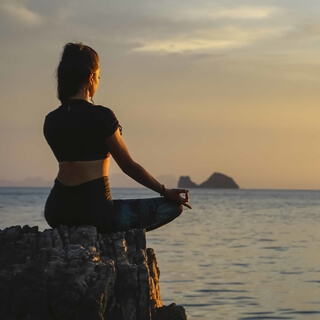
Broader and more lucent focus such as when I gaze outside my window and I look at nothing in particular or when you gaze at the Sun setting at the horizon or when you feel your whole breath as a wave of sensations rolling through your body will induce relaxation.
This is important to be aware of because depending on what you aim to do with meditation,
You may want to use different practices to evoke different moods or levels of alertness at different times of the day.
For example,
Early in the day you may want to increase focus and alertness,
In which case a practice of narrow focus will help you get ready for the day.
The process of focusing your attention on the breath and keep refocusing attention on the breath as you get distracted by thoughts is a good tool to train yourself to be alert and stay on task during the day.
If for example you've been staring at your computer screen for three hours and you need a break or if you're preparing yourself for sleep,
You may want to opt for a meditation that allows your focus to become broader,
Less controlled and more relaxed.
So an open awareness meditation may be more suitable.
The second dimension is more distinct in the sense that we can focus attention either internally inside our body or externally outside our body.
There are meditations that are introceptively focused or extroceptively focused.
Extroceptive meditations are focused on stimuli outside your body that come in via your senses,
Such as smells,
Sounds and images.
These can be walking or sitting meditations where you focus your visual awareness on objects in the room or on people's faces,
Or where you focus your auditory awareness on sounds of trees,
Or your olfactory awareness on the smells while you cook.
Introceptive meditations are focused on what is happening inside your body.
These can be meditations where you observe your thoughts,
Emotions or physical sensations.
The most obvious boundary between introceptive and extroceptive meditation is your visual system,
Because vision in humans is most developed.
When you close your eyes,
It becomes much easier to focus your attention on what happens inside your body.
That being said,
There are moments or there are people for which this is highly uncomfortable,
Because they're over analyzing everything that happens inside or because it feels very unsafe to be in their body.
For people who suffer from anxiety or post-traumatic stress disorder,
Focusing inside can be a very uncomfortable experience.
For others,
Interception is simply very difficult to do.
Some people are in general more extroceptively aware than introceptively aware,
Making it just difficult to focus on things like heartbeat,
Breath,
Thoughts or emotions.
We can also temporarily be sensitive to external stimuli,
Making it hard to focus on what is going on inside of us,
Because our attention is stuck externally.
In contrast,
Some people are generally more introceptively aware and for them it's easy to focus on internal states.
This can take more chronic or oversensitive forms,
For example after chronic sleep deprivation,
After traumatic experiences,
Or if we're suffering from anxiety or depression.
In such cases,
Being inside ourselves can be a very overwhelming experience and observing one's thoughts and feelings and sensations can actually lead to more sleep deprivation,
More anxiety and more depression.
These distinctions are important to be aware of,
Because depending on your personal preference for interception or extroception or your temporary sensitivity to internal or external stimuli,
You may want to choose a different type of meditation.
If some meditations have generally not worked for you in the past,
These distinctions may help you to select those meditations that are appropriate for you at the right time.
So the main goal here is to help you select the best type of meditation for you at a particular time in your life or in your day.
So here are some general guidelines.
First,
If you start a meditation practice,
The most important thing for you to want to establish is consistency.
Consistency comes with a feeling of success and progress.
If something is too difficult to do,
You will definitely disengage and ultimately stop practicing.
So if you're a beginner meditator or if you haven't meditated for a while and want to rebuild a consistent practice,
Start with what's easiest and most enjoyable for you.
Depending on your personal preference of what comes most easy to you at this time,
An extroceptive walking meditation where you watch things or an introceptive sitting meditation where you observe your breath may be a good start.
Second,
Decide on what your goal for practice is.
Do you wish to relax or do you wish to be alert?
Depending on the time of day,
The time of year or the type of task you're preparing for,
You may want to choose a broadening attention meditation to relax or a narrowing attention meditation to focus.
Are you feeling groggy and do you need to ramp yourself up to get started on a daunting task?
Practice a narrow attention focus meditation such as staring at an object or feeling the exact moment your inhale starts or noticing the exact moment when a thought arises in your mind.
Avoid relaxing broad attention meditations that will make you feel looser and more relaxed and will make it even more difficult to get energized.
Are you feeling overly tunnel visioned after staring at a computer screen all day or are you preparing to go to sleep?
Avoid meditations that require you to focus narrowly.
Go for meditations that allow your attention to broaden and loosen without forcing it in a specific direction.
Examples are feeling waves of bodily sensations,
Becoming aware of all sounds around you or looking at the space in between yourself and an object rather than at the specific object.
Third,
If you're temporarily overly sensitive to either external stimuli or internal stimuli,
For example because of sleep deprivation,
Trauma,
Stress,
Anxiety,
Depression or chronic illness,
Choose the type of meditation that helps you relax the most.
For some of us that will be focusing internally and for some of us that will be focusing externally.
Most of all,
Don't judge yourself if a particular meditation seems too difficult.
If a particular meditation seems to make your symptoms worse.
It's okay in a time of stress to avoid things that add to your stress levels.
And not all meditation practices are suitable for your needs.
So there is no such thing as every meditation should help me feel better.
There's a general idea in mindfulness and Buddhist practice that in order to become more present and heal,
We need to sit with our thoughts and feelings and not distract ourselves.
I agree with this in essence,
But I would like to add some caution and nuance that may make a huge difference in your personal experience.
In general,
Ignoring,
Suppressing or dissociating from important emotions,
Thoughts or problems does not help.
Placing kind attention on your suffering usually helps to ease it.
This is the case if you are in a clinically healthy mind space.
For those who are in the middle of a panning attack,
Suffering from severe depression,
From hormonal changes that will disrupt mood regulation,
Or are in the midst of post-traumatic stress disorder,
Doing introceptive meditation can make matters worse.
It can feel very unsafe inside your body and inside your mind for a while.
And it's okay not to want to be there if it's too much for you to handle.
So,
If you notice that a meditation is simply too overwhelming for you for whatever reason and you feel like staying present with your internal feelings makes them worse,
Take a period of focusing on extraoceptive meditation and focus your attention outside your body and mind for a while.
It can actually help you.
Extraoceptive meditation is not the same thing as engaging in mindless numbing or distracting behaviors such as scrolling on your phone,
Watching Netflix and the like.
You can still train your mind to be attentive and mindful so it can help you deal with your challenges.
And make you more resilient.
You're just choosing and training yourself to temporarily place less value and focus on the storm that's going on inside your body and return to it when you are better able to handle and observe what is going on.
Fourth,
If you're in a healthy mind space and you have a rather stable meditation practice,
It is time to ramp things up.
In this case,
If you wish to evoke neuroplasticity and learn to master your meditation practice,
Choose the meditation that is a bit more difficult for you.
So,
If you are a person who finds it easy to focus externally,
Practice introceptive meditation.
If you're a person who prefers to focus internally,
Practice extraoception.
If you find yourself very visually oriented in a particular day,
Create a switch through introception.
And if you find yourself particularly in your head or in your body,
Create a switch through extraoception.
If you prefer broad attention focused meditation,
Train your mind to focus more narrowly and vice versa.
Using the different scopes of attention,
Narrow and broad,
Can teach you to activate and relax yourself through the power of attention.
By mastering this process of switching from one to the other,
Ultimately,
The flexibility of your attention focus and the flexibility of your activation and relaxation response becomes more under your volitional control.
We've discussed how meditation shapes attention and how it can be used to activate and relax your mind.
We've discussed how meditation shapes attention,
Either narrowly or broadly,
And internally or externally.
Now,
If you wish to experience and learn to recognize those four styles of meditation,
So you can in the future better select the ones that work for you,
You can listen to my general meditation,
Attention and Meditation,
Where all four styles will be explored.
The link to the full meditations per style can also be found on my profile.
The knowledge discussed in this Science Insight is inspired by the work of researchers and authors Barbara Fredriksen,
Andrew Uberman,
Daniel Goleman and Richard Davidson.
Thank you for taking the time to gain more insight into the relationship between meditation and attention.
Have a lovely rest of your day.