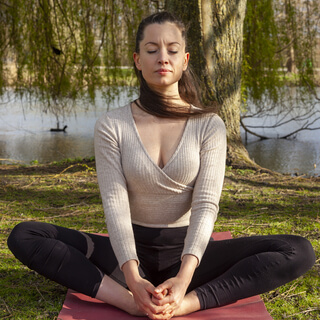
Welcome to this simple meditation exercise.
The Meditation ABC.
This meditation is suitable when you are new to meditation,
When you'd like to create a routine for taking short work breaks,
When you need a quick reset,
A simple stress or anxiety release,
Or a simple check in with your body.
The purpose is for you to create three simple steps that with practice will allow you to cultivate openness,
Calm and focus in mere minutes.
So let's begin.
Take a comfortable seat.
Take a long and slow breath in.
And a longer and steady sigh out.
Gently close your eyes.
We will now follow the acronym ABC,
Which stands for A,
Align,
B,
Breathe,
And C,
Center.
We start with A,
Aligning our body.
We align our body because it will make breathing easier.
To experience just how much alignment matters,
I invite you to start this session with a fully rounded spine.
Let your shoulders be pulled slightly up and forward.
And lift your arms,
Elbows and hands forward,
As if they are hovering over a laptop keyboard,
Like you would if you would be sitting at your desk with tension in your body.
Let your chest cave in.
And with this round spine,
Perhaps even look slightly up,
As if you were to look at a computer screen.
Now breathe.
And just observe where your breath goes.
Take a few breaths and feel where it starts and where it ends.
Now let go of your hands.
Let them rest on your knees.
Actively press your sits bones into the surface of your seat.
Stack each vertebra on top of the next,
Reaching up through the spine.
Gently pull your shoulder blades towards the ears and then drop them down and drop them back,
As you rotate your shoulders down and back.
Open your chest,
Push it up,
Creating this whole upward lift in your core body.
And then when you reach your head,
Align your chin horizontally so you're not looking up or down.
And for the final pull,
Making sure that your head is right above your shoulders,
That your chest is fully open to receive.
And now breathe.
Feel where the breath starts.
And feel where it ends.
I invite you to,
Every time you do this practice,
Experiment with how you align your body,
And observe how the breath changes with every little adjustment you make.
Now that we're aligned,
We can go to the next step,
B,
Which is breathing.
Breathing is the fastest,
Easiest,
And most elegant bridge between your body and mind.
Slow and steady breathing reduces anxiety,
Stress,
It balances carbon dioxide and oxygen levels in the blood,
Lowers your blood pressure,
And allows you to be more present and able to center your attention.
Proper breathing relies on alignment,
And your automatic alignment over time is changed by how you breathe.
You can literally breathe your spine straight.
The most balanced and efficient breathing pattern is estimated at about 5.
5 seconds per breath.
So let's see if we can build towards that.
If you do this for the first time,
Please bear in mind that every body is different,
And it may take time to learn how to breathe slowly.
Many of us have automated fast and shallow breathing patterns because we spend so much time in bad alignment.
Please be gentle and kind wherever your current breathing pattern is at,
And allow yourself to improve with time.
So before we start,
Let's quickly check our alignment.
Pressing the sits bones into the surface,
Stacking your vertebrae,
Rolling the shoulders lightly to the ears and then rolling them over the back,
Pressing them gently down,
Reaching our chest up,
Aligning our chin,
Making sure our head is over the shoulders,
And just see if you can breathe freely.
Let's make sure we breathe out to the full length of the exhale,
And then take a long and slow inhale through your nose,
Filling up the belly,
Side ribs,
Chest.
And when you feel like you're at the top,
Slowly release.
Slowly inhale through the belly,
Side ribs,
Chest,
And a steady exhale,
Releasing chest,
Side ribs,
Belly.
Slowly inhale through the belly,
Side ribs,
Chest,
And a steady exhale,
Releasing chest,
Side ribs,
Belly.
Now as you continue breathing like this through your nose,
Slow and steady,
I'd like you to take your heartbeat as a reference point,
Counting six beats in,
Count six beats out,
Six in,
And six out.
As you continue following your heartbeat,
You may notice that your heart rate increases and becomes more intense as you inhale,
And slows and becomes lighter as you exhale.
Follow that lightness and slowness in the exhale.
Let it steady you.
Let your breath become slower with every round,
And lighter with every round,
Just allowing the natural flow of your lungs and your heart to lead the way.
So now that we're aligned and breathing efficiently,
We are ready to center our attention.
The last part of the acronym ABC is C for Center.
An important part of meditation is to learn how to center your attention.
You can choose to narrow your attention,
And you can choose to broaden your attention,
Both of which are important tools in your day-to-day life.
While we use our narrow external attention focus mostly when we do goal-oriented tasks,
And mostly when we view our phones or computer screens,
We use a broader attention focus when we scan the horizon,
Or otherwise are looking into the distance.
Focusing narrowly on the trees makes us alert.
Focusing more broadly onto the forest makes us relaxed.
Both alertness and relaxation serve their purpose,
And so learning how to switch or center your attention,
Either on one detail,
Or on a wide cloud of details,
Allows you to control your alertness level and your relaxation in a similar way that breathing does.
Centering your attention is something that can be done internally and externally,
And I will invite you to do both in this practice.
We'll start internally.
Center your attention on your hands.
Narrow it down to your right thumb,
Feeling all the sensations in that thumb,
The heat or the cold,
The nil,
The dryness or humidity of the air around it,
Any tingling or perhaps pain.
Perhaps you can even feel a heartbeat there.
Now broaden your attention to all your fingertips,
Radiating out towards your whole hand,
Wrist,
Lower arm,
Upper arm,
Chest,
Left arm,
Left hand,
Neck,
Head,
Face,
Widening to the lower body,
Including your core,
Your back,
Your hips,
Legs,
Feet,
And toes.
Feel your body radiating like a large cloud of sensations.
Paying attention to nothing in particular,
Just allowing all the sensations to be noticed in waves of signals in your center of awareness.
Now I invite you to come back to the external world.
When you open your eyes,
Bring your attention to one spot in front of you that is quite close.
Notice the object in front of you.
Keep your gaze on the tiny little details of this object.
Narrow and center your attention here.
Now start to notice the space between you and this object.
Notice the space around it.
Allow your visual field to widen as you focus more broadly,
Looking further away,
Wider away,
Now looking at nothing in particular,
Just letting the play of light come into your awareness,
Without forcing your attention onto anything.
Just allow your attention to widen your visual field until everything you see is just a big field of colors,
A cloud of visual sensations.
Thank you for taking the time to practice today and getting to know yourself a little bit better.
Remember that the next time you feel stressed,
Tired,
Anxious,
Or unable to focus or activate,
You can sit down and follow your ABC.
Align your body from your sitz bones up.
Take a few simple,
Slow,
And steady breaths through your nose,
And then center your attention on one spot in your body.
Slowly widen it and notice how different you feel.
Meditation is not just about relaxation.
It is about mindfully activating and deactivating,
Using your body,
Your breath,
And your attention.
We have taken 20 minutes together today,
But this can be done in a few simple minutes.
If you want to come back to this practice more often,
There is a version with less instructions.
That is called,
Revisit Your ABC.
Have a lovely rest of your day.
Namaste.