Hello and welcome.
My name is Inge and it is my mission to bring you science-based insights about health,
Psychology and meditation,
So you can gain a deeper understanding about your practice.
One of the main effects of meditation is that we train our ability to focus and refocus attention.
Where we focus attention can have a profound effect on our cognition and our mood,
And training attention can help you manage your internal state effectively.
Where we focus attention,
However,
Can be very different depending on the type of meditation we do,
And the health effects we experience may also be different depending on the meditation we do.
Working from the assumption that in general a meditative practice has profound positive effects on your health,
Specific effects of different types of meditation may be different to such an extent that if you don't know how meditation shapes your attention,
The effects may actually be harmful rather than helpful.
This specific meditation is designed to help you focus your attention on very specific objects,
Things that are close by and that you will study in detail.
In general,
Meditations that induce a narrow scope of attention,
Studying details,
Often visually close to you,
Will make you feel alert.
This particular meditation is thus useful if you find yourself in a situation where it is hard to energize yourself or get into action mode.
It is useful in the mornings when you need to activate yourself or when you need to refocus on work after lunch.
This is not a suitable meditation if you want to relax,
So don't do this before you go to bed or after a hard day of work.
When you're ready,
Let's begin.
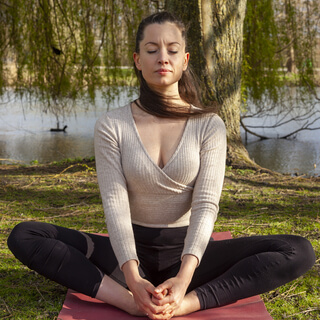
Sit in a comfortable position and take a deep and energizing breath in.
At the top of your lungs,
Hold the breath and then proceed to exhale fully.
Take a few more deep breaths through your nose and then move your attention away from your breath.
Gently open your eyes if they were not yet open.
Allow your eyes to rest on the objects in front of you and take your time naming them.
You can say chair,
Lamp,
Laptop,
Tree.
Take a moment to name all the colors or shades you see in the objects in front of you.
Allow your attention to rest on one object rather close to you in this space,
The closest one you can see.
Notice the play of light,
Color,
Shape.
Keep your gaze fixed on the object.
No matter what happens around you,
You stay locked and explore every tiny little detail of this object.
And if your attention wavers,
No problem.
Simply bring your attention back to the object.
The practice is to focus and refocus.
Now close your eyes and focus your attention on any sounds you hear.
First focus on sounds nearby and then on sounds further away.
Name the sounds you hear coming in.
Now focus on a very specific,
Reappearing or continuous sound in your environment.
Focus all your efforts at keeping your attention on this one sound.
Filter out any other incoming sound.
And if your attention wavers and you get distracted,
No problem.
Simply guide it back to that one sound.
Allow your eyes to close.
Pay attention to the start of your breath,
Feeling the exact moment your lungs start to expand and the inhale is initiated.
Feel the exact moment of the release of the exhale.
Keep your focus at the beginning and ending of each inhale and the beginning and ending of each exhale.
Place all your attention on your belly button.
Feel its movement millimeter by millimeter.
Feel how it coordinates with your inhales and exhales.
Moving away from the spine on the inhale and towards the spine on the exhale.
Keep your attention there on the belly button,
Feeling the exact switch of moving away and towards the spine.
If you lose focus,
No problem.
Simply bring your attention back to the belly button.
The practice is to focus and refocus.
Now shift your attention to your chest and locate your heartbeat.
Feel every bead in your chest.
Feel the difference in intensity and speed with every beat.
Perhaps notice the difference in speed when you inhale and when you exhale.
If you lose focus,
No problem.
Simply bring your attention back to the beat.
Focus your attention on your thoughts.
Thoughts can be visual,
Auditory or verbal.
It can be any idea or story or song that plays out in your head in images,
Words or sounds.
Perhaps now your task list comes up or a discussion with someone or simply just a face.
You may ask yourself what the purpose of this meditation is or you may feel a pain in your knee that makes you wonder how much longer you have to sit.
See if you can notice the precise beginning of a thought.
Where does it pop up?
Can you stay with it until the end?
Where does it lead you?
How does it dissolve?
If you lose focus and any particular thought takes you on a train ride,
Just notice that your attention has wandered and bring your focus back to noticing the precise beginning and ending of each thought.
Slowly bring your attention towards the end of this meditation and mindfully close your practice.
If you found this useful and if you want to learn more,
You have two options.
First,
You can listen to the Science Insight on Attention in Meditation,
Which will explain the psychological and physiological effect of the four styles.
This is useful for your practice because these four styles are often used interchangeably on meditation tracks without explaining their profound differences.
Not understanding these differences may leave you more anxious after meditation,
As opposed to more relaxed,
More activated after meditation while you thought it would help you sleep,
Or more fuzzy while you thought it would help you perform better at work.
Knowing more about this topic will help take your meditation practice to another level,
Where you can use it to tune attention to your specific needs.
Second,
If you want to get better at each specific attention practice,
I've created separate tracks for each one,
So you can listen to each type individually.
Thank you for being curious.
Have a lovely rest of your day.