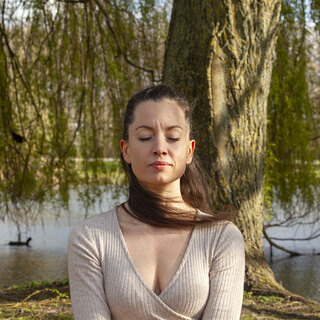
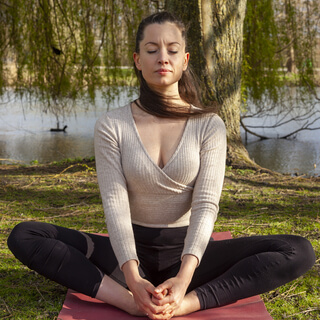
This session is part of the 21-day Breathwork Challenge.
If this is the first time tuning in and you'd like to start at day one,
If you follow my profile Inge Volsink,
You can find all the available previous sessions there.
You can also find all the other tracks in the playlist,
The 21-day Breathwork Challenge.
Are you ready?
Let's begin!
Hi and welcome to your first fast breathing practice.
Before we start,
We need to get a few safety instructions out the way so you can practice with awareness.
If you consider yourself a very healthy individual both mentally and physically,
Suffer no chronic illness or mental or physical injuries or challenges of any sorts,
And you are not carrying a child,
You can skip to minute 3.
15 of this session and start your practice.
Otherwise,
Bear with me for a moment.
The following safety rules apply when you're pregnant or are diagnosed with a respiratory disease,
A mental disorder,
High blood pressure,
Diabetes or heart disease,
Or another chronic disease I haven't mentioned but might be affected by rising heart rates and stress levels.
Please go careful with these practices and preferably talk about practicing with a medical professional.
Although breathing practices like these can be very efficient in relieving symptoms,
They can also worsen symptoms in the beginning.
Having professional support is a good idea for backup.
Definitely skip this practice during episodes of mania or psychosis or if you suffer from epilepsy.
Fast breath work induces hyperventilation,
Which is known to trigger psychosis and epileptic seizures in the brain.
Go very slow and careful with high blood pressure,
Heart disease,
Respiratory disease,
Digestive issues,
Mental injuries such as anxiety,
Panic,
Depression,
And PTSD.
Make sure you have enough experience in slow breath work so you can calm yourself down if this practice is a bit overwhelming for you.
It is wise not to practice this technique on a full stomach as we will quite vigorously engage the abdominal muscles to assist forceful exhales.
For the same reason,
Last but not least,
Especially when pregnant,
You want to avoid pressure on the abdominal area and you want avoid hyperventilation and extreme stress.
So if you choose to explore this practice while pregnant,
Absolutely avoid pulling in the core forcefully.
Just work on mildly activating your deeper core muscles to connect to them rather than pull.
Do only one or two rounds of the slower paced start of the practice so you can experience the feel but not push yourself,
And take a lot of time relaxing the breath afterwards.
In general,
Pregnancy is a great time to explore breath work.
I created this course while I was pregnant,
But keep any fast breath hold or mixed practices at a 20% level or choose to save them for after your delivery.
Okay,
Now that we are all aware of the contraindications,
Let's get to our practice.
Kapalabhati,
Which means lightning skull breath,
Or is sometimes called breath of fire,
Is a fast breathing technique that first emerged in the Hatha Yoga Pradipika.
It is originally listed as a Kriya,
Which is Sanskrit for action or effort,
But is generally seen as a cleansing practice.
Kapalabhati was designed as a cleansing practice of the digestive system,
And when you practice,
You may realize why that is.
This practice is best done on an empty stomach because Kapalabhati is an effortful,
Fast,
Forceful,
Abdominally assisted practice that focuses mostly on strengthening the exhales and using the core breathing muscles to their maximum capacity.
In doing so,
The practice offloads carbon dioxide fast,
And it trains the assisting breathing muscles to become very powerful in exhale assistance.
In Kapalabhati,
The inhales are passive.
We only focus our attention on the exhales,
Which are fast and forceful.
Remember,
The muscles that are driving the exhale are your core and your ribs,
And if you wish to add a layer,
Your pelvic floor.
So on the exhale,
Forcefully draw in your belly by pulling your belly button towards the spine,
Your pelvic floor up,
And your lower ribs in,
All without moving your shoulders.
Inhales are more passive.
You can let them happen naturally.
Let's practice one round of five slow breaths together.
We will start with a slow inhale,
Followed by five forceful exhales through the nose.
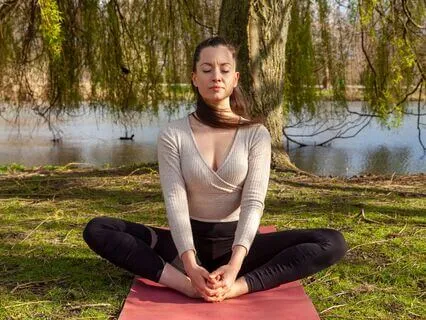
Make sure you sit in a comfortable position,
Where your posture is upright and your shoulders are relaxed.
Take a slow inhale and exhale forcefully through the nose.
Take a few normal slow breaths.
Let's do this again,
And now focus your awareness on your abdomen and ribs.
While you forcefully exhale through the nose,
I want you to draw the belly in and up,
The ribs in,
Maybe the pelvic floor up,
But without moving your shoulders.
If you're doing this for the first time,
Focus on one of these first,
So I suggest you start with drawing your belly button in.
Whenever you're ready,
First take note of your posture.
Your spine is straight,
Shoulders are relaxed,
Hands can rest on your knees.
Take a slow and steady inhale.
Exhale forcefully through the nose.
Draw that belly button in forcefully.
And relax your breathing.
If you are wondering what to do on your exhales,
Just naturally allow the belly to relax and allow inhales to happen naturally,
Without doing anything about it.
The best cue for this is to just not do anything.
Your belly will have to relax in order to pull in again.
Don't pay attention to your inhales,
Focus on your exhales instead.
We will now do three rounds of 20 exhales,
Which I will do with you.
You can follow my pace or choose your own.
If you are proficient in using your Bandhas,
Use them,
One by one or all at once,
If it feels controlled.
Remember,
If there are contraindications or if you feel mentally overwhelmed,
Feel free to stop and slow down your breathing to calm down.
The first round will be slow.
After that,
We will have a recovery period of 10 slow breaths.
Round two will be faster,
Followed by 10 recovery breaths.
And round three will be fastest,
Followed by 10 recovery breaths.
If this is your first time practicing Kapalabhati,
Skip round three for now until you feel comfortable in round one and two.
Sit relatively straight,
Shoulders relaxed.
Take a few regular breaths.
Take a long inhale for round one.
And begin.
Relax your breathing.
Slow it down.
Slow inhales.
Slower exhales.
Count yourself down to 10 breaths.
Get ready for round two.
Notice your posture.
Adjust if needed.
And take a long inhale for round two.
And begin.
Relax your breathing.
Slow it down.
Slow inhales.
Slower exhales.
Count yourself down to 10 breaths.
Notice the beating of your heart.
Notice how it responds to fast and slow breathing.
You are able to shift your heart's power just by breathing fast and slow.
You are the pilot of your stress and relax response.
If you feel that it is comfortable and safe enough for you to proceed to round number three,
Get ready for round three.
Check in with your posture.
Make sure breathing is relaxed.
And take a slow inhale for round three.
And begin.
Relax your breathing.
Slow it down.
Slow inhales.
Slower exhales.
Count yourself down to 10 breaths.
Slowly bring your senses into your awareness.
Listen to the sounds around you.
Open your eyes and look at the scene in front of you.
Notice light,
Color.
Notice how your heart is beating faster and faster.
Thank you for allowing me to guide you on this journey towards greater alertness and improved resilience.
As always,
Please do let me know how this practice felt for you and how you're doing on your journey so far.
I am looking forward to our next practice session,
Where we will practice Bhastrika.