This session is part of the 21 Day Breathwork Challenge.
If this is the first time tuning in and you'd like to start at day one,
If you follow my profile Inge Bolsink,
You can find all the available previous sessions there.
You can also find all the other tracks in the playlist,
The 21 Day Breathwork Challenge.
Are you ready?
Let's begin.
Hi and welcome to this nasal breathing practice.
Ujjayi Pranayama.
Ujjayi Pranayama,
Meaning victorious breath,
Is a controlled,
Slightly constricted and very steady breathing through the nose that works out the tongue and the back of the throat,
As well as the breathing muscles.
Ujjayi is the most often used nasal breathing technique during dynamic yoga classes such as Ashtanga and Vinyasa,
And it's the technique that I used when walking in the Himalayas.
You can practice Ujjayi Pranayama while sitting or walking,
And when you're comfortable with the technique,
You can use it in any type of physical exercise.
The main purpose is to train all the assisting muscles of breathing,
So you have full control over your breath as you train or meditate.
In Ujjayi Pranayama,
We can strengthen all the supporting breathing muscles by assisting breath with our Bandhas,
The yogic word for locks.
The liberate use of Mula Bandha,
The pelvic floor,
Uddiyana Bandha,
The abdominal muscles,
And Jalandhara Bandha,
The space in the throat,
Will help strengthen the force and the length of your breath,
Diaphragmatic range,
And the control of your breath during exercise.
Let's start with the throat lock,
Jalandhara Bandha,
Which helps you to constrain the flow of air.
The glottis is the space between the vocal cords which connects the airways in your throat to your lungs.
When you swallow,
It closes off completely.
Take a moment to try.
Exhale,
Swallow,
And then hold that firmly locked so you can't breathe.
Now try to inhale through your nose,
But keep only a gentle hold.
Do you feel how the muscles open a little and airflow is free but constricted?
Now release fully.
Another way to find your Jalandhara Bandha is by pressing the back of your tongue gently towards the back of your throat.
Not all the way back and down,
But halfway back.
Because you partly close off the airflow,
It's likely that a sound appears,
Sounding like an ocean wind or a whispering ah or eh.
Let's take a moment to feel that sound.
Gently press the tongue to the back of the throat or swallow and then release to about 30%.
Inhale through the nose,
Creating this sound.
As you may notice,
My inhale here is continuous,
Uninterrupted and long.
The continuity of the breath is one of the most important facets of Ujjayi breathing.
Second,
As an addition from myofunctional therapy,
You may want to gently press the rest of the tongue into the roof of mouth.
This helps strengthen the tongue,
Widen the roof of the mouth as you practice Ujjayi and make a habit out of having the tongue rest in the roof of the mouth.
Third,
When practicing Ujjayi breathing,
We can expand the practice by engaging our other two Bandhas.
You can practice with pulling your pelvic floor,
Mula Bandha,
Up like you would if you were holding your pee.
And you can practice with drawing your belly button,
Uddiyana Bandha,
In towards the spine and slightly up like you would if you were putting on very tightly fitting jeans.
Take an inhale through the nose and as you exhale,
Draw your pelvic floor up and your belly button in and up.
Release again on the inhale.
Feel free to focus on the different aspects of the Bandhas in different sessions.
Your priority is the positioning of your tongue in the throat.
After that comes abdominal assistance and pelvic floor assistance,
Which you can also practice again in Module 1.
Okay,
Whenever you're ready to practice the full experience of Ujjayi,
Let's start.
Take a few normal breaths through your nose.
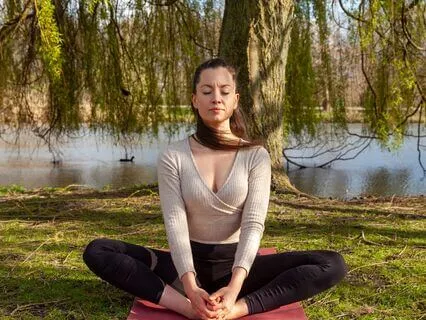
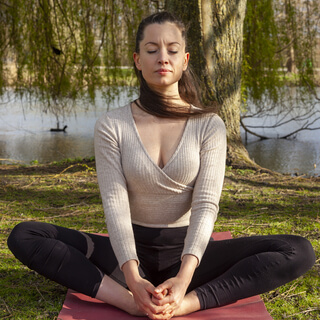
Make sure that your spine is straight,
Your chest and collarbones are wide,
Your head is above the shoulders and your shoulders are relaxed down the back.
The largest part of your lungs is actually in your back area,
So relaxed shoulders are important to allow your body to breathe fully and deeply.
Then focus on gently but clearly pressing your up to the roof of your mouth,
Pulling it back into the throat.
Not all the way down so you can't breathe,
But far enough down so you can feel that the airflow is constricted.
This shouldn't feel too uncomfortable.
Lightly but securely press back.
You will know you got the right pressure when you hear a slight change of the sound of your breath.
Make sure your breath is completely steady.
Breath flows equally fast on the inhale and the exhale and is continuous from the start and end of every inhale and every exhale.
Make it flow.
Flow is the main purpose of this practice.
Focus again on the sound and your throat lock.
Steady inhales and steady exhales.
Focus on your abdomen and your ribs.
Keep a light tension on your whole core as you inhale,
Not allowing the parachute of your belly to fully come out and not expanding your ribs too wide.
Then on your exhale,
Contract your ribs and abdomen all the way in as far as you can without feeling uncomfortable.
Draw your belly button all the way in and upward,
Flattening the parachute all the way.
In between inhale and exhale is a short pause.
Keep this pause steady and keep the breath even.
Again,
Control the muscles,
Use the full length of your exhale to draw the abdominal muscles in.
Okay,
We have now practiced a bit with all our bandhas.
Mula bandha,
The pelvic floor,
Uddiyana bandha,
The abdominal muscles and Jalandhara bandha,
The glottis.
Perhaps you were not yet able to extend the breath as long as I did.
That's okay.
Take your time.
It will come with practice.
We will now do several rounds of Ujjayi breathing and you can build up the complexity and the length.
Start with controlling Jalandhara bandha,
Creating an ocean sound and equal flow of your breath.
After that,
If you have headspace left,
You can add the assistance of Mula bandha and Uddiyana bandha.
Let's repeat this cycle a few times and use a breath count for your breathing.
We will start inhaling for four counts,
Pausing for one,
Exhaling for four counts and pausing for one.
Keep your auditory focus on the sound of your breath and feel your tongue lightly pressing into the back of your throat.
Are you ready?
Let's begin.
Inhale,
Three,
Two,
One,
Pause.
Exhale,
Three,
Two,
One,
Pause.
Inhale,
Three,
Two,
One,
Pause.
Exhale,
Three,
Two,
One,
Pause.
In,
Three,
Two,
One,
Pause.
Out,
Three,
Two,
One,
Pause.
In,
Three,
Two,
One,
Pause.
Out,
Three,
Two,
One,
Pause.
Control the expansion of your core on the inhales and contract the core fully on the exhales.
Slowly increase tension and activation and slowly release tension and activation.
Creating controlled waves of breath.
Now,
Inhale for five,
Pause for one,
Exhale for five,
And pause for one.
Inhale for five,
Four,
Three,
Two,
One,
Pause.
Exhale for five,
Four,
Three,
Two,
One,
Pause.
In,
Four,
Three,
Two,
One,
Pause.
Out,
Four,
Three,
Two,
One,
Pause.
In,
Release your pelvic floor on the inhales and draw in and up on your exhales.
Slowly decreasing tension and slowly increasing tension.
Creating controlled waves of breath.
Going at your own pace,
Choosing to focus on the ocean sound in your throat,
On the waves in your core,
In your pelvic floor,
Or on all sensations.
Thank you for practicing the fundamentals of nasal breathing today.
In the following days,
Many more nasal breathing techniques will come to pass,
But the basics of understanding how to make the nose ready for usage,
How to tone and strengthen the breathing apparatus for future use,
And how to use the supporting muscles to assist and control the flow of air are vital.
If these three things are the only things you ever do as a breathing practice,
You are already doing an amazing job.
Just in case you struggled with extending your breath and you felt a little anxious,
Jittery,
Or stressed out,
This could have to do with the fact that your body is not yet used to slowing down your breathing,
And it may feel like you are out of air really fast.
If this happens,
Remember that very slow breathing and breath holds can be triggering anxiety if you're not used to them,
And allow yourself to take this practice slowly.
Just do the four-second inhale and exhale,
And practice until you are ready for more.
If you struggle to breathe through your nose,
Or if you are interested in the science of nasal breathing,
I encourage you to check out my course on the science and practice of breathing,
Particularly module two on nasal and slow breathing.
As always,
If you enjoyed this particular practice or are enjoying the breathing journey you are on,
Please leave your insights,
Your experiences,
And your feedback in the review section.
I always enjoy reading your comments,
And you might actually help another person come to the practice when they need it most.
Looking forward to our next steps in unfolding the path towards harnessing the full power of breath.
Have a great day.