This session is part of the 21 Day Breathwork Challenge.
If this is the first time tuning in and you'd like to start at day one,
If you follow my profile Inge Volsink,
You can find all the available previous sessions there.
You can also find all the other tracks in the playlist,
The 21 Day Breathwork Challenge.
Are you ready?
Let's begin!
Hi,
And welcome to your next practice session,
Where we will practice box breathing.
Box breathing has roots in pranayama,
As it is very similar to alternate nostril breathing with kumbhaka,
But it was popularized and simplified by the US Navy SEALs in order to be able to effectively manage stress during a stressful event.
When we are in acute stress mode,
We don't have time to think about complex cues,
So a simplified version has higher chances of being effective.
The name box breathing comes from the fact that you divide your breathing into four equal steps,
As if you were breathing along the four equal edges of a box.
Box breathing has both relaxing and activating properties,
As it helps to rebalance carbon dioxide levels,
But extends breath holds to a level where a slight air hunger may be perceived,
Which makes us alert at the same time.
The purpose of box breathing is thus to become calm but alert,
And to train yourself to breathe slowly and lightly,
So eventually,
With extended practice,
Your carbon dioxide tolerance will become better.
When you are ready,
Let's begin.
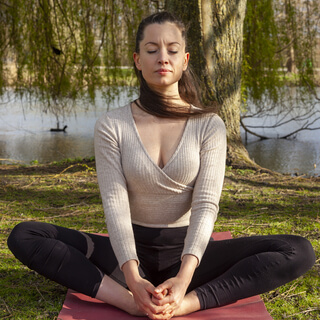
Sit comfortably,
Allow your spine to be straight,
Your collarbones to be wide,
And your shoulders to relax so your diaphragm and ribs can properly move.
Imagine four edges of a box.
Start at the lower left corner and inhale along the vertical edge up.
Hold the breath over the top edge.
Exhale along the right vertical edge.
Hold along the base edge.
Inhale up,
Hold at top,
Exhale down,
Hold at the bottom.
Inhale,
Hold,
Exhale,
Hold.
Inhale,
Hold,
Exhale,
Hold.
Hold,
Exhale,
Hold.
Take a few regular breaths,
And prepare yourself mentally for expanding the breath holds,
From two to four to six to eight seconds.
Remember to let your own volt score be a guiding principle in the length of your breath holds.
Whenever you're ready,
Lengthen the spine,
Open the chest,
Relax the shoulders,
And let's begin.
In,
Two,
Three,
Four,
Hold,
Two,
Three,
Four,
Out,
Two,
Three,
Four,
Hold,
Two,
Three,
Four.
In,
Two,
Three,
Four,
Hold,
Two,
Three,
Four,
Out,
Two,
Three,
Four,
Hold,
Two,
Three,
Four.
In,
Two,
Three,
Four,
Hold,
Two,
Three,
Four,
Out,
Two,
Three,
Four,
Hold,
Two,
Three,
Four.
In,
Two,
Three,
Four,
Five,
Six,
Hold,
Two,
Three,
Four,
Five,
Six,
Out,
Two,
Three,
Four,
Five,
Six,
Hold,
Two,
Three,
Four,
Five,
Six.
In,
Two,
Three,
Four,
Five,
Six,
Seven,
Eight,
Hold,
Two,
Three,
Four,
Five,
Six,
Seven,
Eight,
Out,
Two,
Three,
Four,
Five,
Six,
Seven,
Eight,
Hold,
Two,
Three,
Four,
Five,
Six,
Seven,
Eight,
In,
Hold.
Relax your breathing.
Relax your body.
However far you've come,
Really good job.
Thank you for showing up here today and doing your practice with me.
You can play around with variations of box breathing.
If your bolt is around 20 and you wish to increase it,
You can create your own version of box breath that is rather like the end of this session to further lengthen and extend your holds slowly and steadily.
Our next relaxation tool is called triangle breath.
It's a much lighter version of box breath that is specifically useful if your bolt is low.
So if your sole purpose is relaxation,
If this bolt practice was just a little bit too much for you or if you need a very quick anxiety or panic relief tool,
The next session,
Triangle breath,
Is for you.