Hello and welcome.
This session is part of the 21 day breathwork challenge.
If this is the first time tuning in and you'd like to start at day one,
If you follow my profile Inge Wolsink,
You can find all the available previous sessions there.
You can also find all the other tracks in the playlist,
The 21 day breathwork challenge.
Are you ready?
Let's begin.
In this practice,
We will repeat Kapalapati pranayama,
Adding to it a retention of the breath called kumbhaka.
Again,
We have some contraindications.
If you are pregnant,
Skip this pranayama.
The forceful abdominal inward pull is something you want to avoid.
And the combination of hyperventilation and non-ventilation is not one you want to experiment with at this stage.
Definitely skip this practice during episodes of mania or psychosis,
Or if you suffer from epilepsy.
Fast breathwork induces hyperventilation,
Which is known to trigger psychosis and epileptic seizures in the brain.
Also be careful when you have any of the previously mentioned contraindications that make stress on the body something to treat with care.
Listen to your body,
Take it slow and easy,
And if you want to try it out,
Start with just one round.
Remember that Kapalapati focuses on forceful exhales.
The muscles that are driving the exhale are your abdomen and your intercostals.
So on the exhale,
Forcefully draw in your belly by pulling your belly button towards the spine and up,
And draw your lower ribs inward without moving your shoulders up or down.
Keep your shoulders relaxed.
Inhales are more passive.
You can let them happen naturally.
Please be aware that tingling sensations and slight dizziness are normal physical responses to the combination of fast breathing and breath holds.
As long as there are no contraindications,
You're healthy,
Follow your own urge to inhale without pushing your boundaries,
Use your bolt as a guiding principle,
And you are able to relax your breathing after a round of fast breathing,
You should be okay.
Please note that if you push yourself too much,
There is a risk of temporarily losing consciousness.
Therefore,
Never practice this pranayama in or near water or while driving a moving vehicle.
We will start with a round of normal Kapalapati and we will add Kumbhaka along the way.
Whenever you're ready,
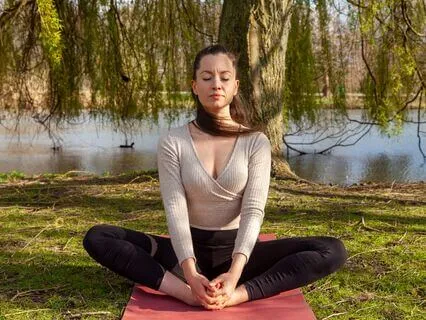
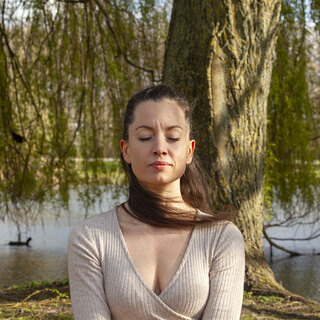
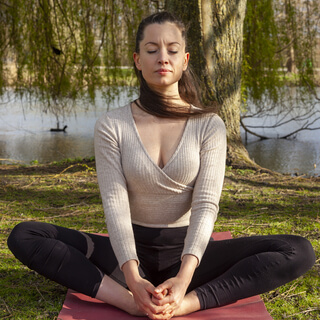
First take note of your posture.
Your spine is straight,
Shoulders are relaxed,
Hands can rest on your knees.
Take a slow and steady inhale.
Exhale forcefully through the nose.
Draw that belly button in forcefully.
And relax your breathing.
Let's do this again and we will now add the Kumbhaka.
Remember to use your core and ribs to expel the air out forcefully.
You may hold the breath for as long as you like but don't force it.
Use your bolt as a guiding principle.
Whenever you're ready,
First take note of your posture.
Your spine is straight,
Shoulders are relaxed,
Hands can rest on your knees.
Take a slow and steady inhale.
Exhale forcefully through the nose.
Draw that belly button in forcefully.
Take a gentle inhalation and then expel all the air out of the lungs.
Hold the breath until you feel the urge to inhale.
Or if your bolt is below 10,
For half a bolt.
Whenever you feel that urge,
Take a deep and controlled inhale.
And hold the breath until you feel the urge to exhale.
When it is your time,
Relax,
Take slow breaths.
Check in with your body.
Remember,
You are the pilot.
Make conscious decisions to move further or stop,
Knowing that you are in control of this situation.
Tingling sensations are okay.
Panic or pain is not okay.
You decide when to stop.
We will now do three rounds of 20 exhales.
The protocol is the same as normal Kapalabhati,
With the Kumbhakas in between the fast breathing and the recovery breathing.
You can follow my lead or take your own pace.
See what works for you.
When you are ready,
Let's begin.
Sit relatively straight,
Shoulders relaxed.
Take a few regular breaths.
Take a long inhale for round one.
And begin.
Take a gentle inhalation and then expel all the air out of the lungs.
Hold the breath until you feel the urge to inhale.
Whenever you feel that urge,
Take a deep and controlled inhale.
And hold the breath until you feel the urge to exhale.
Relax your breathing.
Slow it down.
Slow inhales.
Slower exhales.
Count yourself down to ten breaths.
Get ready for round two.
Notice your posture.
Adjust if needed.
And take a long inhale for round two.
And begin.
Take a gentle inhalation and then expel all the air out of the lungs.
Hold the breath until you feel the urge to inhale.
Whenever you feel that urge,
Take a deep and controlled inhale.
And hold the breath until you feel the urge to exhale.
Relax your breathing.
Slow it down.
Slow inhales.
Slower exhales.
And begin.
Count yourself down to ten breaths.
Notice the beating of your heart.
Notice how it responds to fast and slow breathing.
And then take a deep and controlled inhalation and then expel all the air out of the lungs.
You are the pilot of your stress and relax response.
If you feel that it is comfortable and safe enough for you to proceed to round number three,
Get ready for round three.
Check in with your posture.
Make sure breathing is relaxed.
And take a slow inhale for round three.
And begin.
Take a gentle inhalation and then expel all the air out of the lungs.
Hold the breath until you feel the urge to inhale.
And then take a deep and controlled inhalation and then expel all the air out of the lungs.
Hold the breath until you feel the urge to exhale.
And then take a gentle inhalation and then expel all the air out of the lungs.
Hold the breath until you feel the urge to exhale.
And then take a deep and controlled inhalation and then expel all the air out of the lungs.
Open your eyes and look at the scene in front of you.
Notice light,
Color.
Check in with your body.
How did this feel for you?
What happened in your mind and body?
Take a moment to write down any thoughts,
Feelings or sensations that came up during this practice.
I would like to point out that specifically fast breathwork practices and breath holds might require some extra knowledge on how breathing affects your body.
If you notice some sensations that you would like to understand better,
If you notice the stress response or perhaps anxious thoughts or anything else you would like to understand better,
I would like to direct you to Module 3 of my course,
The Science and Practice of Breathing,
That particularly addresses all the physical processes processes that are important in fast breathing and breath holds.
Like always,
Please drop me your comments,
Your thoughts,
Your experiences,
Your insights in the review section.
Your input is really valued and appreciated.
Thank you for sharing this practice with me.
I'm looking forward to our next session together,
Where we explore the physiological sigh.