Today we will practice a powerful Pranayama breathing technique called Nadi Shodhanam,
Which is also known as Alternate Nostril Breathing.
It is often referred to as the primary Pranayama practice for removing impurities from our energetic system.
This practice is designed to balance the flow of energy through the three main Nadis or energy channels in the body.
The Ida Nadi,
Associated with the left nostril,
Is cool like the moon,
Representing nurturing,
Calming and receptive energy,
Which is feminine in character.
The Pingala Nadi,
Associated with the right nostril,
Is warm like the sun,
Representing the active,
Energising and dynamic energy,
Masculine in character.
And the Sushumna Nadi rises centrally up the spinal axis from the tailbone to the crown of the head,
And it exists outside of karma and circumstance.
It is brought into balance when Ida and Pingala are harmonised,
Allowing us to access a state of calm,
Clarity and grounded presence.
Through this practice we will work to harmonise these energies,
Bringing balance to the mind and the body while creating a sense of inner stillness.
To begin,
Find yourself a comfortable seated position.
Sit tall with your spine long but relaxed,
And allow your hands to rest on your knees or on your lap.
Take a moment to close your eyes or lower your gaze.
Bring your awareness to your natural breath and notice the gentle expansion and contraction of your body as you breathe.
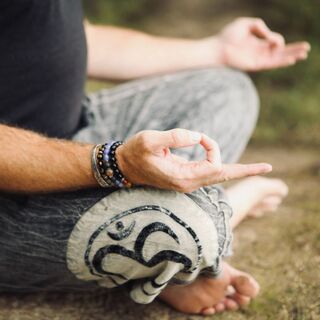
Then we will prepare for this practice by using a hand mudra to guide the breath.
With your right hand,
Perform the Vishnu Mudra.
Gently fold your index and middle fingers towards your palm.
Keep your thumb,
Ring finger and little finger extended.
This mudra will allow you to alternate between nostrils with ease.
Rest your left hand gently on your knee or thigh,
Your palm facing down,
Whichever feels more comfortable for you.
So as we begin the practice of Nadi Shodhanam Breathing,
I will guide you through the following steps.
Use your right thumb to gently close your right nostril.
Inhale slowly and deeply through your left nostril.
Then closing your left nostril with your ring finger,
Release your thumb from the right nostril.
Exhale slowly and completely through the right nostril.
Keeping your left nostril closed,
Inhale deeply through your right nostril.
And then closing your right nostril with your thumb,
Release your ring finger from the left nostril and exhale slowly through the left nostril.
And then beginning the next round,
Inhaling through left,
Exhaling through right.
Inhaling through right,
Exhaling through left.
And as you continue to breathe in this way,
Focusing on the flow of the breath moving through each nostril,
Imagine the breath as a gentle stream of energy clearing and balancing your Ida and Pingala Nadis.
With each cycle,
You are creating harmony and inviting the central Sushumna Nadi to awaken.
And if you feel comfortable,
You can extend the length of your breath.
For example,
Inhale for a count of four,
Exhale for a count of six.
Or simply maintain a steady natural rhythm that feels easeful for you.
There's no need to force,
There is no need to strain.
Just simply allow the breath to be your guide.
Then I invite you to take one final round of Nadi Shodhanam breathing,
Beginning with your next inhale through the left nostril.
Exhale through right.
Inhale through right,
And exhale through left.
Now release the Mudra and return to your natural breath,
Breathing through both nostrils.
And then as you next inhale,
Trace the breath from the tip of the nose to the back of the bridge of the nose.
And then as you exhale,
Trace the breath from the bridge of the nose and out through the nostrils.
And then finding your next inhalation,
Breathing in,
Tracing the breath from the nostrils to the space behind the eyes,
All the way down the length of the spine to the tailbone.
As you exhale,
Tracing the breath from the tailbone all the way up the length of the spine,
The space behind the eyes,
And then out through the nostrils.
Breathing in,
Tracing the breath down to the tailbone.
Breathing out from the tailbone and out through the nostrils.
Continue to deepen your focus here.
And as you next breathe in,
Imagine these two streams of breath as they intertwine their way down and up the length of the spine.
And then imagine that these two streams of breath turn into a single stream of consciousness.
As you begin to breathe into Sushumna.
And then imagine that this single stream of consciousness then turns into a thin golden thread which starts at the tailbone,
Extends all the way up to the space behind the eyes,
Extending into the crown of the head.
Imagine a golden white light extending and radiating from the crown of the head.
As you breathe into Sushumna.
Imagine this light as a symbol of balance and of presence and inner stillness.
And then bring your awareness back to the natural rhythm of your breath,
Allowing the energies to harmonize.
And as we begin to draw this practice to a close,
Remember that Nadi Shodhanam is a practice that you can return to whenever you need to create balance and calm in your life.
By harmonizing the breath,
You are harmonizing mind and body.
So to finish,
Starting to take some deeper breaths.
Introducing some movements,
Wiggling the fingers and wiggling the toes.
Stretching,
Moving and twisting your body in whichever way feels good for you.
And then bowing down your chin,
Flickering open your eyes,
Gently lifting the head.
Thank you for showing up for yourself today,
Carry this sense of balance and presence with you into the rest of your day.