Hello everybody and welcome.
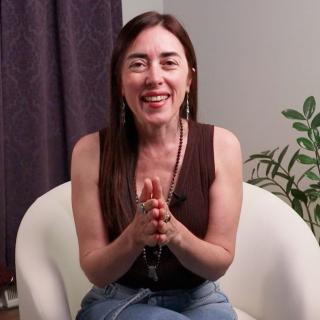
My name is Diana and I will guide you through an awareness through movement session from the Feldenkrais Method.
To begin with you're gonna need a place to lie on the back and on the side on the floor perhaps a little pillow for under your head in a space where you can walk around.
So begin with by standing up and noticing the weight distribution on your feet.
Do you feel heavier on one side compared with the other?
More grounded perhaps or more balanced?
And as you're about to shift your weight to take a step forward observe which foot wants to take that first step.
What feels easier?
And go ahead and take a step and two and just walk a few steps around your room noticing how you carry yourself as you walk,
The movement of your shoulders,
Your pelvis and your head.
And walking forward is so familiar that you will go directly to what you know well,
Very well.
So here and there taking a couple steps backward can give you good information.
Walking backwards is interesting because it's not habitual so your brain will resort to new ways,
New patterns.
What engages in the going backwards?
Maybe you slow down a bit or you use your feet more carefully.
Pay attention especially to the movement of your shoulders and hips today.
Perfect and when you're ready please find that place on the floor where you can lie down comfortably.
Make sure you're uninterrupted for the next 15-20 minutes so you can leave your pets and phones outside of this space for yourself.
Lie down on your back take a moment to do what we call a body scan where you let your attention travel from your feet perhaps following the pressure and contact of your body all the way in the direction of the head slowly and easily.
You're not so much instructing your body to do anything as you are witnessing what is present.
The little sensations on your heels,
Calves,
Buttocks.
Maybe gently comparing the one side with the other in their height,
Weight,
Length relative to the floor.
The two sides of your back,
Your two shoulders.
Gently sensing the length of your arms and the position of your palms where your head is resting.
You're making these observations,
Developing awareness.
You're not trying to change anything or correct anything.
Simply notice what's there.
Maybe you move your head a little if this feels right and comfortable to see if it's easier to move the head in one direction or the other.
Allow your attention to follow the movement,
A small movement,
And see that you can not only do this but also observe your breathing and the change of pressure in your shoulders or whatever else is interesting to you.
Developing expansive awareness,
Including more and more of the experience of your whole self as you move.
Beautiful.
So now let the head quiet in the middle.
Observe one more time the length of your spine.
Imagine where your shoulders and hips position themselves in relation to the spine,
As if you were a big drawing on a piece of paper.
And when you're ready,
Lie on your right side.
Arrange yourself with your knees bent about 90 degrees.
You can place your head under your right arm or a pillow.
As far as the pillow is not too high,
It would work out.
First of all,
Observe your familiar arrangement on the side.
You can open your eyes and see what are you able to see in front of you.
Are your eyes looking directly at the wall in front of you or are they looking down towards your knees?
And again,
At the very beginning,
We don't want to change much.
We want to sense what's there.
We want to feel,
Notice,
Observe.
And now observe also that your shoulder,
The left shoulder that is away from the floor,
Can choose very different places to rest.
It could be in front of you,
As if you were rolling forward.
So go ahead and try that.
That's not how you are right now.
Positioning your shoulder a little bit in front of your chest.
Your shoulder can also be on top of your ribs or shoulder girdle,
More in line with the spine.
Or maybe it can be a little bit behind you.
This will change the position of your elbow.
So notice what is your familiar position as you lie on the side.
What is easier for you?
What feels more comfortable?
And probably you do this when you lie down to sleep.
You place your arm this way,
Your head this way,
Your legs this way.
And that's fine.
I'm going to invite you to have your knees bent about 90 degrees,
Kind of as if you were sitting on a chair.
This will keep your lower back nice and long.
And I'll ask you also to have your shoulder in the middle,
Not in front,
Not behind the spine.
And to make this easier,
You can keep your arm long if you want to,
Along the side of your body,
The hand over your hips.
And this is a restful position for the bones of your arm.
Now picture in your mind a little clock,
Round clock,
Old-school analog clock with the 12,
The 3,
The 6,
The 9.
And imagine this clock simply lying down over your shoulder,
Placed on the shoulder.
And it's exactly in the middle of the clock,
Your shoulder.
And now make a tiny tiny movement,
Bringing the shoulder forward just a little bit.
So if the clock has the 12 towards your ear and the 6 towards your hand,
This would be more or less 9,
9 o'clock.
And your shoulder moves forward and back to neutral or the middle place.
And do this two,
Three times.
See if it's possible for you,
Easy.
If it hurts,
Don't do it.
Just think about the movement,
Imagine it.
And as you let your shoulder roll forward a bit,
See what else wants to move as well.
Perhaps a part of your chest or ribs,
Maybe the contact of the right side on the floor changes.
Whatever wants to move,
You let it move.
And then rest after a few repetitions and sense anything that is interesting.
Even if this is an unusual movement for you,
Just sense that.
Let your awareness be curious.
Now allow your shoulder to explore the opposite direction.
So take it slightly back,
As if in the direction of 3 o'clock.
And notice how do you do this now that your arm is slightly long and not too bent as it was before.
It's not so much a movement of the arm,
It's a movement of your shoulder blade.
And think to yourself,
How can I make this easier?
What could I do or stop doing to make a simple,
Easy movement back,
Behind me,
With my shoulder blade?
And if something comes up,
If you notice that you're tensing up somewhere,
Trying to work hard at this,
Trying to get it right,
Give permission to yourself to stop doing that and simply enjoy the movement.
There's no right or wrong way to do it.
And you can play with breathing as you move,
That always helps.
After three,
Five repetitions,
Please stop,
Take a little break,
Leaving the arm long in neutral position,
And think to yourself about these different directions that we are exploring and how would it feel like to connect them both before even moving.
Think about the direction forward,
Towards nine,
Or in front of you,
And the direction back.
Picture your ribs on the floor like a big cylinder and them rolling a little bit to facilitate the movement of the shoulder forward and back,
Like a big cylinder,
Big roller moving on the floor.
And then imagine the movement being easy and effortless,
Enjoyable.
Then go ahead and do it a couple times to see how much could you imagine and what else is there?
What else is there that you didn't think about?
Maybe your sternum moves or the weight changes.
So use the movement to complete the image.
A little bit forward,
A little bit back,
Your shoulder moves,
And all the little bones connected to it move as well.
Your collarbone,
Your ribs,
Your spine,
Maybe even your head move a little bit.
Maybe your legs or your hips.
Your body wants to move as a whole,
So sometimes it's easier actually to move everything together once you know that you can.
Beautiful.
So stop the movement now and see if it's easier for you now to find that middle place,
And especially if you like to sleep with your arm or shoulder forward or folded fetal position.
See if now there's a little bit more interest in being more oriented towards neutral in the middle and keeping your spine long,
Your shoulders wide.
And perhaps this invites you to change the position of your head to keep it a little bit more upright,
More in line with the spine,
With a long neck.
And this would mean that if you open your eyes you see the wall in front of you more easily than your knees.
So arrange yourself to be comfortable on the side and if you need a break on your back of course you can take it.
But if you can move a little more with me right now,
Imagine taking this shoulder clock in the direction of 12.
So closer to your ear.
Not so far that you create tension or contraction.
Simply enough to feel how the whole side gets a little longer.
There's some space between the ribs that is now possible.
Your arm may move and you simply go to 12 and then back.
Rest for a moment.
When you do it again maybe try something new like breathing or softening your jaw.
So it's not a repetitive movement,
It's an exploration of how to move with more and more ease with each repetition.
We're creating new pathways in your brain with these movements and we don't want just one and only one option.
We want slightly different options until we find the one that we go oh this this pathway feels great.
Now I feel that I'm breathing and I sense my ribs and the weight of my body on the floor.
You can add more and more and more detail.
Notice how easy this movement is.
For the most part a lot of us carry tension on the shoulders and raise them up.
So this is a familiar movement,
We all do it.
Now let the shoulder quiet in the middle and explore the opposite direction.
So you will take it now downward in the direction of your feet as if you were going to six o'clock and this for some people is not a familiar movement.
This requires flexibility on your ribs because they will want to come together and fold or side bend.
You can picture your hand gliding down in the middle so again you're not rolling forward or back.
It's a movement directly down towards six and then back to neutral.
Sensing if it's easy the more you do it but don't rush to make too many repetitions.
Allow yourself to stop,
Rest and in your mind imagine the two movements combined as you rest and sense yourself.
Begin to think of the shoulder going up and down in this direction toward your ear towards your feet and making a small movement.
By the way it's not a large movement to begin with.
When you feel ready do it a couple times.
Connect the 12 and the 6.
Breathe into your ribs that are now expanding and contracting and make a note of where is neutral.
Where is that middle point where you're not on 12,
You're not raising the shoulder towards the ear and you're not dropping it down.
Notice what does your other shoulder know about this neutral place.
What happens to the shoulder that's on the floor?
How can you use both to find neutral?
Maybe three four times is enough for your attention to notice this and let it go.
Take a full rest,
Pause moving and sense anything right now that is interesting.
Observe your choice of resting position and if you want to,
If you are the the person that is more comfortable with your arm folded in and round in front of you and the head tucked down as you lie on your side to sleep,
Go back to that position for a moment and see how it feels now and if you're only thinking about the freedom of your breath and the comfort and ease for your wide shoulders and your long neck,
Which one feels better?
Let your body choose.
Now coming back to this neutral position with the long spine and the arm in the middle,
Think about connecting the four directions.
Picture in your mind this elegant and effortless movement where the clock goes from 12 to 3 to 6 to 9 slowly and easily like a ball rolling in slow motion.
Very very little small movements to begin with and as it gets easier you will make it bigger.
So take your shoulder towards your ear and then a little back behind you,
A little down and then forward and then up again.
Go around and around taking your time with this because we want to make it circular.
We want to take care of all the little kinks and tiny tensions that we find along the way and the smaller the movement,
The easier this is to do.
If you rush through it,
You may skip areas where the muscle,
Fascia,
Tissue,
Tendon,
All that intricate structure of the body is tight and you will want to make a line or an angle,
Not a circle.
The joint is designed to move around in circles.
We're restoring that function.
Once again notice what else can you allow your body to do easily like breathing or moving your ribs.
What facilitates,
What makes the movement easier?
And if you catch yourself doing something that makes it more difficult you can stop that.
Tension is tricky,
The clenching of our teeth,
Of our belly's contraction or the fists,
Even the toes.
Lovely,
So now you come back to the middle and change the direction,
Just go opposite the movement that you just did.
So instead of clockwise,
We'll go counterclockwise and see if there's any difference.
What is easier for you?
To go up and behind you or to go up and forward.
Excellent,
So now let the shoulder rest for a moment in the middle.
Observe the line of your spine,
Your head,
Your pelvis and take a full break now on your back.
Rest completely and notice any changes in your body that you can sense compared to the first time you lay down today.
Notice your breathing,
Scan your whole body,
Especially your chest,
Neck,
Shoulders and if you can move your head a little bit right to left and remember how this was before.
Observe any differences here.
We're looking for quality of the movement,
Not so much range which comes as a consequence of quality but quality.
Does the movement feel different,
Easier,
Less restricted?
Is there a slight movement of your shoulder when you move your head?
Wonderful,
So we're gonna do the movement on the other side and if you have any restrictions or pain on that shoulder you can place some blankets or pillows under your ribs on the left side and that will elevate your weight off the floor so that will put less pressure on your shoulder.
Now in this moment you know so much about the movement that it's gonna be not so easy to start over from zero like the other side.
So we invite you now to cultivate beginner's mind as if you had no idea of what we're doing and begin by arranging yourself on this side and seeing what is easier to keep your head long,
Continuation of the spine or to fold it down and come into a fetal position.
What is easier for you?
Not what is right,
Not what is best but take it as a window into your habitual patterns that you can look into.
So start there and position your right arm wherever you find it comfortable.
One alternative could be palm on the floor,
The arm in front of you,
The arm long along the side of your body and thinking now of this little clock allow your arm now,
Your shoulder and arm to move in the direction of 12 o'clock.
So take it up,
Place your shoulders and earring.
We do this all the time.
Tension,
Holding phones,
Purses,
All kinds of things.
So let your right arm do what does so well all the time and you just make it easier.
Breathing,
Softening your jaw and we don't have to do this too many times,
Maybe three,
Four times.
Make it very precise.
It's going up,
Staying there for a sec,
Coming down.
You're training yourself to sense the difference between up and neutral and all along you're noticing what else is moving.
It's never just the shoulder.
Perfect.
Now let it rest and think of the movement down towards your knees.
Imagine there's a little ribbon placed on your wrist and that someone very friendly is tugging down and pulling down on your arm.
So the movement down is easy and you're reducing the effort with each repetition,
Doing it less and less of an effort and more and more of a curious movement that explores how far can this arm go,
Bringing the ribs with it,
The right shoulder with it and what happens to the left side,
The side that is on the floor.
Because the ribs move in a funny way.
When one side gets shorter the other side gets longer.
Can you sense this?
The left side getting longer as the right arm moves down,
Making the right side a little shorter.
Okay,
Now in a free movement up and down connect the two directions and this will be so much easier than the other side because the two sides move together.
So you've been already moving the right side.
So you go up to 12 and down to 6.
Noticing now any ripple movement on your neck and how the position of your head will change this movement.
So keeping your head forward basically stops the neck from moving and the moment your head is a little more upright,
In line with your spine and your eyes looking forward,
Then as the shoulder moves the neck moves.
Beautiful.
So now let this go and rest for a moment.
Think of the top of your head and an imaginary line between the top of your head and your tailbone.
And that is the line that you were tracing with your movement,
That long line of your body.
And now think of the movement of the shoulder back and forward a little bit and explore both directions.
See what is easier.
Is it easier going back a bit or forward?
And take your shoulder in the easier direction a couple times.
Behind you and back to neutral or in front of you.
You'll eventually do both but I'm guiding you to follow your sensations and go first where it's easy.
And see if the movement of the shoulder,
Once your head is long and free at the top of the spine,
See if the movement of the shoulder invites your head to move a little bit.
Especially if it's not held in place by your arm or a pillow.
If the head can move it will want to roll a little bit as you move the shoulder back and forward.
So you can allow your eyes to move,
To let the head move a little bit with them.
And again there's no right way to do this.
It's more about exploring what is easier for you to look to the right when your shoulder goes back or to the left.
You just let your eyes be curious and follow the movement of the shoulder and you'll see for yourself what is easier,
More efficient.
Find the direction of the movement that makes you feel at ease.
Even if it's very small or very slow.
This can be a very relaxing movement.
And explore the opposite direction.
Take it away from what was easier first and make it easier a little bit.
How to involve your whole self to make it easier becomes now the experiment.
Perhaps rolling your ribs a bit or moving your head so the shoulder doesn't feel so alone.
Whenever you want to rest you can pause,
Rest your arm,
Rest it in neutral.
And think now that you're going to move the shoulder in all directions but this time we're going to be thinking about what happens to the side that is on the floor.
And really pay attention to that.
So yes you move the right shoulder now up and then back and down and forward and it's going to go counterclockwise but don't think about the numbers on the clock.
Don't think about making the movement perfect.
And be curious about how these two shoulders move together.
And whatever is happening on the right side is reflected on the left side.
And if you don't sense any movement,
Think about this as a possibility.
Connecting the two sides.
And make it so it's lazy and not perfect.
It's okay if there's mistakes in there.
But especially think about the difference your head makes in this and play with a couple different positions of your head until you find the easiest one for you.
Again the whole thing is about you.
How do you like it?
What is easier?
More comfortable?
So the head fixed down looking in between your legs or the head up looking in front of you.
Maybe at the wall directly in front of your eyes.
Or the head fixed,
Rigid or moving a little bit depending on what the shoulders are doing.
The head is connected to your teeth so play with your teeth clenched and tight or slightly loose and open at the jaws and again choose whatever makes it more pleasurable for you,
More enjoyable.
And change the direction.
And notice that on this side we added elements and see if it made it overall easier for you to actually pay attention to more things or if it made it more complicated.
And you can always do less.
When you do this lesson again you can always do less.
Beautiful.
So now let this go and lie on your back one last time appreciating this moment of awareness,
Self-care,
Wellness that you gave to yourself today and noticing any new sensations that are there for you to harvest.
Of course you can sense your breathing and the slight movement of your head right and left.
But let your body tell the story of how did it like these shoulder circles.
And when you're ready put your feet on the ground and continue sensing before we even get up.
Imagine now that these shoulders of yours are gonna move in space and they can be making circles as they walk.
Maybe in a different plane.
Maybe they won't go up so much but they are free to move in all these different directions that you just explored.
So gently when you're ready take your legs to one side or the other.
Come to sit and slowly come to stand.
Don't rush into this.
Savor this moment.
Allow yourself to find gravity again and become this witness to your own body movement,
To your own breathing.
Before you go back into the habitual way,
Sense now what is there.
The weight on your feet,
Balance,
How stable do you feel,
The image of your shoulders in space,
The position of your head over the spine,
Your breathing,
The choice to keep your teeth clenched or slightly open,
And the intention to take that first step and just notice what's different.
Go for a few steps around your space and no expectations here.
Simply noticing what can you bring into life from the lesson we just did.
What can you allow to move?
Where is a hidden tension that you can identify and let go of?
How does it feel to keep your head up and your eyes gazing in front of you instead of forward or back or down?
I hope you can take this into your day today and thank you so much for your attention.
I look forward to seeing you again next time.