Welcome.
Before we begin,
Notice that you've arrived here,
Just as you are.
You don't need to have a solution for tension or conflict.
You don't need to understand why you withdraw sometimes.
You simply get to be present with this moment.
Let's arrive together.
If you're seated,
Feel the support beneath you.
If you're standing,
Feel the weight of your feet on the floor.
Let yourself arrive softly,
No agenda,
No forcing,
And no judgment.
Take a long,
Easy breath in,
And a slow exhale.
One more time,
Take a long,
Easy breath in,
And a slow exhale.
Even if your body tenses at the thought of conflict,
Even if your mind starts listing scenarios or worries,
That's okay.
This is your practice,
Not a correction,
Not a lecture,
And not a performance.
Today,
We're just noticing,
Just being here,
Just arriving.
Before we move on to our teaching,
Let's take one more deep breath.
Leaving during conflict,
Whether physically stepping away,
Withdrawing into silence,
Or just disconnecting emotionally,
Is often misunderstood.
Many of us have been told that walking away is weakness,
That detaching from tense moments is avoidance,
Or a failure of some kind.
But in truth,
Disassociation is the body's way of protecting itself.
When tension rises,
Your nervous system begins to sense danger,
Even if the danger is emotional or relational,
Rather than physical.
Your body may respond by physically pulling away,
Panicking or intense anxiety,
Zoning out,
Numbing emotions,
Or disconnecting from sensation.
This is an important statement,
So I want you to hear me.
This is not a moral failing.
It's a survival response.
Think of it like a tree bending in the storm.
The tree doesn't fight the wind,
It flexes to stay standing.
Similarly,
The body steps aside to stay intact when conflict feels too strong.
Notice how many times this might have happened without conscious awareness.
Maybe you left the room.
Maybe your thoughts went blank.
Maybe your chest tightened,
Your shoulders rose,
Or you felt invisible.
These are subtle cues of your system trying to stay safe.
These are not signs that you are failing.
They are signs that your nervous system is deeply intelligent and very protective.
Understanding this shifts the lens from correction to compassion.
It's not about staying in the fight.
It's about learning how to return safely to yourself afterwards.
Let's practice returning to the body after a conflict.
My goal with this practice is to help you associate presence with safety,
Rather than associating absence with safety.
If it ever feels like too much,
Pause and come back when you're ready.
If it's comfortable,
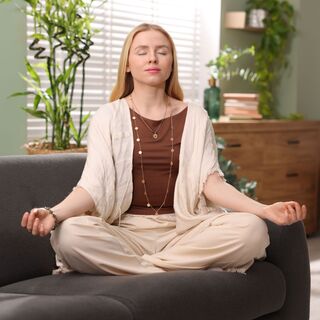
Place one hand on your chest and one hand on your belly.
Or simply rest your hands where they naturally fall.
Close your eyes if that feels safe.
Take a soft inhale.
And a slow,
Gentle exhale.
Imagine that your nervous system is like a river.
When conflict comes,
It flows fast and scattered.
Leaving or disassociating is like the river retreating into deeper pools.
They're safe,
Hidden,
And waiting.
You're not stopping the river.
You're allowing it to find a place to rest.
Bring your attention now to any part of your body that feels present.
Maybe it's your feet on the floor.
The seat beneath you.
Even the tip of a finger.
Even if it's faint,
Place awareness there.
Breathe toward that sensation.
Imagine.
Invite your attention to linger gently,
As if saying,
I'm here.
I'm safe to return.
If memories of recent conflicts arise,
Notice them.
Acknowledge them.
You don't need to analyze,
Fix,
Respond,
Or go over it again.
Your job is simply to witness.
That happened,
And I'm safe now.
I'm returning to myself.
Say that with me.
That happened.
I'm safe now.
I'm returning to myself.
As you exhale,
Allow your shoulders to soften.
Allow your chest to open slightly.
Notice any subtle pulse,
Warmth,
Or movement that signifies life.
A quiet proof that you are present and intact.
Repeat silently.
It's okay to step back.
It's okay to step back.
It's okay to return.
I am safe with myself.
Once more.
It's okay to step back.
It's okay to return.
I'm safe with myself.
Take one more full,
Natural breath.
And let it settle you.
Now that we've calmed ourselves,
Let's gently reflect on what rose during that practice.
When I leave during conflict,
What is my body signaling?
What sensations or patterns appear when I disconnect?
How does it feel to witness this without judging myself?
What small gestures of self-return feel most supportive right now?
Even noticing one tiny sign,
A pulse in your hand,
A grounding of your feet,
The rise and fall of your chest is meaningful.
Each is a breadcrumb guiding you home to yourself.
Remember,
This isn't a lesson in confrontation or winning an argument.
It's a lesson in embodied awareness,
Learning to honor your boundaries and reclaiming your sense of safety from within your own skin.
As we conclude,
Take a final breath that's just for you.
Slow,
Gentle,
And unhurried.
Let it sweep through your whole body like a soft wave of return.
Carry one small practice into your day.
Maybe a hand on your chest for one inhale.
Maybe a grounding of your feet for five seconds.
Maybe silently repeating the affirmation,
I'm safe to return.
I'm whole in myself.
And if this practice supported you,
You're welcome to stay connected with my work here.
I'll be expanding this series with more teachings and practices around embodiment,
Returning to yourself,
And cultivating inner safety.
If you'd like to be notified when new classes are released,
You can follow Create the Calm here on Insight Timer.
Thank you for giving yourself this time.
May each return,
No matter how small,
Deepen your sense of safety and wholeness.