Welcome to today's meditation.
Thank you so much for joining me today.
I'm going to invite you into doing a little exercise called Spread Activation Theory.
We're going to be dimming the lights on the past for just a moment.
And before we get started,
I just want to invite you to come in and to take a couple of deep breaths.
Get settled,
Get comfortable in whatever seat is comfortable for you.
I invite you to take a couple of deep breaths.
Maybe plant your feet on the floor.
Just kind of connect to wherever you're sitting,
Whether it's in a chair,
Whether you're laying down on the floor or on a bed.
I just invite you to just get comfortable and just kind of lean in.
Fall into whatever it is that you're sitting on and just trust that it has you,
That it can hold you for this few minutes.
I just want to explain something for a moment before we get started.
You can just continue just to take those deep breaths,
Breathing in through your nose and out through your mouth.
Well,
I just explain neuroception.
Neuroception is our conscious ability to assess risk and danger and safety,
And it's often outside of the realm of our awareness.
So every experience that we have gets filed away,
And it's what our brain pulls from to determine if something is dangerous or safe.
It's like a little filing cabinet of memory,
If you will.
Both positive and negative experiences get filed away this way.
But because our brain has a negative bias,
It is bent toward looking for danger cues,
And its design is to keep us alive,
And it's a brilliant design.
But it can also feel overwhelming.
So oftentimes when we have an experience in the present moment that feels more overwhelming than it should,
It's most likely due to the fact that our unconscious brain is focused on those past experiences.
And so I'm going to invite you to do this little exercise in this meditation just to get some of the focus off of that past for just a moment,
And to be present in this current moment.
This is an exercise that I learned from Dr.
Scott Lyons,
And it may feel silly for some,
And I get it,
But I just invite you to lean in and kind of trust the process.
So with this one,
I invite you to actually open your eyes.
And if opening your eyes is too distracting,
Then you can keep them closed.
But the reason why I'm inviting you to open your eyes in this one is because we are trying to connect with the current moment that we're in.
And oftentimes when our eyes are closed,
It's easy to kind of be untethered from this present moment.
So I invite you,
Whatever you're going to connect most with,
I invite you to do.
But if having your eyes open,
You can do that,
Then let's do it.
So I invite you to look across the room and imagine that there is like a movie screen.
And it's kind of playing some of those experiences from your past that may feel overwhelming.
And you don't have to envision experiences at like a level 10,
Maybe at like a level like three or four.
I don't want to overwhelm your system.
Whatever you feel like you have the capacity for right now,
Just kind of envision those experiences flashing on that screen.
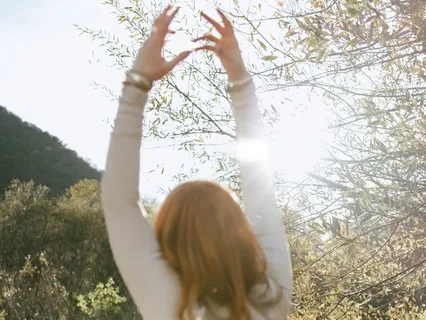
And I want you to take your palms and face them up and kind of envision eyeballs on your hands,
On the palms of your hands.
And I want you to turn your hands away from your body as if they're watching that screen.
And this is how our neuroception works,
Right?
It's our body responding to memories of the past.
And so what our brain is doing is it's watching those memories,
And this is all happening subconsciously,
But it's watching those memories from our past as if it's like actual eyeballs on our hands,
Taking in all of those memories.
And as you do that,
I just want you to notice for a second what that kind of feels like in your body,
Just to be consciously aware of the fact that all of these experiences that we've had in our life are filed away,
And that our body remembers them.
It can feel a little heavy.
If you've had a lot of negative experiences,
It can feel really heavy.
But even if you've had a great childhood,
No one is walking away from this life unscathed.
No one is walking away from this life without any negative experiences.
We all have painful memories.
Some may be more intense than others,
But the intensity itself is actually irrelevant.
It's how your body stores it that is relevant.
So as your hands and these eyes are watching this screen playing of these memories from your life,
I just want you to notice what's happening in your body.
Just want you to notice what's happening in your body.
Is your breathing becoming shallow?
Does your chest kind of get tight?
Does your stomach kind of get turned upside down?
Does your throat restrict?
Do your palms get sweaty?
Just notice,
Without judgment,
What a brilliant job your brain has done and your body has done at keeping track and keeping a record and keeping the score of all the things that have happened to you,
So that it can kick into gear anytime it perceives that maybe there's a threat coming.
Do you know why your body does that?
It's because it wants to keep you alive.
Because your life is worth living and your body knows it.
You have a place on this earth and you were created for a purpose and you belong here.
And so your body wants to keep you here.
It wants to keep you alive.
But sometimes those sensations can feel really overwhelming.
And sometimes it almost does too good of a job at keeping the score,
Right,
Of keeping that file cabinet of all of the memories.
And so in this moment,
What I invite you to do,
And you can do this with your eyes open or your eyes closed,
I want you to take those hands and I want you to turn them away from that screen of all the memories from the past.
And I want you to slowly just turn them towards you,
Towards your body,
So that the eyeballs that are on your hands are actually looking at you and not the past.
And maybe you can slowly bring those hands towards your body.
And maybe you place one hand on your chest and one hand on your stomach.
Or both hands on your stomach or both hands on your chest.
But if you can,
And it feels safe,
I want you to make contact with your body.
In this present moment.
That the eyes can actually look inward.
Right here,
Right now.
And I invite you to take a couple of deep breaths.
And through your nose and out through your mouth.
And on the exhale,
I really invite you to let all the air out of your lungs.
Maybe you can even add in a little sigh.
Maybe you can add in a little sigh.
Maybe you can even add in a little sigh.
We're just going to dim the lights on those past experiences for a moment.
And just be present with your current experience.
And your current experience may be really overwhelming.
For some of you,
You're going through some really,
Really hard things.
But the memory of past experiences could be adding towards the fear that you may be feeling.
It could be adding to the overwhelm.
It could be adding to the intensity.
So for a moment,
We just want to dim the lights of the past.
And just kind of release a little bit of the tension.
For some of you,
You might not be going through anything significantly hard at all.
But that you've noticed that you've just been carrying around this heaviness or this anxiety.
Or this fear or this tension.
And you're not sure why.
And it simply could just be that there's some experiences from your past where the lights are still on super bright.
Where your eyes have been focused on.
Even if it's unconscious.
And we just want to give your system a break for a moment.
And just be present with your current experience.
And we just want to give your system a break for a moment.
Because you deserve that.
It's done a really good job at keeping you alive.
But in this moment,
We want to celebrate.
And we just want to notice that you are in fact alive.
That you are in fact safe.
And I just invite you for the next two to three minutes to start remembering who you have in your life that supports you.
Who's that person that you can call and you know they'll answer even if it's two in the morning?
Who are those people in your home who show you that unconditional love?
Do you have food in your refrigerator?
Do you have a warm bed?
Do you have a pet that just brings you joy?
Do you have a job that's consistent with hours and a paycheck?
Do you have a car that's working?
Do you have a favorite food that you have access to?
Do you have a favorite food that you have access to that just brings you joy?
Do you have a favorite candle that when you light it,
The smell just causes you to relax?
Is there a piece of clothing that you have access to in your closet that you just feel so good in when you wear?
And this is not an attempt to ignore the past or to ignore our hard circumstances.
We just want to turn the lights on,
The positive memories too.
Because our brain does a really,
Really good job at remembering the negative.
But we also want to remember the positive.
And when we can bring those positive memories into our conscious awareness,
And just dim the lights just a little bit on the negative experiences from our past,
We can add new files to our neuroception,
And we can begin to train our brain to also look for the good.
To also look for what is working,
Where we do have support,
Where we are safe.
Because that matters too.
And as you breathe,
And as you think of those moments,
Those moments that you've had,
And as you breathe,
And as you think of those moments,
And those people,
And those things that create safety,
And joy,
And peace,
And you breathe into that,
How does your body feel?
How does your body feel?
Do you feel like your chest is a little less tight?
Is your stomach a little less in knots?
Are your palms a little less sweaty?
Is your throat a little more open?
Even if it's just a little bit.
I want to remind you of the power of the two-degree shift.
That when you're going through hard times,
And you're wanting to experience something good,
And you're wanting to experience relief,
Oftentimes we want all of the bad to go away,
A hundred percent,
And we want to experience like this 360 turn around,
Or this 180 flip upside down,
And experience the good.
But all it takes is a two-degree shift.
And if you're sailing on the ocean,
If you were to change your direction by just two degrees,
Over the course of time,
You will end up on a completely different place of the map than you would have before that two-degree shift.
And in order for our system to feel safe,
Slower is better.
And so today in this moment,
Can you take a two-degree shift at just remembering,
Just simply remembering,
Where you are in fact safe,
Where you are in fact loved,
And cared for,
And nurtured.
And can maybe you take that into the rest of your day.