Hi,
Welcome back to today's guided meditation.
I invite you to take your seat,
Sit in an upright,
Dignified posture,
Not too tight and not too loose.
As you adjust your seat,
Notice your body breathing.
Find the area in your body where you noticed your breath the strongest.
It may be the rise and fall of your abdomen or chest,
Or it may be the air moving over your upper lip as you breathe in and out of your nose.
Wherever it is,
Place your attention here and notice your in-breath followed by your out-breath.
You may even notice the pause between the in-breath and the out-breath,
Or the pause between each out-breath and each in-breath.
As you place your attention on your breath,
You might notice your distracted thoughts take your attention away from the object of your meditation.
When thoughts arise,
Simply label them as thinking and bring your attention back to your breath without any judgment.
Thoughts will continually arise and just gently escort your attention back to your breath.
On certain days,
Our mind may race and it might be difficult to maintain the focus on the breath.
If this is the case,
You can try counting the breaths.
Breathe in and out and count one.
Breathe in and out and count two.
You may try counting up to three and then starting over again at one.
On certain days,
We might find the sitting practice to be extremely difficult.
Our mind may be racing,
Our body may be fidgety,
And these are the days where the practice is most necessary.
Come to it each day with open awareness and without judgment.
You may simply bring your attention back to your breath over and over again for the entire meditation.
Just remember that each time you recognize your mind has drifted and you label that as thinking and return your attention back to your breath.
You have done one mental pushup,
Strengthening your mind further for open awareness.
It is this awareness that we are developing here and now,
Which can help us during everyday activities to become more aware of our body and bodily sensations in everyday situations,
Especially when we may be stressed or depressed or anxious.
Simply become aware of and place your attention on the breath and when your attention drifts to sounds or thoughts or feelings,
Simply label those all as thinking and gently escort your attention back to your breath over and over again.
We gently escort the attention back to our breathing,
Back to the rise and fall of the chest and abdomen,
Back to the body breathing as a whole.
Back to our body taking each in-breath and each out-breath,
Bringing nutrients and oxygen to our muscles and organs throughout the body.
And on each out-breath,
Removing carbon dioxide and other toxins from the body to further purify this body that breathes for us day in and day out all of the years of our life.
Now,
Gently rest your attention and I'd like to talk to you today about depression.
And while talking about depression today,
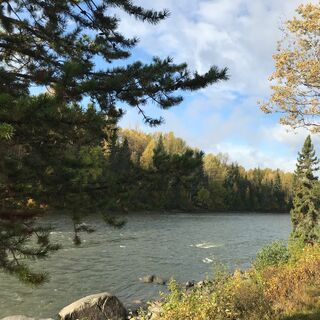
I'd like you to imagine sitting on a riverbed alongside a river and on the beach are thousands and thousands of smooth river rocks.
As far as the eye can see,
There are river rocks,
Up river and down river from the water's edge to the edge of the forest behind you.
As you pick up a river rock that's sitting in front of you,
You might notice and label it as an emotion of depression.
The rock that you might pick up might be sadness or loneliness or worthlessness or numbness or any of the other emotions that you identify if you struggle with depression.
And what I would like you to do is not grasp onto this rock of depressive emotions,
But simply look at it at arm's length.
Turn it over and over in your hand.
Examine it like a child examining a rock for the very first time.
We can use this type of effort when we become aware during our day of depressed emotions that we might feel.
And instead of being the emotion or letting the emotion overtake us,
We can simply evaluate and examine the emotion at arm's length for what it is,
When it occurred,
And where it occurred.
And once you've examined it,
Simply replace it back along the thousands of rocks along the river.
Because the mistake or problem that we might occasionally fall victim to is picking up rocks that have distorted thoughts.
Distorted thoughts of depression.
We might pick up a rock that says,
I'm a failure or I'm unlovable or I'll never get better or even that life is hopeless.
And instead of examining these rocks at arm's length,
We place these rocks around us.
We build these rocks up to become a wall.
Over time,
We place so many rocks around us that we have cocooned ourself within this house of distorted negative thoughts.
This can lead to worsening emotions,
But it can also lead to other behaviors associated with depression,
Such as isolation.
So if you struggle with depression and if you struggle with the behaviors or distorted negative thoughts associated with depression,
I encourage you to try using each of these emotions when they arise as a way of examining the emotion for what it is.
Be aware of how you feel and where you are and what you may be doing.
Once you've examined that rock of emotion,
Simply return it to where it came from and see if you can prevent that rock wall of distorted thoughts from building up around you.
Be safe and be well.