Hi,
I'm Dr.
Kim.
Welcome to this practice for lower back and hip pain.
This practice is best done from the soft surface of your bed.
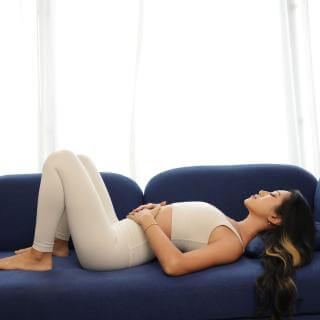
Laying flat on your back,
Legs straight,
Body completely relaxed.
Unclench your jaw,
Relax your forehead,
Shuffle your shoulders down,
Away from your ears.
Completely relax your lower back and hips.
Begin by bringing your right knee up to the ceiling,
Foot flat on the floor.
Take a deep inhale.
As you exhale,
Allow your right knee to fall outwards towards your bed.
Allow it to rest here in this open figure four position.
While we rest here,
Focus on your breath.
As you inhale,
See your diaphragm move downwards into your belly.
Feel your belly expand up to the ceiling.
This position puts your psoas muscle in a gentle stretch.
Taking deep diaphragmatic breaths here signals to the nervous system that it's safe to release tension from this muscle.
As you breathe,
Notice how your right knee relaxes down to the bed further and further.
Keeping your right knee open,
Slide it down to a straightened position to join the left leg.
Take a moment here to notice the changes between the left and the right hip.
I can already feel my right hip feels different to the left.
It feels much looser.
Now,
Let's do the left hip.
Bring your knee up to the ceiling,
Foot on the bed next to your right.
Deep inhale here.
Exhale,
And let your left knee fall out to the bed.
Completely relax your pelvis,
Your hips,
And your legs.
Focus on your breath.
Move the diaphragm down with every inhale.
Expand your stomach up to the roof.
Resting here,
Putting that psoas muscle in a very gentle stretched position.
And now,
Keeping the knee open,
Slide the leg down to meet the right.
Notice the difference in your hips compared to before.
Now,
Let's focus on strengthening your deep core.
Bring your belly button all the way up to the ceiling,
Forming an arch,
A tunnel,
Between your lower back and your bed.
If you're on a soft surface,
It's okay if there is no gap that you can put your hand through.
Hold this position.
And now,
We're going to move our spine the other way.
Push your belly button all the way down and press your lower back into your bed.
Squeeze your butt cheeks together.
Stay here.
And feel that activation of your deep core.
Your deep core muscles lie far beneath your abs.
They wrap around your lower back,
Giving it support.
Now,
Inhale.
Arch your belly button all the way up to the ceiling.
Exhale.
Press your lower back down into the bed.
Squeeze your butt cheeks together.
Inhale.
Arch.
Exhale.
Flatten.
Inhale.
Arch.
Exhale.
Exhale.
Flatten.
You should feel your pelvis rock forwards and backwards with this movement.
For most people who have chronic lower back pain,
Their deep core is completely deactivated.
It is so weak.
And this is a major cause of chronic lower back pain.
This movement provides a gentle activation and strengthening of both the deep core and the glutes.
Both muscles play a vital role in stabilizing and supporting the back and the hips.
Notice how there are no thoughts in your head.
The only thing that exists is this moment and this movement.
Last one.
And on your exhale,
Hold the flatten.
Breathe normally.
Feel the deep activation through your deep core.
And your glutes.
If these muscles are particularly weak,
Your body may shake from the effort.
This is completely normal.
This can also be a sign of emotional release from this area.
Allow any shaking and trembling to happen.
And finally,
Release.
Relax all of your muscles.
Take a moment for a few breaths here.
And very carefully,
You're going to roll over onto your side.
Here,
You can use a pillow underneath your head.
Or you can rest your head on your outstretched arm.
Make sure your shoulder,
Hip and feet are all in a straight line.
Knees bent in front of you.
Glue your ankles together.
Place your top hand on your glute muscle so you can feel the activation through the muscles of the hip.
As you inhale,
Open out your top knee to the ceiling very slowly.
Feel the muscles contract underneath your fingers.
Exhale.
Bring your knee back down.
Inhale.
Open.
Exhale.
Close.
Inhale.
Open.
Exhale.
Close.
Continue breathing and moving slowly with control.
This clamshell movement activates the glute medius,
An extremely important stabilizer of the hip.
This muscle is weak on many people,
So you may notice shaking of your leg.
This movement may be quite difficult for you if this was your first time doing it.
This muscle has been deactivated for a long time.
And last one.
And close your knees.
Relax your glutes.
Give them a break.
Keep your body in the exact same position,
Only straighten out your top leg.
From here,
Move your ankle a couple of inches behind you.
Around a foot,
Actually.
And now let that back leg completely relax down into your mattress.
Feel that subtle stretch running from deep inside your belly,
Down through the front of the hip.
Again,
We're consciously relaxing and stretching your psoas muscles.
In many cases of chronic lower back pain and hip pain,
The psoas muscle is extremely tight.
This is one of the easiest and least painful ways to stretch out that muscle.
As you relax here,
Take deep breaths into your belly,
Signaling to your nervous system that it's safe to relax and unwind that tension.
And carefully bring that top leg back on top of the bottom.
Relax here.
Feel the relief spread through your body.
And now let's do the other side.
Make sure your head,
Shoulders,
Hips,
And feet are all in one straight line.
Straighten out your top leg.
Move your ankle one foot behind you.
And now let's do the other side.
Allow your leg and knee to relax down into the mattress.
Feel the stretch run from your spine down through the front of your top hip.
Breathe deeply into your belly.
As you breathe,
See if you can focus your breath directly into the front of that top hip.
With every inhale,
See if you can induce a little more attention into this stretch.
And now replace that top leg on top of the bottom.
Feel the relief flood through your body.
Place your top hand directly in front of your chest.
Here we're going to induce a gentle rock into your body,
Pushing with that top hand.
Allow your neck and head to relax completely,
Letting your head lull on your arm.
Feel the subtle rocking of your pelvis.
Deep breaths into your belly.
Rocking movements like this deeply calm your nervous system.
When your nervous system is stressed,
When it's in that fight or flight mode,
All of the muscles in the body contract,
Especially those surrounding the hips and lower back.
You cannot heal pain when your body is in this mode.
By practicing somatic movements that deeply calm your nervous system,
We shift it into a state of rest and digest.
Once your muscles let go,
Once your body can truly relax,
This is when your cells can start healing.
Enjoy this movement,
Feeling deeply relaxed.
Allow any emotions to surface.
Perhaps a sigh or a yawn or even some tears.
My eyes are watering right now.
And now let your body come to a still.
Notice the relaxation of every single muscle in your body.
Notice the sleepy feeling,
The heaviness around your body.
Your eyes.
Notice how good this feels.
Slowly and lazily roll onto your back.
And now allow your body to lead any movements that need to come through,
Whether that's a stretch or a contraction.
Some more rocking.
After this short practice,
You may sense a little more ease,
Space and relief.
Imagine what could unfold if you gave your body the time and guidance to go even deeper into this kind of release and rebalancing.
If today's session resonated with you and you'd like to experience longer lasting results,
I've created a full course on healing chronic lower back pain.
It's there for you if you feel ready to take this journey further.
Until then,
I encourage you to repeat this practice,
To keep listening to your body,
Moving with kindness and trusting your own capacity to heal.
See you tomorrow.