The practice of Yoga Nidra is a practice of yogic sleep.
You will be guided to a state of consciousness between wakefulness and sleeping.
There is a level of discipline required to remain just above the sleeping state.
While your mind is your own,
You can think or daydream if you choose.
The focussed practice is to remain awake by listening to the sound of my voice.
Try to follow without excessive effort.
Absorb what you need and leave the rest behind.
If your mind becomes overactive with thoughts or worries,
Try to come back to the sound of my voice.
Find a comfortable position,
Such as lying on your back.
You may choose to have your knees slightly bent and supported.
You may like a thin pillow or a folded blanket to support your head.
If you are pregnant or for any reason you prefer it,
You may practice sitting upright or lying on your preferred side.
Make sure that you are warm enough and that your position is one that will be comfortable for the duration of this practice.
Don't worry you'll become agitated if you do not hear everything I say.
It is perfectly natural to flow in and out of conscious hearing.
Whatever your experienced day,
This practice will still work.
There is no way to do this wrong.
Simply listen without trying too hard.
Coming into stillness now,
Remain still for deep rest.
Give your body and your brain a chance to fully relax.
Feel your natural breath.
Allow your bones to become heavy.
You can feel your bones becoming heavy and sinking into the earth.
Bring awareness to the sounds around you.
Become aware of the sounds you can hear in this moment.
Listen out for the most distant sounds that you can hear.
Let your sense of hearing radiate outward.
Searching out these distant sounds and follow them for a few moments.
Moving your attention from sound to sound without labelling the source.
Gradually bring your attention to closer sounds.
To sounds outside.
To sounds inside.
To sounds in the space you are in.
Without opening your eyes,
Visualise the space you are in.
Visualise what is around you.
What is above you.
And the ground beneath you.
Visualise your body position.
Your clothes.
Your hair.
Your face.
Become aware of the existence of your body on the ground.
Bring your attention now to your natural breath.
Become aware of your natural spontaneous breath which moves in and out of your body without any effort.
Observe the feeling of your breath as it comes in and out of your nostrils.
There may be a subtle difference in temperature between the inhale and the exhale.
Perhaps a sense of coolness as you inhale through your nose to the back of your throat and down into your lungs.
And perhaps a slightly warmer sensation as you breathe out.
Pay attention and gently allow your breath to become slower and longer.
Take a long slow inhalation followed by a longer slower exhalation.
If it's comfortable for you,
Make your breath even slower.
Notice the slight pause after your exhale.
Allow the inhalation to enter slowly and pause again.
Exhale.
Pause.
Make the next inhalation even slower and pause.
Lengthen your exhale and pause.
Long slow inhale.
Pause.
Long slower exhale.
And pause.
Continue like this in your own rhythm.
Try resting your awareness in those pauses between the breaths without strain or effort.
Continue a few rounds of this slow breathing with pauses.
At the end of your next exhale,
Release the focus on the breath.
Listen again to the sounds around you and allow your breathing to find its own rhythm,
Releasing any control over your inhale or exhale.
It is traditional to make a sand caliper or resolve.
This creation of a sand caliper is about choosing to shape your mind in the way you want it to be.
It is thought that in the deep reset of yoga nidra,
The subconscious is very receptive.
And the sand caliper you make during yoga nidra plants a seed in your mind to bring about transformation and healing.
Your sand caliper should be a short positive statement in simple language.
For example,
I am or I will statements that reflect your deepest values.
An example of a sand caliper you may wish to use is I am enough.
Or perhaps you have set a sand caliper before.
Repetition is powerful so you may choose to keep that one if you wish.
Your sand caliper should come to you naturally.
So if you are unsure,
Don't force it.
If you wish to use a sand caliper,
I invite you to state it clearly to yourself now.
In your head,
Say it with feeling and full awareness three times.
Allow your awareness to travel through your body now on a journey of sensation.
Simply feel each part as I mentioned it without moving and remain still.
We begin on the right side.
Right hand thumb,
Second finger,
Third finger,
Fourth finger,
Little finger,
Palm of the hand,
Back of the hand,
Wrist,
Forearm,
Elbow,
Upper arm,
Shoulder,
Side body,
Hip,
Thigh,
Knee,
Calf,
Ankle,
Sole of the foot,
Top of the foot,
Right big toe,
Second toe,
Third toe,
Fourth toe,
Little toe,
Left hand thumb,
Second finger,
Third finger,
Fourth finger,
Little finger,
Palm of the hand,
Back of the hand,
Wrist,
Forearm,
Elbow,
Upper arm,
Shoulder,
Side body,
Hip,
Thigh,
Knee,
Calf,
Ankle,
Sole of the foot,
Top of the foot,
Left big toe,
Second toe,
Third toe,
Fourth toe,
And little toe.
Now bring awareness to the back of the body.
Right heel,
Left heel,
Right calf,
Left calf,
Right thigh,
Left thigh,
Right hip,
Left hip,
Lower back,
Middle back,
Upper back,
The entire spine,
Right shoulder blade,
Left shoulder blade,
Back of the neck,
Back of the head,
Top of the head,
Forehead,
Right temple,
Left temple,
Right ear,
Left ear,
Right eyebrow,
Left eyebrow,
Middle of the eyebrows,
Right eye,
Left eye,
Right nostril,
Left nostril,
Right cheek,
Left cheek,
Upper lip,
Lower lip,
Both lips,
Chin,
Jaw,
Throat,
Right collarbone,
Left collarbone,
Right side of the chest,
Left side of the chest,
Upper abdomen,
Navel,
Lower abdomen,
And the pelvis,
The whole right leg,
The whole left leg,
The whole right arm,
The whole left arm,
The whole face,
The whole head,
The whole torso,
The whole body,
The whole body,
The whole body.
Now imagine your whole body becoming light,
The sense of contact between your body and the firm surface beneath you becoming more subtle,
Lighter,
Almost as if your body could float up off the ground.
Your head is light and weightless.
Your limbs are light and weightless.
Your torso is light and weightless.
Your whole body is light and weightless.
You are rising higher and higher away from the ground.
Now return to the ground.
Feel the sensations of contact with the surfaces that support you.
Imagine your body becoming heavy.
Feel heaviness in all parts of the body.
Each part is becoming heavier and heavier and heavier.
Your head is heavy.
Your limbs are heavy.
Your torso is heavy.
Your whole body is heavy.
Your body is so heavy that it is sinking down into the earth.
Now return to the feeling of connection between your body and the firm surfaces that support you.
Your body is neither heavy nor light.
It is just as it is.
Start to cultivate a sense of temperature.
Awaken the experience of cold in the body.
Imagine being outside in winter.
Create a sense of feeling,
This chill,
Permeate your entire body.
Now allow a sensation of warmth to take over.
Imagine warmth spreading through your whole body.
Remember the feeling of heat in summer when you are out in the sun.
Cultivate a feeling of heat radiating into your skin,
Heat all around your body.
Now return to the sensation of the temperature of the body just as it is.
Not especially cold or hot,
Just as it is.
Begin to concentrate on the space inside your forehead,
The space known as the Chidakash.
Become aware of any colours,
Patterns or light which may be present.
Continue your awareness of this space but do not become involved.
Practice detached awareness only.
If any subtle images make themselves known,
Simply notice them and let them go.
If thoughts occur,
Let them come and go and continue watching with detached awareness.
Now a number of different things will be named.
Envise them on the level of emotion,
Memory and imagination as best you can.
Remember that you have control of your own mind.
If you prepare to skip any images,
Please do so.
We will move at a steady pace.
So allow your inner vision to jump from image to image as soon as you hear it.
A path into the woods.
A deep vibrant sunset.
Taking a deep breath.
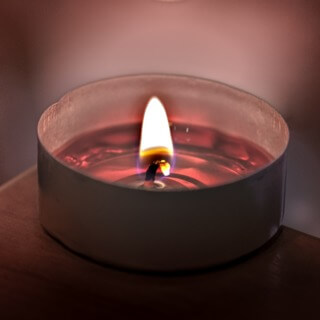
A single burning candle.
Steps leading down to a waterfall.
A single tall tree.
Your own reflection in a mirror.
Waves breaking on the coastline.
A full moon.
Walking through a beautiful garden.
An afternoon with friends.
Walking on the beach as the sun rises on the horizon.
It is now time to repeat your Sen Kalpa.
Repeat the statement you made to yourself at the beginning of the practice.
Repeat it three times to yourself now.
Come back now to the feeling of your breath flowing in and out of your nostrils.
Maintain your awareness of breath and at the same time develop your awareness of your physical body.
Your body is relaxed.
Notice the heaviness of your body.
Take into awareness the points that are touching the ground.
With your eyes remaining closed,
Start to visualise the space you are in.
Imagine the objects around you.
Lie quietly until you feel ready to move.
There is no hurry.
Start by slowly moving your hands and feet.
Take new time.
There is no hurry.
When you are sure that you are fully awake,
Gently allow your eyes to open.
Notice the light and colours in your line of sight.
As you start to bring some movement to your body,
You might like to stretch out.
Perhaps a yawn or a sigh will come.
If it does,
Allow it.
You could choose to hug your knees into your chest or perhaps take a gentle twist by lowering your knees to one side and then the other side.
As you feel ready,
Prepare to move onto your preferred side.
Stay on this side for a few more breaths.
When you are ready,
Move gently into a comfortable seated position.
The practice of Yoga Nidra is now complete.
Namaste.
Thank you for your practice.