Hi,
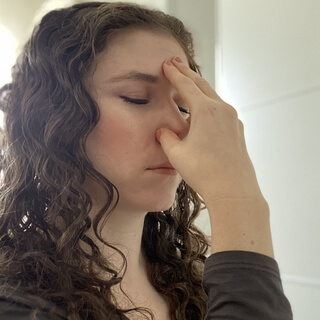
I'm Caroline and today I'm sharing with you one of the most common yogic breathing techniques used in almost every yoga class.
Ujjayi Pranayama,
Which translates from Sanskrit to victorious breath,
Is an energizing and powerful breath that helps keep awareness on your breathing as you move through a yoga flow.
The quality of your breath at all times is directly related to your state of mind.
So when you are aware of your breath,
You can also be aware of your inner state,
Particularly beneficial during a yoga practice where the goal is to remain present with your inner state as much as possible.
In this guided meditation,
I will first share some of the benefits of ujjayi breathing,
How it can be used,
And then finally guide you through practice where we will tap into this victorious breath technique and then add in some gentle arm movement as we practice flowing in and out of the breath.
The signature sound of ujjayi breathing is created by constricting the muscles at the back of your throat as you breathe in and out in order to create a sort of whispering sound with your breath.
When practiced correctly,
The sound can take on even an ocean-like quality while mimicking the sounds of waves rolling in and out to sea.
Both the inhale and the exhale should be equally audible and equally strong while practicing ujjayi breath.
During normal breathing,
The flow of our breath tends to taper off toward the end of the inhales and exhales,
But while practicing ujjayi,
It is important to make the second half of each inhale and exhale equally as strong,
If not stronger than the first half.
Ujjayi breathing has many benefits,
Including soothing the nervous system and promoting calmness and peace of mind.
This steady breathing helps to calm our sympathetic nervous system or our fight-flight-freeze response when we feel under stress.
This is also why it is such a beneficial breathing technique to practice during flow style yoga where we can easily begin to feel stressed or even out of breath while we move.
For me personally,
I have noticed that keeping up my ujjayi breathing flow during my yoga practice helps me to build and maintain my own lung capacity while practicing both yoga and other cardio exercises like running.
It helps keep my mind focused on my practice because I can literally hear my breath with each inhale and exhale,
Reminding me to stay focused,
As opposed to breathing quietly where I may forget.
And it also helps to keep me from losing my breath or becoming out of breath during a yoga flow,
As it itself is the guiding force during my practice.
The audible quality of this breath is crucial,
So don't be afraid to breathe aloud and proud.
If you are practicing alone,
It serves as a focal point for your own practice.
If you're in a studio or practicing with others,
It can help remind them to stay focused on their own breath and their own flow.
Imagine that you're practicing yoga or breathing with Darth Vader.
Your breath should be this loud,
Steady,
And strong.
Many vinyasa-style yoga classes direct yogis to start channeling ujjayi breath right at the beginning of class in order to help build internal heat and also to set the pace of the practice to come.
Therefore,
I want to walk you through how to channel this breath yourself and begin to integrate it into either your regular breath meditation or your regular yoga or other exercise practice routines.
First come to a comfortable seat or standing posture.
If you're sitting in a chair,
Come to the edge of the chair and plant your feet firmly on the ground.
Create a long spine and rather than focusing on how high you can lift your head and how tall you can sit,
Focus on how open you can make your chest.
Keep your shoulders relaxed and tuck your chin in slightly toward your chest.
Allow your eyes to close if that feels comfortable for you right now and begin to focus on your breath as it is presently.
Feel the cool air as it comes in through your nostrils,
Travels down your throat,
And into your lungs.
Feel your chest lift slightly with your inhale,
Your ribcage expand as you engage your intercostal muscles.
Some yoga teachers cue to feel this inhale expand also through your belly,
But I personally prefer to keep this breath in the lungs and the chest and keep my core muscles contracted and engaged.
This is called Uddiyana Bandha.
This helps me to bring more power to my yoga flow as this core engagement is one of the key components to nearly every single yoga pose.
As you exhale,
First feel the lungs begin to empty,
Your ribcage pulls inward,
And then this warmer air flows up through the throat and out through the nose.
Between each inhale and exhale is a brief moment of stillness.
In some breathing exercises,
We explore this stillness more deeply,
But in Ujjayi breathing,
It is sufficient to simply notice it as it passes by after each in and out breath.
Now that you're aware of how your breath is coming and where it's flowing,
We'll begin to engage this victorious breath practice.
Take another inhale more deeply than before.
Aim to maintain a steady rate of breath in throughout the entire inhale.
On your exhale,
Create the same intention.
Maintain a powerful,
Steady breath out that roughly equals or exceeds the length of your inhale.
Try this two more times and find a pace that you're comfortable with.
Know that during a guided breath meditation such as this,
It is more difficult to practice at your own pace,
But I would encourage you to practice this skill first with a guide or a meditation and then explore your own personal pace of breathing once you feel more comfortable with the skill.
Take another inhale.
This time,
As you exhale,
Open your mouth and imagine that you're trying to fog up a window with your breath.
Notice the different muscles that engage in the back of your throat on this exhale.
Try that twice more.
Inhale deeply at a steady pace.
Exhale out of your mouth at a steady pace as if you are fogging up a window.
Now really start to channel your inner Darth Vader breath.
Close your mouth and on your next exhale,
Through your nose,
Try to make that same sound as if you are fogging up glass.
Try it twice more.
Focus on keeping a steady rhythmic inhale and a steady rhythmic exhale.
And finally we'll add this engagement to the inhale as well.
After your next exhale,
Keep this engagement,
This constriction in the back of your throat and try to make your inhale just as loud as your exhale.
This constriction of your throat allows you to breathe both deeply and steadily but without running out of air too quickly or too slowly.
Notice what feels like a good rhythm for you and your practice.
Keep up this breathing for a few more rounds.
Notice how your breath sounds like waves crashing down onto a beach.
Each inhale and each exhale steady,
Powerful and rhythmic.
You can continue practicing in stillness or we'll add in some gentle arm movement.
Continue practicing your Ujjayi breath.
Bring the palms of your hands together.
Your eyes can remain closed if they already were or if you feel comfortable to do so now,
Feel free to close them.
Closing your eyes can help you let your focus remain on the sound of your breath.
On an inhale,
Sweep your arms out wide and up overhead.
Rather than focusing on how high you can lift,
Focus on your chest and feel all of the space of your chest opening up as your arms reach overhead.
Bring your palms together and on your exhale,
Let your thumbs float back down toward your sternum.
Continue this movement with your own pace of breathing.
Try to let the movement of your arms follow the flow of your breath.
Keep reaching upward as you inhale.
Even if your arms are no longer traveling toward the sky,
Energetically extend upward until your inhale is done.
As you exhale and bring your palms back toward your heart center,
Keep pulling inward,
Engaging through your ribs and pulling your focus back in.
On your next inhale,
As you reach your arms up,
Option to tilt your head back and gaze up toward your hands as they meet overhead.
Notice how this movement of your neck up and back may affect the pace or the quality of your breathing.
Try to maintain steadiness and power in your ujjayi breath.
Continue this movement reaching out,
Looking up,
And pulling the hands to heart center.
On your next exhale,
As your hands come together to heart center,
Interlace your fingers together.
Flip your hands so that your palms are facing outward and as you inhale,
Send them together forward and up overhead,
Stretching through the wrists and shining your palms up toward the sky or ceiling.
Bring your palms back together overhead and pull them down toward heart center on your exhale.
If it's okay for your neck,
Continue to let your gaze drift up and then back down with your inhales and exhales.
Continue for a few more rounds of this movement or any movement that feels good right now on your own.
If your mind wanders,
Listen back to the sound of your breath.
If your breath shifts in tone or length,
Notice what is happening in your body.
Adjust your movements so that your breath can remain strong and steady.
Allow your movement to follow your breath rather than the other way around.
Whenever you feel ready,
Allow your palms to return gently to heart center.
Take another Ujjayi inhale,
Then open your mouth and sigh this breath out.
Take one more breath like that.
Inhale deeply and sigh it out.
If they were closed,
Allow your eyes to open slowly.
Relax your body.
Thank you so much for listening and practicing with me today.
May you always see your inner courage,
Speak your strengths,
And hold joy in your heart.
Namaste.