Hi,
Welcome back or welcome for your first time.
What we're going to be doing today is a session particularly for people who walk or run a lot,
But also people who sit a lot as well.
If you sit for long periods of time,
Then the muscles can get tense and the connective tissue as well can start to get kind of stiff,
Basically patterns of tension in the connective tissue and of course that's what we're stimulating,
Particularly in yin yoga.
For those of you who walk and run a lot,
Then what we're doing today is bringing some balance to that repetitive continuous rhythmic movement of the legs,
Stretching out those areas that you may get tension or tightness in.
So particularly we're looking at the hips and also at the hamstrings and the quads.
Those last two muscle groups are where runners can particularly have issues with,
So with these poses do be careful not to go too far in and back off or come out completely if you need to.
The reason that the quads in the front of the thighs become so strong and can feel tight for example,
Is actually because they're protecting the knees.
It's kind of like the muscles are tightening,
They're wrapping around the knees to keep them safe.
This is something of course that you want as a runner,
So do be careful and don't go too far in when you're doing the pose for the quads.
For anybody who hasn't done yin yoga before,
Bear in mind that we stay in the poses for a number of minutes,
Generally between three and five,
So it's really important to allow yourself to relax,
To go to your natural stopping point and then allow the body to soften into the pose.
Saying that,
You may find that after a bit of time the intensity,
The feeling in the body can get stronger,
So if you feel that then by all means back off a bit or even come out completely.
We do resolve to stay still in the poses,
However if it gets too much or if something starts to hurt,
Then again back off to a lesser edge or just come out.
You might want to try my introduction to yin yoga session first to get an idea of how to approach this style of practice,
So just search for that either in Insight Timer or my Facebook page.
Okay,
So we're going to go directly into the poses today,
So first make your way to the wall and we'll start with the feet.
First of all,
Put the toes of the right foot on the floor and the heel up against the wall.
What we're trying to do here is stretch the bottom of the foot,
The soles and the toes.
We're going to be doing this for a bit less time than usual,
For about two minutes each side,
But do play with the position of the foot if you feel that you need more or less stretch or perhaps if you're feeling too much compression in the front of the toes and that's hurting you.
You might want to bring the foot more towards the wall for example,
For more stretch,
Or further away for less compression on the front of the toes.
And you can also play with the weight of the body and see how that feels,
Bringing the weight further forward for instance or back closer to the wall.
We'll be here for another minute or so and again,
If you find that the front of the toes are hurting you,
There's quite a lot of pressure there,
Then I suggest taking the weight off a bit by moving the body closer to the wall or sliding the toes away from it to lessen the flexion there.
Okay,
Now let's go to the other side.
So gently let that right foot settle naturally on the floor and position the left foot so that the toes are on the floor and the heel against the wall.
Again,
Play with the position of the foot or the weight of the body,
Moving forwards,
Moving backwards to find where the best stretch is for you that isn't too much or too little and you can stay in a reasonably comfortably position for around two minutes.
Obviously our feet take a pounding walking,
Running,
Standing.
They hold the weight of the whole body,
So it's really good to stretch them out sometimes,
Stretching the toes,
Stretching the soles of the feet.
And if you lose the stretch at any time,
Then adjust the foot or the body,
Making very small movements to feel the amount of stretch that works for you.
Okay,
So now gently untuck the toes,
Gently place the foot on the floor and for now just stay standing and notice how the feet feel before bringing any movement in,
Perhaps sensing how the body sways slightly.
Noticing the weight on the feet,
Sensing how they feel.
So now you might want to move the feet as a counter pose to that yin stillness,
Pointing and flexing the ankles,
Pointing the toes,
Pushing out the ankles,
Perhaps circling the ankles one way and then the other.
Lean against the wall if you want to,
As you might want to use it for the next pose too.
So just do what you want to do just for a few more moments with the feet,
With the ankles,
A bit of yang within the yin.
The next pose is going to be on the feet for a change.
As perhaps you've noticed,
The majority of yin yoga poses are generally on the floor,
But this one is standing,
So perhaps you might want to use the wall to get into this position,
Or maybe not,
You choose.
So for this pose,
Dangling,
We basically just fold forward from the hips.
Start with your legs straight as we're trying to stretch the backs of the legs,
And you can try if you like putting your bum against the wall to give you a bit of support and see how that works for you.
It doesn't matter how far you fold,
As long as we have a stretch in the hamstrings and maybe into the calves as well.
You can then take hold of the opposite elbows or just let them hang loose,
Maybe shaking the head slowly from side to side to loosen the neck.
If you find at this point that dangling isn't working for you,
If you have high or low blood pressure for example,
Or perhaps you have your period,
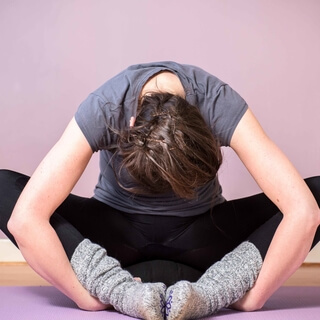
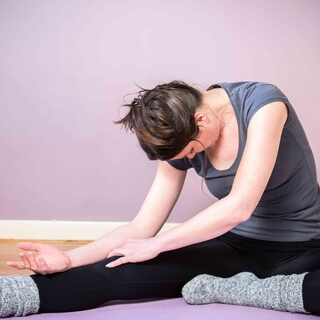
Then another option is to sit on the floor with your legs out straight in front of you and fold over the legs into caterpillar,
Basically the same pose but on the floor.
In both dangling and caterpillar,
Your feet can be together or they can be separate.
You can have the feet straight out of the front,
The toes pointing out to the sides,
Or the toes pointing in.
Play with the different options to see again where the appropriate amount of stretch is and where it is.
Now we're going to stay for another two and a half minutes or so.
The hamstrings can get really tight when you're running or walking a lot,
So this can be a really nice stretch for anybody who does this.
And for this last part,
You might want to play with the weight a bit.
So try moving the weight of the body a tiny bit forward and a little bit back,
Noticing how a stretch might either change location or intensity.
And if you're finding that this stretch is actually too intense in general at this point,
Then you can of course put a bit of a bend in the knees,
And that may well take off the pull in the backs of the legs,
Which may be very strong if you walk,
Run,
Move a lot.
Okay.
So when you're ready,
Then let go of the elbows if you're holding onto them,
Or put the hands on the floor if you want.
If you're standing and dangling,
Then gently bend the knees,
Come down onto the floor,
And then sit on the floor,
Kneeling or whatever neutral sitting position you prefer to feel the rebound,
To feel the effects of the pose.
And if you're in caterpillar,
Then just move up to a seated position as well.
Close your eyes again if you like,
And notice how the back legs feel,
The back line of the legs.
Perhaps you can feel this in the lower back as well,
Another area that can be affected by a lot of walking,
Running,
Standing.
So let's move directly into the next pose.
This one is more for the quads and the hips,
And it's called Dia Pose.
Start in a cross-legged position,
Then keeping the right leg where it is,
Bring the left foot towards the outside left hip.
Bring it as far back as you can without pulling on the knee,
Careful of the knee.
What we're looking for here is a stretch in the quads,
The hip flexes of that back thigh.
So just make sure that the front leg is comfortable,
The front leg isn't so important.
Now it's going to be different here for different skeletons,
So I'll give you a couple of options.
First,
Twist to the right.
You can either stay up on the hands,
Go down onto the elbows,
Or even bring the body down completely onto the floor.
Try which one gives you a mild to moderate stretch in the quads and an opening in the hips.
Alternatively,
If that's not working,
You might find that folding over that front leg gives you a better stimulation.
So you choose,
Twisting to the right or folding over the leg.
But remember what we want is a stretch in the back leg,
Quads,
The hip flexes.
As long as you're passive and feeling that stretch,
Then anything goes.
If you're feeling it in the knees,
For example,
Then you might want to lessen the bend,
So moving the foot further away from the body,
Or maybe moving it closer to you.
Play with the position until you can find a shape you can stay in for around two more minutes now.
And then when you've found it,
Resolve to stay still,
Relax the body.
Try to soften the body.
If you feel that you've lost that stretch a bit now,
Then slightly adjust the body again.
Maybe twisting a bit further around,
For example,
Or moving the torso a bit to the right or a bit to the left.
So let's come up now.
If you're folded over,
Then you can come up onto the hands,
Move to the center,
Bring that back leg forward a bit,
Pull it in,
Drag it in,
And put your hands in a neutral position,
Whatever that may be,
Maybe a bit of a soft deer pose.
And before we move onto the next pose on the same side,
Then see how the body feels,
How that back leg feels.
And if you'd like to do a short counter pose here,
You can put the right hand on the floor,
Push into that hand,
And bring the hips up into the air.
Then go back down again and just repeat that a few times,
A bit of yang.
Okay,
Let's go directly to the next pose,
Square.
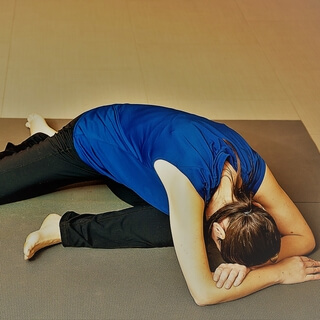
So what we're going to do this time is cross the legs again,
But with the left leg in front.
Now fold forward over the legs.
Now as the target area here is the outside left hip,
Then if you feel enough stretch here already,
Remember it should be a mild to moderate stress that you can stay in for around four minutes,
Then this is your pose,
And you can simply stay here.
If you want more stretch,
However,
Then bring the feet forward a bit so that the shins are kind of parallel to the front of the mat,
Depending on your legs,
Of course,
And then fold forward.
What we're looking for here ideally is a stretch in the outer line,
So the hips and or glutes of the left leg.
And if you aren't feeling that,
Then you might want to play with the torso again.
So maybe twisting a bit to the side or playing with the position of the torso,
Playing with the weight.
You can also play with the legs,
Moving the feet further away from each other or closer.
And we'll stay here for just under three minutes now,
Keeping the body relaxed.
Okay.
Notice as always,
If you can feel any tension anywhere,
It's quite natural actually for your body to start tensing after a couple of minutes.
Notice that,
And if it has,
Breathe into that area.
See if you can soften it.
Okay.
Okay.
Okay.
So let's come back up to the center again.
Slowly come up and then put the legs out in front of you.
And you might want to put the hands on the floor behind you.
Close your eyes.
Notice how the legs feel.
These poses can be really good for stretching and opening the parts of the body that can get tense with walking,
With running,
With anything using the legs,
But also with being in one seated position a lot of the time.
And you can use them if you wanted to also as a warm up or a cool down for any physical activity that is focused on the legs.
But I would suggest doing them for a short period of time,
30 seconds maximum,
For example,
Maybe a minute,
Making them more yang,
So meaning bringing a little bit more muscular effort.
Okay.
So let's just give the legs a little bit of a shake first before going to the other side.
So we're going to start with deer again on the other side.
First move into a cross legged position once more,
But with the left leg in front this time.
So the right foot goes back towards the outer right hip,
Taking that leg back but not pulling on the knee.
Pull it back as far as it's comfortable and you're starting to feel a stretch.
The other leg can be wherever it was as I said,
Maybe at a right angle,
Maybe with the knee a bit more bent or a bit less bent.
It doesn't really matter with this leg.
Next,
Choose where you want to put your torso so that you get a mild to moderate stretch in the left hip flexors and quads.
So consider if you're just going to fold over the legs or do that twist again up on your hands,
Down on your elbows or folded forward,
Whichever one works for you.
Experiment.
Now let's stay here for around three minutes,
Keeping the body relaxed.
If you lose the stretch at any point,
Then play with the position a bit to try and find it again.
Moving the body weight,
Moving the body,
Maybe more of a twist for instance.
And now I'm just going to leave you with the birds for around a minute and a half.
So there we go.
Okay,
So bring your body back to the center wherever it is and drag that knee forward to bring it into a bit of a neutral position,
A soft ear pose maybe.
Before you make any movements,
Let it rest first.
Sometimes you don't feel so much in the pose and then afterwards in the re-bend.
That's when you really feel what you've done.
That's very normal.
And also bear in mind that it's very common to feel fragile after doing yin poses,
Slow,
Long,
Passive.
And then when you do feel any sensations pass in your own time,
Then do the same thing that we did before.
Putting the left hand on the floor behind you and then gently pushing the hips up into the air.
Doing that a few times.
Now let's move into cross legs or square on the other side.
So we start again in a cross legged position but with the right leg in front and once more fold forward.
If there's enough stretch in the right outer hip here then just stay.
Otherwise come back up again and square the legs to the front side of the mat and fold forward.
If you feel this in the knees at all which is something we never want then you can try bringing the knees a bit closer to each other.
That might help.
Or a bit further away.
That also might help.
Another option for the knees is to put something underneath them to support them.
Or sit up on something.
That can also help.
You choose which one's best for you.
Again we stay for around three minutes.
Close the eyes if that's comfortable and simply notice the sensations in the body.
Just noticing your normal natural breath.
Close the eyes.
Yoga is sometimes considered a type of mindfulness,
Focusing on the bodily sensations,
The breath,
The point of focus and anchor to the present moment.
So let's move back up to the centre,
Straighten the legs out and lean back on the hands.
Notice again how the legs feel and if there's any difference between the right side and the left side.
And you can shake the legs out one more time if you want,
Before we move into Shavasana.
So this time we're going to lie back directly into Shavasana,
Into the resting pose.
So be gentle,
Get comfortable,
Put a blanket on if you're cold,
Socks,
Whatever.
Or if you prefer,
You can move into a seated position and move directly into a meditation.
Either way,
Make sure the body is comfortable and allow the ground to support you.
Relax the body,
Soften the body,
Maybe taking a deep breath if that feels good.
And now I'm going to leave you to either relax in Shavasana or to move into your meditation,
Whatever that may be,
With the birds lightly,
Gently in the background.
I'm going to leave them going for around 10 minutes or so.
Take your time,
Allow yourself to enjoy your Shavasana or your meditation.
And once more,
Thank you so much for joining me.
If you enjoyed this session,
Check out my other offerings on my website uchala-yoga.
Com when you have a chance.
Perhaps you might want to join me online sometime.
It would be really lovely to have you there.
Namaste,
Dear friends.