Hello again,
And welcome to my latest Yeen Yoga audio session.
Today we'll be working on the deep front line of the body or DFL.
The DFL is the foundation or the core of your body and is what stabilizes and aligns you both in your yoga practice and in general.
It's basically a long set of interconnected muscles,
Fascia and other connective tissues starting from the ankles,
Travelling up the inner line of the legs,
Moving through the pelvis,
The trunk,
And up the front of the spine to the tongue.
In a more active or yang form of yoga,
A class based on exercising the core often means working on the muscles of the body.
In yin yoga however,
We're focusing more on the connective tissue,
Stressing them in different ways to help them become stronger and healthier.
The main difference here is that in yang styles of exercise,
The movements are often more repetitive and rhythmic,
So suited in general to exercising muscles which have elastic properties.
By that,
I mean that after being stressed,
Stretched or shortened for example,
They return to approximately the same state as they were in before.
Connective tissue in general however is not as elastic,
And the type of exercise it tends to respond to best is what we call yin exercise,
I.
E.
Long held and relatively slow poses.
So in our class today,
We'll be centering on the connective tissue of the deep front line,
Largely the torso,
And the arm or humerus joint.
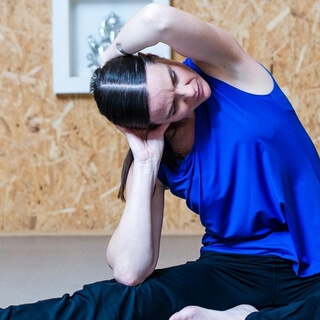
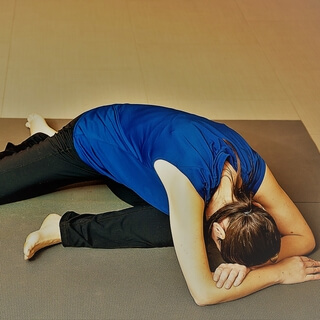
If you wanted to look at the images of the poses as a general guide,
Please check my blog on uceleioga.
Com.
And if you'd like to have some props ready,
Then a blanket,
Some blocks,
Books or cushions,
Something to raise you up would be good.
Now we'll start with our breathing exercise.
Begin by sitting in your chosen position,
Whatever that may be.
Cross legs,
Caesars,
So kneeling,
Perhaps even lying if you want to.
Just get yourself comfortable,
Move the body a bit if you need to,
The torso,
The shoulders,
The hips,
Whatever you need to move,
And then close the eyes,
Or if it's more comfortable then just soften your gaze.
Make sure that the back is straight and the chest is open but your shoulders are still relaxed.
And what we're going to do is we're going to breathe in and out normally to begin with,
Then we're just going to shorten the in breath a little bit and elongate the out breath all through the nose.
So when you're ready,
Just start to bring your attention to your normal breath,
Noticing where you can feel it in the body.
That may be the belly,
The diaphragm,
Maybe the chest,
Perhaps the rise and the fall of the shoulders,
Or maybe you can feel the air going in and out of the nostrils.
Just notice where you can feel the breath.
And as I mentioned,
What we're going to do now is shorten the in breath a little and allow the out breath to be long,
To go right to the end of the out breath.
So just shorten the in breath just a little bit and then allow the out breath to be long.
If after a bit of time you feel it's not really working for you,
Then by all means just go back to your normal breath and perhaps just slow it down a little bit.
The reason that we're doing this is that making the out breath longer activates the parasympathetic nervous system,
Which ultimately means it can help slow you down,
Slow down your heart rate,
Slow down your blood pressure and ultimately help to relax you,
Relax the nervous system,
Relax the mind.
If you maybe even want to shorten the in breath a little bit more and make the out breath a bit longer,
Then experiment and see if that works.
And then if you're not already on your normal natural breath,
Just go back to that now and see how you feel.
And if you find that that breathing exercise did help to bring some calm,
Maybe to relax you,
Then try to use it in the poses today,
Using the out breath to help you relax deeper into the pose and help gravity to bring you down.
So as we're going to be working on the joint of the humerus or the arm today,
Then I just want to go through the movements of this joint.
There are six movements,
So let's do them together as a kind of warm up.
First of all,
Start by standing up and just let your arms hang loosely by your sides.
So the first two movements are flexion and extension.
Flexion is swinging the arms forward,
So just swing the arms forward.
Flexion is when they go back,
So swing the arms back.
Flexion arms forward,
Just do it with me.
Extension arms back.
Flexion extension flexion extension.
The next two movements are abduction and adduction.
So bring the arms out to the sides,
This is abduction.
Then bring them closer to the body,
Bring them close together,
Now even cross them over one another,
This is adduction.
So abduction,
Arms out,
Adduction,
Close together.
Abduction adduction.
Abduction adduction.
Now just rotate your whole arm outwards from the shoulder so that the thumb is on the outside and the little fingers are closer to the body.
This is external rotation of the humerus.
Now go the opposite way,
So rotating the whole arm from the shoulder inwards so that the thumbs are closer to the body and the little fingers are on the outside.
This is internal rotation.
Internal rotation going out,
Internal rotation going in.
External rotation,
Internal rotation.
So those are the six movements that we're going to be doing today.
And I was just doing that not to make you feel like you're back in school,
But just pay attention to how they feel as we use them in the poses,
Encouraging the lubrication of the humerus joint and consequently a potential for increased range of motion or flexibility in this area.
Now we'll move into the first pose,
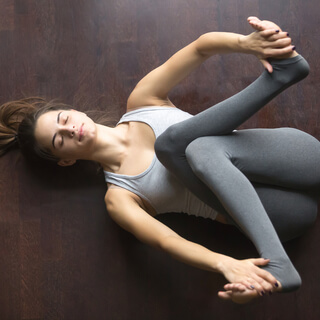
Sitting swan.
So obviously for this you're going to need to sit down.
So just move to the floor and sit with your legs out straight in front of you.
Now bend the knees,
Put the feet on the floor and the hands on the floor behind you,
Fingers pointing away from you towards the back of the room.
Now put your right ankle or shin on the left knee,
Above the left knee.
So hopefully you may be feeling a bit of a stretch on the side of the right leg.
Now if you feel you want more stretch here,
Then you can either move the left foot closer to you or you can move the hips,
The bum,
Closer to the left foot.
If you find that's still not giving you much stretch,
Then try moving the right leg either more towards you or perhaps playing with it,
Moving it more to the left or to the right.
So if you find that there is too much pressure in the arms or the wrists,
Then move the hands.
It may help for example to move the hands further away from the torso to lessen the flexion in the wrists.
You might find that separating the hands is helpful or maybe alternatively bringing the hands closer together,
Maybe even bringing them closer to the torso.
And when you've found your position,
We'll stay for around 3 minutes.
If you would like to bring that breath back now.
Then just start shortening the in-breath a little and elongating the out-breath,
Letting yourself deepen naturally without pushing into the pose.
What we're doing here,
As I briefly mentioned before,
Is exercising the tissues.
We're exercising the connective tissue of which there is a lot in and around the joints and we're encouraging the lubrication of the joints,
Potentially increasing the range of pressure and also helping with stiffness which can be very common,
Tension and maybe pain.
Yeah.
And now let's go to the other side.
So just bring that right foot down onto the floor,
Keep the knee bent and this time place the left ankle or shin just above the right knee.
Play with the position of the torso so that you're feeling a mild to moderate stretch this time in the side of the left leg,
Maybe even going into the glutes.
Move the torso closer to the foot,
To the foot on the floor or move that foot closer to the torso.
If you want less stretch then move the foot and the torso further apart.
You can also play with the legs,
So moving that top foot closer to the torso for more stretch or away for less or perhaps moving that foot more to the right or to the left.
Being very careful of anything that feels like it's hurting anywhere and making sure to adjust.
Any pressure in the arms or the wrists,
Try moving the hands away from each other,
Away from you or the opposite,
Closer to each other,
Closer to you.
You can even move the hands around a bit if you want to but just try to keep that opening in the chest if you can.
And now again we'll stay for another three minutes and I'll be quiet during this time but just remember if it's helpful for you to use that breath,
Short in breath,
Longer out breath in whatever way is comfortable for you then please use that to help you or alternatively just deepen the breath a bit.
Paying attention and sending the breath to the target areas,
The opening of the chest,
Stretching the legs and the compression in the arms and in the wrists.
Now let's move out of the pose into the rebound.
So take that top leg off,
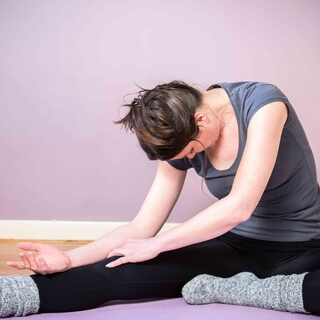
Just straighten the legs out again in front of you and then either just sit up or fold over the legs.
Starting if you can feel anything,
Any after effects in the hands,
The arms,
Maybe the shoulders,
Perhaps the legs.
Now when you feel any sensations pass,
Just relax.
Then just start moving the fingers a bit,
Just bending and extending the fingers,
No big movements.
And then start making small fists,
Slowly slowly getting bigger and bigger,
Closing and opening the fingers.
And you can circle the wrists,
First circling to the right,
Then circling to the left.
And finally just shake the arms out,
Shake the hands out before we move into the next pose,
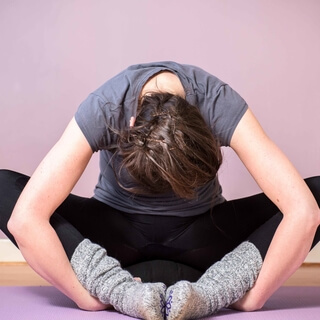
Cross caterpillar.
So that was extension of the arms.
Now we're going to do flexion and adduction of the arms.
Start with the knees bent again but this time with them a bit further away from you and the heels on the floor.
Now adduct the arms,
So cross them over at the tops and then take hold of the outsides of the feet.
Right hand on left foot,
Left hand on right foot.
Just remember that you can change this at any time if you feel it's better for you to hold a bit further up,
Even onto the toes or perhaps further down the feet,
Maybe even the other side of the feet.
Adjust it,
Make it your pose.
So what we're looking for here is a stretch on the upper back and the backs of the arms.
So if you're not really feeling that then just round over more,
That could give you more of a stretch.
If you're still not feeling it then push the legs further away or maybe separate them.
If you're feeling the stretches too much then bring the feet more towards you again so that your knees are more bent.
Do play with the legs until you find the position that works for you.
You may be feeling this in the back line of the leg as well,
The hamstrings,
The calves,
Different for different people.
Remember that what we want is to come to our natural stopping point,
To feel a mild to moderate sensation in the target area,
So in this case the upper back,
The backs of the shoulders,
The backs of the arms,
Without pushing.
And remember,
If you want to,
You can bring back that breath,
Perhaps this time noticing that short,
Natural pause at the end and then breathing in again.
Beautiful!
You you you you you you you you you the arms you you you you you you you you you you you you you you and again we stay for two minutes you you you you you you you you you you you you you you you you you you you you you but don't count just enjoy you you you you you you you you you you