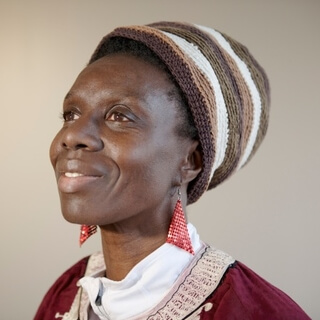
So welcome.
It's just lovely to be able to sit with just people of colour.
It really nourishes me.
And it's just absolutely wonderful to explore one of the seminal teachings of the Dharma,
Non-self.
And as we know,
This day long here at the East Bay Meditation Centre is what race,
Skin colour,
Gender and sexuality got to do with non-self.
And I'm not going to say I'm going to answer all of those questions,
But I am going to speak to this teaching of non-self.
I love this teaching.
It's a teaching that has really transformed my life.
I can remember,
It was about 30 years ago when I started practising and after a year I can remember saying to one of my teachers,
Well one of my teachers is like,
Oh I have to let go of all these labels and now I have to call myself a Buddhist.
That doesn't seem right,
Does it?
And they looked at me as if I was mad,
But I was like very clear.
It's like,
So you want me to let go of calling myself a lesbian,
Calling myself black,
Calling myself this and that,
But then I have to take this label as a Buddhist.
And so that's been a journey for me.
So what is self?
I think for me it's really important to begin to really look at what is self rather than kind of starting from the point of non-self.
And for me,
Self is all those identities that I have attached to.
All those identities of being a Dharma teacher is an identity.
Being black is an identity.
Being a woman is an identity.
And there are these certain identities that I'm attached to.
Being a writer is an identity.
And layered on top of those identities,
It's what we make it mean.
What I make it mean being a Dharma teacher.
What I make it mean being black.
And many of these identities didn't just come to me today or yesterday.
Many of these identities were formed in childhood.
If I look at this black identity,
Who created this black identity?
Society created part of this black identity.
As a child when I was called names like nigger or wog or eenie meenie miney moe,
Capture nigger by its toe.
Or when people would come up and say,
Wog a matter,
Are you all white,
Go black home and eat your coon flakes.
And some of you would have had names like slonty eyes,
Slitty eyes,
Yellow.
All these names created part of my identity.
They created part of my identity because it was what I made it mean.
When I heard those things,
I made it mean something was wrong with me.
I made it mean that I was dirty.
I made it mean I wasn't good enough.
And this is where these identities began to emerge.
And then as I grow,
They're reinforced.
So I don't get into the college I want to get into.
I'm not good enough.
I ask somebody out.
They don't want to go out with me.
I'm not good enough.
And I keep on perpetuating and reinforcing these certain identities.
And then in the end,
They become this fabrication and the concoction of the mind.
Sometimes when I think of just gender,
To me,
It's one of the worst human rights thing,
The worst.
It's a human rights issue,
This thing around gender that somebody came along and said,
You're a woman,
You're a man.
It's like we know in many of our indigenous cultures,
Gender wasn't that binary.
It wasn't binary.
And yet we live in this world where you're man,
You're woman.
What does it mean to be a woman?
I work with children and sometimes I can feel the heat rising in the teachers as I say this to the kids.
And I say,
A good 60,
70% of women who are cisgendered women who identify as being female have facial hair.
But yet,
If we allow that facial hair or bodily hair to grow,
How different would we look from the male counterpart?
How different would we look?
What is female?
What is male?
And what is female and what is male is what we make it mean.
Because if you was to point to where is woman or where is male,
What would you point to?
What would you point to?
It's like,
For example,
Those of you perhaps who go to a university and if I said to you,
Point to the university,
What would you point to?
The one building?
The green where the campus is,
The grass,
What would you point to?
Again,
If you think of a bicycle and you tell me that that is the bicycle,
You point to the bicycle.
But if I disassembled the bicycle and the two wheels were on the floor,
The handlebars were on the wheel,
On the floor,
The pedals were on the floor,
What would you point to and tell me is the bicycle?
What would you point to?
Something for us to reflect on.
Often we hear quoted that the Buddha said,
This is not me,
This is not mine,
This is not I.
This is not me,
This is not mine,
This is not I.
What do we mean by this?
So we know that there are two teachings,
There are the teachings of the three marks of existence.
A nature impermanence,
Dukkha,
Unsatisfactoriness,
Natta,
Non-self.
These are the three marks of existence.
And then there is the teaching of the ten fetters,
Fetters,
The mental bonds that ties to suffering.
And this first one is non-self.
But in all the teachings is implicit of seeing through the illusion of self,
Seeing through the illusion of gender,
Seeing through the illusion of sexuality,
Seeing through the illusion of race,
Seeing through the illusion of skin colour.
And one of my favourite teachings that I think really explains and helps us to see through these illusions is the Heart Sutra.
And you all have a copy of the Heart Sutra.
And we know in the first opening stanza,
There are many,
Many translations and we're just using the translation from my tradition,
From the Tri Ratna tradition.
And the opening stanza says,
The Bodhisattva of Compassion,
When they meditated deeply,
Saw the emptiness of all five skandhas and sundered the bonds that caused them suffering.
And I use the word they and then because when somebody becomes a Buddha,
There is no gender.
They are genderless.
In fact,
It was said that when Shakyamuni,
Well actually they weren't Shakyamuni,
When the prince broke through to enlightenment and became a Buddha or awake because we know the word Buddha means awake.
So when the prince woke up to the truth,
It was said that they said something like this,
That these labels that identify me as a man,
A god,
A deva and a sura,
These labels have been destroyed by me.
Yeah,
That's what was said,
That these labels have been destroyed by me.
We have to destroy the labels that are projected onto us and destroy the labels that we attach to ourselves.
So,
The Heart Sutra.
I was doing some reading and because Thich Nhat Hanh has a lovely translation of the Heart Sutra and I really encourage you to Google it.
It's very easy to find online.
But he tells this story,
The story of a Zen master and a monk.
And the Zen master says,
Do you understand this Heart Sutra?
Do you understand it?
And the monk says,
Yes,
I understand it.
Yeah,
There's no ear,
There's no eye,
There's no nose,
There's no tongue,
Body or mind,
No colour,
Sounds,
Smell,
Taste or touch.
I get it,
I understand it.
And the Zen master said,
Great,
Come closer to me.
So the monk comes closer and the Zen master takes his hand and pinches the nose really tight and the monk says,
That hurts,
It hurts.
And the Zen master said,
But you said there is no nose.
And this to me is a really important teaching because often we think,
Well,
When we say there's no eye,
Ear,
Nose,
Tongue,
Body,
Mind,
That literally it isn't there.
Of course it is there.
When we're this thing of,
I don't want to let go of my race,
I don't want to let go of my identity.
I am black.
I am black.
Well,
That's debatable because really this is black if we believe in colour,
But it's very different from the skin colour that I have.
But for the sake of it,
We can be attached to,
I am black.
Why do we have to let it go?
And Thich Nhat Hanh has a great analogy because he speaks about the balloon.
There is the balloon,
But the balloon is empty inside.
And so in a way,
We need to discover the emptiness in all these identities.
And the emptiness in all these identities is letting go of what we make these identities mean.
So yes,
It's a fact that racial profiling happens.
That is a fact.
That happens.
But what do we make that mean?
And that's what we have to begin letting go of.
And that's incredibly difficult,
But we are often so attached to what we make it mean.
So it's not saying that we are not black or brown or Asian.
What we're saying is,
Is to find the emptiness in it,
Find the meaninglessness in it,
Because we are constantly making meaning out of things,
Constantly.
One of my heroes is the late Dr.
M'Bekka.
And I really encourage you,
If you have not heard of Dr.
M'Bekka,
Dr.
M'Bekka,
Especially those of you who are activists and who work in the social justice field,
Because often the question is,
Can you be a Buddhist and an activist at the same time?
It's not binary.
It's not separate.
For those of us,
This whole thing of politics and can we be political?
For every one of us,
Every day we step out into this predominantly white world is a political act.
Every single day.
We cannot separate from that.
People are projecting this stuff,
This narrative on us.
I can be walking along the road and people just catch the glimpse of black and define me as a male.
There and across the road.
Every day it's a political act.
Dr.
M'Bekka is from India,
A person of colour.
Dr.
M'Bekka was born in the late 1800s and I'm not going to tell the whole story because that would take a good couple of hours.
But let me tell you the nuggets,
The parts of the stories which really inspire me.
When I read Dr.
M'Bekka and I got to a part of his story,
I could not hold onto my black self in the same way.
It was like that black self,
That African descent self shattered in my hands.
Dr.
M'Bekka was born and untouchable.
So what that meant is that if I here was an untouchable and my shadow landed on you over there,
I would be polluting you because you were in a higher caste to me.
It meant that I had to do the shit work.
It meant that I couldn't drink from the same tap as you because I would be seen as polluting you.
In the Peshwaran days,
It meant that people had to have a broom and walk with a broom behind them,
Sweeping their footsteps away because they would be seen to polluting the land.
It meant that in the Peshwaran days that if I was untouchable,
I would have to carry a bowl around my neck to spit into the bowl because in India,
Hot and sandy,
People spit.
But my spittle couldn't touch the ground because I would be seen to be polluting the ground.
This was the context and actually even in his day,
There were some places where those practices still happened.
So he was born into this context.
But he was fortunate because his father had been part of the British regiment in the army,
The untouchable regiment.
But the Brahmins were very upset with this.
They didn't want to fight alongside the untouchable.
So they had to disband that regiment.
And so the Britishers,
As they were called in those times,
Gave the people jobs.
And this is why Mbeka was able to get an education,
Very unusual.
So he had an education and he had a philanthropist who seconded him,
Who paid for his education.
So he was able to come to the US and study law.
He was able to go to the UK and study law.
And he became one of the most educated men in India.
And he is around at the same time as Gandhi.
And I know all of you,
I shouldn't assume,
Most of you would have heard of Gandhi,
But few of you would have heard of Dr Mbeka.
Gandhi was from the merchant caste.
Dr Mbeka,
Actually,
He wasn't even seen,
His group of people weren't seen fit enough to be in the caste system,
Which is why they were called untouchables.
So Dr Mbeka described the caste system as a house with four floors.
And you were born on a floor and you died on that floor.
There's no stairway.
So at the top,
You had the Brahmins and then you had the warriors and then you had the merchants.
These three groups of people who would be the minority of Indian society had access to the sacred teachings,
Could hear the sacred teachings.
Then you had the Shudras,
Who are the workers,
Who were born to serve the top three.
And the Shudras did not have access to the teachings.
In fact,
If they were caught listening to the teachings,
They would have molten lead poured into their ears.
And then there was a group of people who weren't even considered fit enough to be in the caste system.
And this was the untouchables.
So I just want to say at this point that all societies have had their forms of slavery,
Not just in the Indian culture.
All societies have had their forms of slavery.
So this was what Mbeka was born into.
Because he was educated,
He came back to India.
When you're seconded,
There are strings attached to it.
So he had to go back to the city of Broda and work in an office.
And there were people who knew that he was an untouchable,
But they kept it under wraps.
But in the office,
It was impossible for him to do his work because people would throw books at him.
People didn't want to talk to him.
And to get accommodation,
He passed as a Parsi.
But word got out that this untouchable was working in this office,
Managing this office.
And one day,
They came with axes and sticks and beat the door down.
And it said Mbeka fled for his life.
And he went to a park.
And it said that he sat in this park.
And he thought to himself,
If this is happening to me,
And I have this amount of education,
What is happening to the rest of my people?
And in that moment,
He saw that liberation wasn't about himself because he could have been one of the most wealthiest people in India.
But in that moment,
He saw that his liberation had to be the liberation of his people.
And so he committed his life to the uplift of his people.
He was a lawyer.
And he tried to change things through law.
And we know that actually racism today in this country is illegal.
We know that.
But actually,
It still happens.
And in his time,
In the 40s,
He was the godfather of the Indian constitution.
And let me tell you something about the Indian constitution.
If India lived by its constitution,
It would be one of the most radical constitutions in this world.
And Mbeka was a visionary.
He fought for women's rights.
Educate,
Agitate,
Organize.
Educate your women.
This is where you have the liberation.
So he was in that first government,
The Nehru government,
And made untouchability illegal.
But he realized after so many years that that was just in writing.
It didn't change anything.
In fact,
We know the caste system still exists in India.
He had a political party.
Still things didn't change.
He was radical.
And I have to tell you one of the activist things that he did.
As I told you,
Drinking from the same water would pollute the water.
And so he was at a conference,
A famous conference.
I think it was the Yehola conference.
But he was at this conference.
The point of this story is that he led a political action.
At this conference,
He led people who were defined as untouchable to the tank of Masahad,
Where this water was.
And they drank from this tank.
And there was outrage.
And the caste Hindu people purified that tank with the urine of a cow and the curds of the cow to purify it,
Because that's their tradition and what they did.
He also at one point burned the Manu Smriti,
The sacred book,
Political activist.
But this is the point where that black self shattered.
So just imagine this context of what Mbetka grew up in.
And 99% of these people did not have that education.
He was born or living around the same time as Gandhi.
Gandhi had tried to say,
OK,
We'll bring you into the caste system.
We'll call you Harijans.
So you'll be children of God.
No,
That didn't do it.
No.
Yeah.
But I won't go into the politics of Gandhi and those people who were then called the untouchables.
But it is quite important.
What was he going to do for his people?
And he began reading different religions.
But he came to this point.
So he's born in this context.
99% of these people aren't considered fit enough to drink from the same tap as the caste Hindu people.
He came to the point that all caste was,
Was a notion of mind.
All cast was,
Was a state of mind.
And as I read that,
I was reading,
All color is,
Is a state of mind.
All color is,
Is a notion of mind.
All black is,
Is a state of mind.
It's a notion of mind.
All race is,
Is a state of mind.
It's a notion of mind.
And if you think about it,
It's true.
Look at what they did to our different races.
Look what they did.
Look how they were able to do slavery in Africa.
Look at what they did here in this continent to the indigenous people.
Look what they did in Australia to the indigenous people.
Look what they did to the indigenous people in Canada,
Where I live.
Look what they did.
They created a race and said we were inferior.
We were inferior.
In fact,
We don't even need to go that far back.
Look at what Cyril,
Bert,
And Eisen did,
Those psychologists who said that we were 13 points inferior to white people because of our brains.
And I went to,
I passed through a whole education system which was built on the statistics that came out from Bert and Eisen's research saying that because I was black,
I was inferior.
And guess what?
They found out that they had confounded those statistics.
They found out that those statistics were false.
These were these psychologists working in the States in the 40s and 50s.
Yeah.
And Becker came to that realization.
When I read all caste is a state of mind,
I'm thinking,
Bro,
How can you get to that point?
Look at what you're living.
And you can see that all caste is is a state of mind.
All it is is a notion of mind.
How did you get there,
Bro?
I can't even say that my life was just as bad as yours.
And not only that,
Because he came to this awareness that all caste is is a state of mind,
All caste is is a notion of mind.
Therefore,
You need a religion to emancipate the mind.
As Bob Marley says,
Emancipate yourself from mental slavery.
Yeah.
Emancipate yourself from mental slavery.
Baldwin says,
I'm not your nigger.
But actually,
Because of this mental slavery,
I'm still your nigger.
I'm still that Chicano.
I'm still that white man.
I'm still that Chicano.
I'm still that Arab.
I'm still that Asian yellow person.
I'm still that because I need to emancipate myself from mental slavery.
I'm still that mixed race person.
I'm still that person who does not know how to define myself.
Who hates my skin colour.
I'm still that person who's not in harmony with my race.
I'm still that person who's not in harmony with my gender or my sexuality.
So,
And Becker realised,
Because all caste,
All race,
All colour is a state of mind,
A notion of mind,
We need a religion to emancipate the mind,
Emancipate ourselves from mental slavery.
And through his research of all the religions,
He realised that Buddhism was about the emancipation and the reformation of the human being.
Yeah.
I spoke about informative learning and transformative learning.
The Dharma is transformative learning.
It's transformation.
It can emancipate us and free ourselves from that mental slavery,
Free ourselves from the prison of our minds.
Because often we are living in the prison of our minds.
Some of you,
As you have been listening to this talk,
You haven't been listening to me speaking,
You've been listening to what's going on in your head.
You've been in your own prison,
Just listening to that narrative.
Because this is the world that we have fled to.
This is the world that we have escaped to.
So coming back to the Heart Sutra,
The first stanza,
The Bodhisattva of Compassion,
When they meditated deeply,
Saw the emptiness of all five skandhas and sundered the bonds that caused them suffering.
And let me just talk briefly about these skandhas.
So we begin to see the emptiness of form,
The emptiness of the body.
It's not saying that the body doesn't exist,
But we begin to let go of the meaning that we make of this body.
We begin to see the emptiness in feeling.
Often we say,
I feel abandoned,
I feel neglected.
These are not feelings.
These are interpretations about what is going on.
Basically,
Feeling is about hedonic tone in the body,
Pleasant,
Unpleasant or neutral.
And at some point,
You would just see feeling as just sensation arising in the body.
There won't even need to be the need to label it pleasant,
Unpleasant,
Neutral.
But upon feeling arises perception.
And this is where we begin to label and recognize objects.
And we know once we start labeling,
We start giving meaning.
And we move into the next skanda of mental formation,
Where all the fabrication and the concoction of the mind begins to occur.
And we have to begin to see the emptiness in this,
The meaninglessness in this.
And then consciousness,
The fifth skanda,
Where we have an awareness of objects that trigger us.
And it's not just external objects,
It can be internal objects.
In fact,
The internal objects,
The narrative that we have,
Are the biggest triggers that we have,
Where we begin to make it mean.
And we have to begin to see the emptiness in this.
So when we talk about this non-self teaching,
We're not saying that you don't exist.
We're not trying to give you this nihilistic teaching that you don't exist,
Or black doesn't exist,
Or brown doesn't exist,
Or Asian doesn't exist,
Or African doesn't exist,
Or mixed race doesn't exist,
Or racial profiling doesn't exist,
Or that racism doesn't exist.
That's not what we're saying.
Because these things do exist.
But what doesn't exist is what we make it mean.
And we have to begin to let go of this papantia,
This proliferation of all this thinking,
Thinking.
We have to begin to let go of this,
So that we can begin to see through the illusion of self.
So that we can begin to see the emptiness of self.
And I will end there.
Thank you,
Because it's time for lunch.
Thank you.