Hi,
Everybody,
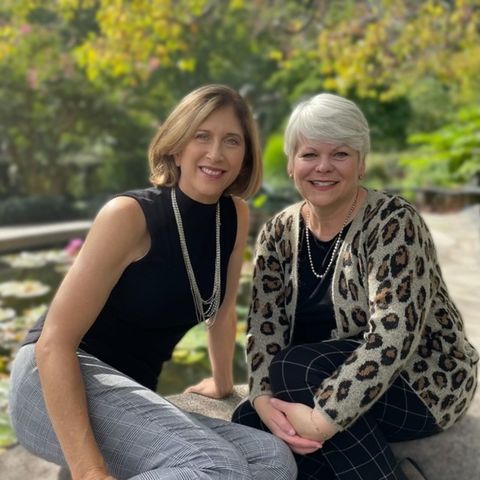
And welcome to Two Eyes Women Talking.
My name is Shira Khan.
Hi,
Everyone.
This is Diana Zahir.
I'm so happy to be here with you and with Shira.
We've been together for 30 years as friends and students and teachers.
We're so excited to talk about the mystery and the path and this present moment.
So let's get started.
Hi,
Shira.
Hi,
Diana.
I'm so glad we're talking again on our podcast.
Me too.
So we're going to talk more about couples today.
Such an important subject.
I love working with couples.
I love being a couple.
It's a wild part of our lives,
Isn't it?
Yeah.
It's where the most intense learning seems to happen.
Yeah.
Yeah.
So I think we have places we want to go,
But I thought we would start taking a moment or two to check in.
So I want to invite each and every one of us as individuals,
Because of course,
To become part of a couple,
We want to feel really good as an individual.
I'm going to take a couple of breaths here.
Just starting exactly as you are in this moment.
There's not a thing we need to change,
Not even how we're breathing.
I want you to feel what it's like to be you,
To be in this body,
In this mind,
In this heart.
I want you to feel yourself sitting or lying down.
Let's visit you for a minute in the warmest,
Gentlest way,
Just to see what's here now.
What's true right now,
Because we really,
Really care.
One of the simplest and easiest ways to do that is to be in the body.
When I'm working with couples or I'm working with individuals who are touching something tender,
I always ask them to go to their feet.
Just visit your feet for a minute.
You might be able to feel into them.
You might just imagine them in your mind's eye.
What's it like to pay a visit to your feet?
You might feel your feet in your socks or in your shoes or in your slippers.
Have a visit with your feet.
Even imagine your feet breathing.
That sounds a little crazy.
It's actually really fun to imagine breath moving in and out of your feet.
When you're ready because you are the boss of you,
We might forget that a lot,
But it's true.
In this inner harbor where I live with myself,
I am the boss of me because nobody knows what I'm feeling or experiencing.
I am the only one in here.
I can choose to let my attention and my awareness move from my feet up into my legs,
Moving through the ankles,
Into the calves,
At just the pace I want to go,
Into the knees,
Into the thighs,
Up into the pelvis,
To the lower back and the belly,
Into the middle back and the solar plexus.
Into the upper back and the chest and the shoulders,
Moving down through the arms.
I think moving into our arms can be a lot of fun,
Like a little water slide or melting warm honey from the shoulders down to the upper arms,
Down to the elbows and the forearms and the wrists and the hands,
Coming up into the neck and the throat,
All the parts of the face,
The jaw,
The mouth,
The nose and the cheeks,
The eyes and the ears,
The forehead,
The top of the head,
The back of the head.
You can imagine,
You can feel into this whole body as if it's a unit.
This is where you live.
This is something life has given you.
You can feel your breathing.
A lot of teachers have this way of looking at the breath.
We feel like we're breathing,
But sometimes life is breathing us.
So pick the version that feels the most comfortable to you.
You are alone in here and it's good.
What's in here is good and it's precious and it's alive and it can learn.
We're so happy you're with us today to learn because we love to learn about this and we love to teach.
It's all about education.
Our parents didn't get to learn these things.
Our grandparents or all the people before them.
We're so lucky to be alive right now.
A lot and a lot of opportunity to learn.
When you're ready,
You can come back to the room slowly.
Maybe stretch your body a little bit.
Feel your skin.
Notice the room.
Open your eyes.
Bring yourself back.
Whatever we talk about today,
Take away the things that matter to you.
Take away the things that feel supportive and empowering.
The things that don't resonate,
Just let them go.
What you're supposed to hear today,
You'll hear and it'll feel good.
It'll help you feel more alive.
It'll quiet any judgment.
I feel so much more here now.
It's so relaxing to be in the body and so quiet in there.
Wouldn't it be fun if every time we were going to talk to our partner we did that first?
Yes,
It would.
Because we'd all arrive more.
It would have to go better from a place of calmness.
It would have to go better from a place of calmness.
Well,
And also self-remembering.
Because I think when we're with our partner,
It's so innocent and natural that our attention is on them and we don't have closeness with ourselves.
But when we do a practice like this to remember,
Even to only remember our body,
We land.
We're more here.
Then it's probably the opposite of what we think.
But if I'm more landed,
I'm actually more with my partner.
It's that abundance model of I'm here with me and I'm also here with you.
As opposed to you're delicious and I want to merge with you and I want you to behave and then I'll be happy.
Right.
Or I'm mad at you and I want you to behave.
So then I'll feel better.
Right.
It's an other referencing goal.
Also,
If you're outside of yourself trying to get and you're feeling better depends on the other person.
It's a little insecure and scary compared to if you have a place inside yourself that you know that you can go to and feel better.
There's less pressure on your partner behaving a certain way.
It's a relief to know that.
Yeah.
Well,
It's conditional then.
Right.
They will only be good if you behave in this way.
Again,
This is all so innocent that this happens for us and it's so reminiscent of our childhood.
Right.
If mom or dad are upset as a child,
I feel unsafe.
I feel like something's wrong.
We're dependent on them.
Yeah.
So that's still within us.
But the present moment right now,
It actually doesn't require anybody to behave a certain way for me to feel connected to all that is,
All that's good.
It's really true for adults and that needs to be known to whoever's listening that this is a possibility.
This is an option that you have within and that it's reliable and safe.
Let's talk for a minute though about what happens when we're in relation to someone and we forget about this resource inside.
Let's talk for a minute about why that happens.
I'm thinking of if we add understanding to that,
It might help people find their way back to the calm place inside.
Yeah.
Maybe we could start with that falling in love part we were talking about before.
Everybody loves that part.
Yeah.
Yeah.
We were talking earlier about how,
Well,
When the relationship starts getting challenging and difficult,
There's this part that goes,
Hey man,
All I wanted to do was fall in love.
All I want to do is have a partner in life.
I didn't want to have all this stuff come in that I have to deal with.
Just instantly falling in love over here and then all of a sudden to deal with all of this and I don't even know what's going on.
Exactly.
This isn't the fairy tale.
This isn't the yummy part.
This isn't what I see in the movies.
What's happening?
I love that honeypot beginning.
I just want to be with you all the time.
I don't want to eat or sleep or work.
I just want to be close to you and merge and have sex and have so much fun.
What is this other stuff that's happening?
I don't like that.
I don't understand that.
I just want to get back and be in your arms again.
How do I get back there?
Just behave so I can get back in your arms.
Yeah.
So dreamy that beginning part.
You can feel like this is the person that you complete me.
Yeah.
And you're the person that's going to undo all the bad that was done to me.
Well,
And it can feel like that.
That love is such a healing balm.
Mm-hmm.
Right?
Mountains for it.
Mm-hmm.
Tolerate all kinds of discomfort because when we're in that together,
Wow,
I do feel made whole.
That is magnificent.
Yeah,
It is.
So what they don't tell us is something I want to say here,
Which is that we can end up still having that love available,
But inclusive of whatever is still unresolved inside,
Inclusive of what hurts.
And that is the next phase after the honeymoon's over is at some level,
The couple is getting ready to find out,
Well,
Can we deal with all of us here and still have love?
Right.
Right.
So Shira,
You and I were talking about how this is the conversation that doesn't happen in most people's lives to understand what is this relationship journey anyway?
We have this whole yummy honeypot beginning,
And then a lot of couples have a hard time moving into the next phase.
It doesn't mean we're talking about deep psychological processing all the time.
That's not the next phase.
We're always encouraging people not to process too much actually,
But there is a shift.
There's an integration.
There's an evolution of love.
We can go from that oneness and yumminess into something that has more capacity and potentially things can heal,
But it's an awakening phase,
I think you could say of what is happening in that next phase?
You and I could talk about that right now,
I think to give an overview,
But to also encourage people,
This is not a bad thing.
This is not like the bad movie after the fantasy movie.
Right.
It doesn't mean that it's not a good partner after all,
Or that you need to break up,
Or that the couple is doomed.
Right.
It actually means I have an invitation here from life to take that delicious beginning and to also have my own deliciousness.
Could you say more about that?
Then I have a thought.
Yeah.
Well,
In the honeypot time,
Everybody's forgetting themselves.
It's kind of how it's designed.
We don't have a separate self.
We go into this oneness together.
That's tricky.
I don't want to get too much into that symbiotic phase of life where we're in oneness with mom because we're not,
Of course,
In oneness with mom when we're with the person we love now,
But it's the closest thing to that where we disappear.
We just completely melt and let go,
And we're so held by life.
And so met by the other person in the beginning.
That's what it feels like.
Yeah.
It's like all the boundaries disappear,
Which is similar to what happened when we arrive on the planet,
And we have that with mom.
But now we're an adult,
And we have it with another human being.
I often talk about it as Turkish delight.
You can't get enough of it.
You want more.
It's the most delicious food you've ever had.
So to shift out of that to a more individuated state where there are two people,
It can happen.
There's a big disappointment for some people who haven't had enough of that merging with mom,
That oneness in childhood.
And so they don't want to move out of that.
Like,
No,
No,
No,
No,
No.
I don't want to come back to being a person.
I want to be in that honey pot.
That's a great point.
And also it's a paradox that two individuals can actually have more connection as adults.
So we think there's going to be less connection because there's going to be more separation.
And when we are little,
The way to have connection is through merging when we're really little.
But in adulthood,
It's like a set of paradox.
So that can be a shock too of how am I going to wait?
I'm going to lose love if I lose the merging.
That's right.
That's right.
And sometimes it's hard to even know,
Do I really love you?
And I probably do love you,
But do I also just love the merging?
Right.
And there's a way that chemically or karmically,
The way I merge with you is incredible.
I've never merged with another person like that.
So I'm ready to leave the merging.
Yeah.
This is the best thing ever.
It's the answer to my prayers.
Are you kidding?
I don't want this to be over.
And then come back,
Come back to merge,
Come back.
Let's do that again.
Yeah.
I want to say for the tape that what you just said,
I want to pull out and state that one way of phrasing what you and I are teaching here is how to be autonomous in relationship and still have a really juicy love connection.
Yeah.
And a really,
A really love filled connection,
Even though it's from two individuals.
Right.
It's one way of phrasing what an overview of what we're teaching.
Yeah,
Exactly.
Before I say more about that,
I just want to say about that part of us that isn't ready to leave the merging and,
You know,
I don't want to grow up.
I want to stay in the merging.
I have a lot of compassion for that.
I think we all have times in our lives where that is the most important thing.
It's part of being a human being.
So if that's where we are,
Or if we are remembering that time in our lives,
It's so understandable.
It's so natural.
It's part of being a human to want the merging and nothing else.
May I disclose.
So I've never,
I've never actually heard this put into words.
I'm really grateful to you.
So for me,
After the merging stage with my mom,
That was the last positive interaction I had.
There was,
It was not positive after that.
So now I feel even more like,
No wonder I I'm,
I was so always looking for the honeymoon stage.
I,
Yeah.
Thank you.
I think it's true for so many of us that we want that.
And,
You know,
I talk about this with a lot of people that I had those memories in my own life.
And I really liked that part of me,
Actually.
I mean,
Not that I want my own children to suffer the way I did when I got so hooked on the merging for a while.
But that merging was phenomenal.
And I think we're supposed to have these experiences.
So we can say that's what's possible for a human being that we can hit those zenith moments of complete and utter bliss.
The important part,
I mean,
Probably for me,
The most important takeaway from today is I feel like we're marketing.
Here's why it's good to go to the next level of relationship.
Not that,
You know,
Better ignore the merging or compare it,
But the way you just phrased that as an adult who as an adult,
Who can have oneness with myself and pleasure in this inner harbor where I live,
Where there's a friendliness with me,
There's,
It's like an attitude or a way of relating to myself that has so much ongoing good.
What ends up happening is this possibility that because I have this capacity to be with me,
Our yumminess together has longevity.
It has sustainability.
It has steadfastness.
Without my relationship to my inner harbor or without having some experience of a self that's reliable and I know I'm there,
I can't really take this yummy beginning into a future.
I can have a lot of really delicious times that are deep and merging and symbiotic,
But then they end and usually painfully.
Usually because of a fight or something.
A fight or a rip or a betrayal or all these things.
Learning about this next phase is so hopeful.
Because that means I can have a life filled with love with my partner,
With myself,
With other people,
Because I'm growing in me this ground where love not only resides,
But it keeps growing.
It's an abiding.
I can abide in here.
I can abide with you.
I can have the delicious times of oneness.
And it's also okay if that's not happening.
I'm still going to be okay either way.
I'm still going to be connected to the universe,
Connected to love.
I'm still going to survive.
Amazing.
It's going to be much better than okay.
Actually.
I wish you were here,
But it's a party in here.
I have that relationship to my own heart and my own presence and glad you're here to enjoy the party,
But I don't need you to be here for the party.
And I don't need you to behave in a certain way for me to have a part.
So I think this can't be overstated.
And when I finally learned this and became strong enough in myself to weather the storms of whatever was happening with my partner,
But still have that safe place inside a certain level of my suffering was never as profound again.
Because that suffering when your partner's not available,
If you don't have that place inside yet,
It's excruciating.
I can also tell you that from the brain body perspective,
That when you feel cut off,
Your attachment system comes back online and there are neurochemicals that are emitted to try to make you reattach.
It's biological,
But to endure those chemicals and those impulses to attach when your partner's not available,
It's a very painful and specific kind of human suffering.
So when there's enough attachment with who you are inside,
With your source,
With God,
That the chemical onslaught doesn't come as much,
It's just so much easier to get through those times.
And like you said,
Actually still feel,
There's a party in the,
I'm more than okay.
I mean,
That's amazing.
Yeah,
I think the contrast is huge.
I can remember so many times when I was in a kind of merging zone with someone and we couldn't line it up,
I really felt like I was hanging onto the side of the planet.
It's not exaggerated.
It feels that painful.
I mean,
Having that rip inside of you because you can't get to the merging when you want it.
It's more pain than we can imagine.
Yeah,
It is.
And there before.
Yeah.
So this is for another podcast,
But with attachment styles between couples,
If somebody is anxiously attached or having a moment of being anxiously attached,
The other person is avoidantly attached,
Then the one who wants connection asking for that actually makes the avoidant person feel more dysregulated and upset themselves.
And that's even more painful for everybody.
One person saying,
I'm really advocating for myself here.
The other person saying this advocacy that the person is doing is hurting me more.
Yeah.
So this inner harbor is an alternative to that.
Right.
Right.
And then I just want to say that when people are feeling calm again,
Connected,
Then they can talk about it.
Right.
But in the moment,
Even though that's when there's the urgency,
If there is that anxious avoidant thing going on,
It's even harder to talk about that.
So one way we could kind of include all of that is when we can all land,
When we can all arrive in our inner harbor,
It doesn't even really matter our attachment style.
Right.
Because we're here in the present moment and we can connect.
Yeah.
Yeah.
I think this teaching is revolutionary.
As someone who has studied couples counseling,
They didn't talk about this yet when I was in school.
I know this is starting to come and be spoken about in the couples counseling discourses now.
But I want to invite people to maybe slide back in time to the meditation.
Just remember,
Let's remember our bodies again for a moment.
That returning to the feet and the arms and the legs so that we have a felt sense of what it is that you're talking about.
That what it is that we're both talking about.
It's an actual experience of being in the body.
Yeah.
And a practical tool,
You know,
That we can take this into our lives after the conversation today.
I'm with my partner right now.
And my heart feels so much love and I feel my feet.
Or I'm with my partner right now and they're really pissing me off and I can feel my feet.
Mm-hmm.
That that becomes our anchor.
Yeah.
For the present moment,
No matter what's going on.
I wish they would hug me right now and they're grumpy and I'm feeling my feet.
Yeah.
And the other person isn't available,
But I'm available to myself.
That's right.
And when I go in my feet,
I can feel a closeness with me.
There's someone here,
Even if the other person isn't here,
Someone here.
Yeah.
Yeah.
I want to add that if there's a moment of escalation or something happening with the partner,
It may be like a meditation that you may need to bring your attention back into your body.
You're going to go out and like maybe feel what's happening in the field and get upset maybe.
But then there's that part of you that can remember,
Oh,
But my body's still here and come back.
Right.
I think before we finish today,
We need to connect to this back to the critical voice again,
That if we don't have much experience connecting with ourselves,
The way we're describing today can feel really awkward and foreign,
But we might also realize when I pay attention to myself,
I start judging myself or being mean to myself.
Mm-hmm.
And to remind you or to let you know,
That's just a layer.
That's not the conversation we're talking about.
And so until we have a little more understanding of what that layer is,
To imagine bringing in the kindest energy possible you can to yourself.
What's the kindest thing you could say to yourself?
What's the kindest thing you could do to yourself right now?
And putting your left hand on your heart center and just having it be there in the simplest way.
It's not a big activity.
Just feeling the weight of your hand on your chest,
Feeling your breath.
Maybe you feel the hand rising and falling.
This is a great way to visit yourself and to move out of those beliefs or judgments or that voice in the head that gives us a hard time.
That's not really what is ultimately going on when you go inside,
But it might be the first layer you encounter.
That's a great point.
The inner critic is loudest when it perceives a disconnection with a loved one.
And it says mean things.
It can find fault with us for the disconnection,
But deep down,
It's really upset because human beings are wired for connection.
And when we're disconnected,
We perceive it as a threat to our survival.
That's why we get so upset about little things like,
I told you I don't like my toast that dark.
Because deep down by that person not listening,
We feel disconnected.
So then the critic gets really loud.
And a lot of times it focuses on us.
It finds fault with us because it wants to do something to change the situation.
So that's something to be aware of when you turn inside.
But as you said,
That's only a layer.
There's so much more waiting for us inside beyond that critical voice.
So we're going to teach more about the critical voice so we can understand this layer and expand beyond it and beyond its way of perceiving things so that you can have more resources with your partner.
I'm so glad you're saying that.
And I feel so touched by this moment in our podcast.
I feel like this is something we've led up to with all of the previous episodes.
Just want to really underscore it and highlight it,
Bold typeface.
Everybody,
Most people on the planet,
I would say,
We have these problems in relationship.
And we don't know what to do about them.
And we feel so alone.
And we end up listening to the critical voice.
And we turn it on ourselves,
Or we turn it on our partner.
And so this is something you and I care so much about.
It's what we teach people.
It's what we want to help educate people about for their lives,
That when you have trouble in your relationship,
Here's a new toolkit.
We want you to feel empowered to go inside yourself in a different way.
But we also want to help you understand there's a reason you're upset right now.
There's a reason your partner's upset right now.
And we can do something new with that moment.
Yeah,
That's exactly it.
That from generation to generation,
We've been shown,
Okay,
Here's what you do.
And someone gets upset in relationship.
But so many times it doesn't work and leaves people feeling quite desperate inside.
Whereas there's a set of skills that we would like to offer that if you don't have the skills you have,
If you know the set of skills,
You have an alternative to what you inherited as far as how to get through the difficult moments in relationship.
Yeah.
Yay for that.
Yeah.
Because we keep doing the same thing.
I think that's why our relationships have so much destiny of trouble.
We keep doing the same dance with our partner.
We're deferring to our history.
They're deferring to their history.
And we just keep having this boring,
Repetitive dance.
And of course our critical voice often looks at them saying,
Oh my God,
You sound just like your mother.
You sound just like your father.
We can see glimpses of history in the room.
One of our teachers used to say,
If you have two romantic partners in a room,
It's not just those two people at six.
It's you and me and my parents and your parents.
But we want to give some other options here.
We're not talking about processing all of that.
We're talking about how could I function differently in that moment when I notice I'm unhappy.
And because you and I teach so organically,
Of course it's going to be creative,
But you and I tend to have a map that isn't linear,
But we tend to have those stops on the map,
I think,
When we teach people.
Yeah,
There's an aspect to being in relationship,
A successful relationship that just has to do with education because most of us didn't learn it in our families of origin.
And there are things we can understand,
As you said,
And actions we can take that create a different outcome.
More to come on this topic and many others.
I'm so glad we got to do this today.
Yes,
And I want to thank all of the listeners for engaging with us and with this material.
Have a beautiful day and a beautiful night,
Everybody.
And be sure to enjoy your closeness with yourself and with everything you love.
Bye for now.
See you next time.