Hello and welcome to Triscule Talks.
I'm James Shaheen,
Editor and publisher of Triscule The Buddhist Review.
Today,
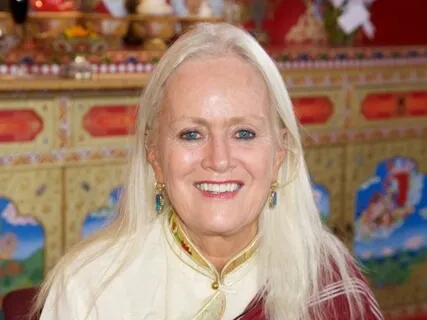
Executive editor Emma Varvaloukas is joined by Lama Tsoltrum Elion,
Known in good part for her work exploring feminine power in Tibetan Buddhism.
Lama Tsoltrum,
Who was once Alan Ginsberg's meditation teacher,
Has written a new book that explores how we can integrate spirituality into our daily lives by adopting the power of the Dakinis,
Fearsome embodiments of wisdom whose qualities anyone can develop.
Specifically,
Lama Tsoltrum shows us how to transform negative energies such as anger,
Impatience,
Or greed into sources of clarity and strength.
The book is called Wisdom Rising,
Journey into the Mandala of the Empowered Feminine,
Although its powerful lessons are applicable to all genders.
Now let's listen to Emma in conversation with Lama Tsoltrum.
Lama Tsoltrum,
Welcome.
Thank you so much for talking to me today.
My pleasure,
Emma.
So we're here to talk about Wisdom Rising,
Which is your new book,
And it's a book about connecting with a feminine power.
And something I wanted to say from the get-go is,
You know,
For any listeners who are listening to us who don't identify as a woman,
This feminine power is more like an energy.
So you don't need to be a woman to connect with this.
And Lama Tsoltrum,
In the book,
You talk about positive models of feminine energy in our culture,
And usually that's connected to this nurturing,
Motherly type figure.
But the power that you,
You know,
Go into great detail about in the book is a little bit more wild.
It's a little bit more mystical.
It has the sense of it can't be contained.
And it's also wise,
It's fierce,
It gets shit done.
And that's called a Dakini in Tibetan Buddhism.
And I was wondering if you could tell us just what a Dakini is for anyone who's listening who doesn't know.
Well,
As you said,
The image of the devoted and peaceful motherly feminine has always been acceptable,
Even in patriarchal cultures that are extremely repressive.
But this aspect of the intuitive sacred feminine,
A place connected to the paradoxical,
The intuitive relationship with the earth,
The sacred feminine also connected to paradox.
That has not been allowed.
And so for me,
This idea that we need to be able to be fully present,
Not just bring part of ourselves to the table,
Has always inspired me about the Dakinis,
Because they have an aspect which I could identify with,
Which is that they are both fierce and wise,
And they're spiritual,
But they're also sexual.
They have this quality of embodiment and wildness.
And so the word itself Dakini in Tibetan becomes khandro,
Which means sky dancer or she who moves through space.
And it is the most important aspect of the feminine in Tibetan Buddhism,
Although it's not the only aspect of the feminine by any means in the Tibetan teachings.
The Dakini can appear as a human being or also as a deity.
If she's a deity,
Which is how I largely portray her in the book,
She's fierce,
She's surrounded by flames,
She's naked,
Dancing,
And she has a really embodied power.
So I think one of the ways that the Dakini is defined is as a messenger of spaciousness and a force of truth who presides over the funeral of self-deception.
I like that.
It's just kind of like this badass messenger of truth.
It feels very Wonder Woman to me.
So you're talking a little bit about this motherly figure being allowed in even repressive patriarchal societies,
But this more wild figure is,
As you say in the book,
It's relegated to the unconscious,
The negative,
To the shadow.
And one sort of modern equivalent of the Dakini that people might be familiar with is the term nasty woman now,
Which I like a lot too,
The nasty woman.
But it's also hard to think about a true Western equivalent to something like a Dakini.
I was thinking about it recently and the closest I came to was the main character in Avatar,
Do you know Natiri?
So something like that.
But it's inspiring to be able to be introduced to a new kind of role model.
And I was wondering if you could talk a little bit more about the connection between feminism and the allowing of this fierce feminine power to be revealed and unveiled in society.
Well,
First,
I'd like to define the way I'm using the word fierce.
It's not like a sort of violence.
It's a fierceness like a mother animal defending her young.
It's the ability to have that laser beam of pure energy that can say no,
Or can say yes,
And harnessing that energy into very direct and powerful,
As they said,
Laser like force.
So that fierceness is in this case without aggression or hatred.
It's an energy.
It's like a fast moving strong energy.
So nowadays,
We have well,
First the woman's march and then me too and time is up and it's not over yet by any means.
It's just getting going this fierce aspect of the feminine showing up.
And so what I see in this is that yes,
There's righteous anger and yes,
We need to be fierce.
But if we can direct that with wisdom and transform the anger into skillful means or skillful action,
That will be more effective in terms of reaching our goals.
So what I'm doing in the book is really offering a process and a tradition of empowerment,
Like the word I-N,
Empowerment,
That leads to outer empowerment,
E-M.
So the way I see it is that as women are rising,
And I saw this in the woman's march,
That we see so much energy and so much anger and so much enthusiasm and humor and so on.
But what's the inner resource that the women and their allies are drawing from?
Where are they getting that inner power so they don't get burnt out or discouraged or kind of burnt up by anger?
And so what I wanted to offer was an inner process,
Meditations and practices to make this sustainable,
And not only sustainable,
But really to have an inner resource for empowerment that we could draw on constantly.
And I think that really gets to the heart of a question that lingers on a lot of people's minds these days,
Which is it's really tiring to sort of constantly go up against certain challenges and attitudes and actions.
And this question of how do we keep nourishing ourselves and having this,
I love the word,
Empowerment?
How do we keep the well running so that we have something to draw from?
So obviously you have to tell us the answer to this now.
How do we do it in five minutes or less now?
Well,
There's a variety of methods to do this.
The primary method that I'm suggesting in Wisdom Rising,
This new book,
Is through the mandala,
Through the mandala of the five wisdom dakinis.
Because the mandala is a template of wholeness in itself.
It's something that Carl Jung,
The Swiss psychologist,
Discovered appears in situations of psychic confusion and disorientation.
So it's an archetype that is constellated or represents a pattern of order,
Which becomes kind of like a psychological viewfinder.
And essentially what a mandala is in its most simplistic definition is a circle divided into four quadrants with a center.
So this is the template of the mandala.
That's the mandala in general.
But the Tibetan mandala,
The Tibetan Buddhist form of the mandala,
Is a kind of like a sacred enclosure for the mind.
In other words,
It's a sacred enclosure in which we place the mind that creates this sense of order in which we can replenish ourselves.
And so what I teach in the book is the mandala of the five dakinis.
So it's that mandala principle,
That template of wholeness.
And by the way,
The word mandala quite simply means the circle.
But it can also mean the manda,
Meaning supreme or best,
And then la,
The marker,
The completion.
And in Tibetan kilkor,
Which means the center and the swirl that comes out of the center.
So when you have the mandala of the five dakinis,
You have a template of wholeness with the fierce feminine being activated within that.
I love what you said about the centering and then the swirl around that.
So it's the centering of the self and then that's translated into the swirl of action around you that operates with wisdom instead of,
Like you're saying,
Anger and aggression.
Yeah.
And I find just personally,
You know,
When I wake up in the morning,
There's just immediately so much input.
And it's really easy to get fragmented in that situation,
Or not even when we wake up,
But you know,
Just all day.
And so when I do the mandala practice,
It's kind of like sealing the borders so that there's a container,
There's a sense of wholeness and relaxation with that.
And in a way,
The mandala is kind of like an incubation chamber for transformation that I place myself in when I do the practice.
And it's immediately healing.
Like as soon as I begin the mandala,
I immediately feel myself coming out of that fragmentation into an experience of being settled and not just settled like in mindfulness,
But settled in a transformational container,
Essentially.
I mean,
That's definitely as good of an endorsement for Tibetan Buddhist practice that you'll ever hear,
Probably.
That sounds lovely.
Yeah,
And maybe we should back up a little bit and talk about one of the basic premises of Tibetan Buddhist practice,
Which you were just talking about now,
Which is this ability of transformation,
Which is taking things that might be a negative in your life or a stress or an affliction and transforming them into something positive and good and beneficial.
Could you tell us a little bit more about how that works?
Yeah,
That's actually very exciting because sometimes with spirituality,
We have a feeling we have to just like calm down and kind of cut off all our energy.
And you know,
We can't be passionate,
We can't be angry,
You have to just calm down.
And in the Vajrayana tradition,
It's not like that.
We take those energies,
Which are natural energy,
We do have energies of calmness,
But we also have movement.
And we work with the energy itself as it is,
And then transform it from these,
What I call encumbered patterns and what they're traditionally called is poisons.
So we,
Let's say anger,
For example,
Anger is an encumbered pattern,
It causes harm,
It causes a lot of suffering,
We've all been hurt by it,
Right?
But if we remove the struggle of anger and the egoic fixation on being right and everything else that comes with it,
We have an energy,
We have a fast moving,
Powerful energy that often has a lot of clarity in it.
And so the Vajrayana process or the Tantric Buddhist process is how to remove the fixated grasping struggle part of that poison or that encumbered pattern and get to the pure essence energy and really maximize that as wisdom.
And so we get these five wisdoms that are the energies like desire,
You know,
Our desire,
Our craving.
Again,
This is something that can cause a lot of problems,
So much suffering can come from it.
But if we pull off the shroud,
You could say,
Of egoic clinging and fixation that's attached to it,
Desire is a blazing,
Beautiful energy that can have a tremendous positive effect.
So passion becoming compassion.
So this whole concept of transformation,
Rather than renunciation,
Is key to the Mandala principle and to Vajrayana in general.
And in the book,
The organizing principle for all of this is the five Buddha families,
Right,
Which is sort of the five common afflictions and then their inverse,
Which is this new positive energy.
And it was kind of fun to go through the Buddha families,
At least for me,
Because you can kind of start to identify which type you are.
And I learned about myself,
I think I'm in the karma family,
Which is the stressed out workaholic type.
But I live in New York,
So that probably doesn't surprise me.
The whole city is dominated by karma family.
Maybe you can just give us a quick rundown of what those five common poisons are,
And then what the turnaround is for each of them.
Yeah,
Yeah.
So yeah,
I like to call them encumbered patterns,
As I said,
Because this pure energy really is under it.
So the word in Tibetan is nyomong,
Which literally means drowsy or obscured.
And so each of these five families has an obscured pattern and a wisdom.
So in the center of the mandala is the Buddha family.
And the Buddha family is connected to the encumbered pattern of what's called ignorance.
And it's also connected to the element of space.
And so this ignorance is never really meant very much to me.
Like,
What does that mean?
Like,
I don't know anything ignorance.
That's not the idea.
The idea is this Tibetan word is marigpa,
Which means non awareness,
Which is very different than ignorance.
So it's a kind of being slightly asleep quality,
Being vague,
Forgetful,
Procrastinating,
Spacing out,
Essentially.
And it's also connected to depression and in its more extreme form,
Dissociation.
So then what does that become when we take the shroud off or the obscured energy away,
We have spaciousness.
So the wisdom there is all encompassing wisdom.
So it's the vastness of space that permeates everything,
Which is a really different experience than than being kind of vague and confused and spaced out.
So an easy way to remember Buddha family is it's spaced out becomes spacious.
So that's in the center of the mandala.
And then the Vajra family is in the east,
And the element there is water.
And the obscured pattern is anger.
And when that anger is transformed into wisdom,
It becomes mirror like wisdom.
In other words,
That clarity that you have with anger and that fast moving intense energy,
It's sort of liberated version becomes mirror like wisdom of the mind like a mirror.
And what that means is that,
You know,
When you pass in front of a mirror,
The mirror doesn't change,
Right?
Like if something really ugly passes in front,
The mirror doesn't change.
If something beautiful passes in front of the mirror,
The mirror doesn't change.
The state of the mirror doesn't change.
And so we say the nature of the mind is like a mirror,
Because it has this vast reflective clarity that doesn't need to be encumbered by the judgment and the grasping and the I'm rightness of anger.
I think a lot of contemporary Buddhists have this phrase used,
It's responding without reacting,
Like you're still of the world,
But you're not getting mutated into this,
You know,
Gremlin figure who's totally contorted by anger and other other afflictions.
Yeah,
Yeah,
That's a good way to put it.
Yeah,
So that's in the east.
And then and and as I'm speaking,
Maybe you can kind of visualize this that's in front of you that part of the mandala and it's blue.
And then to your right is the yellow family of Ratna.
It's the element of earth and it means jewel.
So it's the jewel family.
And the obstructed pattern is pride,
Arrogance.
And when we think about that pride and arrogance,
We know that when we are being prideful,
It's actually coming from a feeling of being slightly shaky,
That you're actually not confident.
And so you have to kind of inflate yourself,
Puffs on the up.
Yeah,
Exactly.
Puff yourself up.
And so that becomes then the wisdom of equanimity.
And unchanging stillness and also enriching presence.
So the right of families actually connected to the energy of fertility and prosperity,
A natural sense of richness that comes from trust in the earth.
The element is earth.
And so this need to sort of puff yourself up,
Inflate yourself like a big balloon.
When that shifts and releases itself,
There's a natural richness.
There's a sense of trust.
You know,
That feeling that you maybe have some times of,
I can trust this situation.
I don't actually have to do anything.
I don't have to inflate myself.
I don't have to grasp at anything.
There will be enough.
So it's that feeling of enoughness.
Sort of innate enoughness.
I think that's one that a lot of people struggle with as well.
It is.
Yeah.
Yeah.
And it's interesting because most people don't identify with being full of pride,
But they do identify with this feeling of not being good enough.
So that's to your right in the south of the mandala.
And the reason I'm saying the south is to your right is because in the mandala,
You're always facing east.
So Vajra is always in front of you and Ratna is to your right.
And then behind you is the Padma family.
And this is the element of fire,
The west and the symbol of the lotus.
And the obstructed pattern is that craving,
The desire that I talked about before.
And I think we all know about that one.
No.
You know,
That wanting of the other and the feeling that if we could just find that right relationship and we could bond with that person forever,
Then everything would be solved.
And of course,
Sexual energy is in here too.
That kind of burning energy.
And again,
It's fire.
So that craving creates superficiality in the sense that it sort of feasts on itself.
And once the seduction is over,
Then somebody really stuck in a Padma pattern isn't interested in the hard work of relationship.
They just want to be in that tie,
That kind of high of seduction.
So it's like sort of feasting on that energy of magnetizing.
And it's not only sexual,
You know,
It's the kind of thing where you kind of feel like you have to have a relationship with the waiter,
You know,
And like,
Where are you from?
And you just have to somehow draw them in.
Right.
It's reminding me of like something that's very enlivening at the time,
But eventually it exhausts itself and sort of collapses in on itself.
Yeah.
Yeah.
Yeah.
And then the wisdom there in Padma family is discernment,
The wisdom of discernment,
Which is also interesting one because I first heard it,
I was like,
What does discernment have to do with desire?
Picking a good partner.
Exactly.
Picking a good partner,
But also the way that you become very discerning when you're trying to seduce somebody,
You know,
You figure out what they like,
What they want you to wear,
What they like to eat,
Their favorite color,
Whatever.
And you have a real ability to magnetize through your discernment about what this other wants and you draw them in that way.
You're being strategic.
Yeah.
Sort of magnetically strategic.
Okay.
I mean,
Real strategicness would be more Vajra because it has to be strategic.
Real strategicness would be more Vajra because it has that sharp intellect quality in Vajra.
But the discernment in Padma has to do with the ability to see relationships.
So Padma is also connected to the arts,
The relationship of color and form,
Sounds,
How do you put these things together in relationship to create something.
And so when it's released from the obstructed or encumbered pattern,
Padma becomes really blazing with rich,
Juicy energy that's really able to be very creative and to understand relationship without that egoic investment in I want to seduce you.
So it's passion into compassion.
And we have one more.
Yep.
Karma in the North.
Oh,
This is mine.
We reached my family.
Finally.
You were probably impatient because you're karma.
Like,
Okay,
Let's get there.
So Green Air,
It's envy.
And as you said,
It's speediness,
Workaholic tendency,
Stress induced through comparison,
Like wait,
Somebody else is getting ahead.
So,
You know,
It's what business is based on is really karma paranoia,
You know,
And karma does tend to be paranoia,
Not paranoia.
And it's like somebody's trying to do something,
But more paranoia of somebody's getting ahead and I don't know,
Or there's a party going on,
And it's the A group and I'm not invited.
So that sort of comparison type paranoia.
And then luckily,
There's a wisdom.
And that's all accomplishing wisdom,
Which I'm sure you have to,
Where you just get into the flow and things just start to happen synchronistically.
Like one person,
You're talking to somebody about something,
But then something else happens.
So,
You know,
That feeling of,
Wow,
The book's falling off the shelf and opening to the page that I was looking for that quote or.
It feels a little bit magical.
Yeah.
Yeah.
And really it's not magical.
It's because you're in the flow.
When you're caught in the forcing energy of the neurotic karma,
Then you're not in the flow.
You're in the force.
So I would say with karma families,
Instead of saying,
May the force be with you,
You'd say,
May the flow be with you.
Thank you.
You're listening to Emma Varvaloukas and conversation with Lamit Sultrim Elion,
Author of wisdom rising to read an excerpt from Lamit Sultrim's book,
Along with a step by step practice to tap into your own transformative energy,
Pick up the latest issue of tricycle available at bookstores now,
Or visit us at tricycle.
Org to read the article.
This month we've got a special offer for our podcast listeners.
Join meditation teacher Sharon Salzberg for a six week online course exploring what real love is and what it isn't.
The course begins on July 16th and as a tricycle podcast listener,
You'll get an exclusive $25 discount when you enroll with the code,
Tripod 25.
That's TRI pod 25.
Enroll now at learn.
Tricycle.
Org.
And now let's return to Emma and Lamit Sultrim.
It strikes me as you're sort of running us through the mandala.
Aside from the cool factor of just the potential of what can be unleashed if we can unencumber ourselves.
It also strikes me as a kind of a useful way to filter and understand your own behavior and the behavior of people around you,
Just as an organizational tool.
Oh yeah,
Definitely.
Yeah.
Yeah.
And I was,
I was hoping actually that you could also talk to us about your own personal connection with Dakini's and Dakini practice.
You know,
Part of the book is a little bit of a memoir and you talk about,
You know,
First connecting to Dakini's as a young nun when you were going through some feelings of loneliness and then that connection intensified after you unfortunately lost one of your children.
Yeah.
I was just wondering if you could tell us a little bit of your own personal story with this and how this helped you.
Well,
After I was a nun and I became a mother,
Then of course,
Then I was in a relationship,
Obviously.
And so after I lost Kiara,
Which is,
She was actually my fourth child,
And I lost,
I lost my daughter and that led me to the longing for and the need for the stories of women.
And through that,
I began to research the Dakini principle.
And then around that time,
I also began to feel that even though I had been a nun and done so much practice and so on,
That my emotional,
I guess you could say my emotional body or my emotional life hadn't evolved that much.
And of course,
That's a little disappointing to realize,
You know.
And I thought,
Well,
How can we bring these things together?
How can we have emotional evolution with spiritual evolution?
And I realized we need to work with the emotions.
And so I decided to do this within the context of a Dakini practice called the Dakini Simhamukha,
Which is the lion headed Dakini.
And it's a mandala just like I just took you through,
But the deities inside are these five lion headed Dakinis.
And so I started doing that practice intensively.
And I had the experience of this bringing me into wholeness.
And remember,
Now I'm a mother,
I've got three little kids,
And I've been through a death.
And then fairly soon,
I'm going to be a mother.
And I'm going to fairly soon after that,
I realized that my husband was cheating and he was a drug addict.
And I had to leave the marriage.
So there I am a single mother,
Three little ones,
And then trying to cope.
And so the state of fragmentation that I started out talking about was a very real thing for me just actually physically trying to take care of them and make the money to support them and so on.
And so at this time,
I started the Dakini work.
And I started teaching these retreats called Dakini retreats.
They were two week retreats.
And by then the kids were old enough so that I could leave them for that amount of time.
And I was working intensely with one of these emotions at a time,
Like every two days,
A different one of these emotions with Western modalities like co counseling and with mask making and a hypnotic regression of sort of taking you back and looking from today all the way back to when you were conceived,
Essentially,
Looking at the emotions and so on.
So it was a pretty intensive practice.
And these retreats were very powerful because working with both these things and the Dakinis became very present for me in my life and entering the mandala.
As I spoke about sort of coming out of fragmentation into wholeness in the practice.
And my daughter actually said to me,
At one point,
She said,
You know,
Mom,
It's really good when you go in there in the morning and you meditate.
I really noticed a difference when you do that.
Real time feedback.
Yeah.
So for me,
The Dakinis were a lot.
It was a lot of things.
First,
It was this way to transform emotions into wisdom.
Second,
It's this template of coming out of fragmentation into wholeness.
And third,
The first feminine,
These were not peaceful ladies sitting down and being quiet.
They're standing up and they're dancing and they're holding their own in a very real way,
Which I needed to do also at that time.
So it was all those things,
Being with a fierce feminine,
Coming into wholeness and the transformation of emotions into wisdom.
Yeah.
And speaking of women holding their own,
We talked a little bit about this in the beginning,
With now being a particularly politically charged moment or socially charged moment for women with the Me Too movement and so on.
And Buddhism is sort of going through its own reckoning in regard to the status of women and its own Me Too.
Yes,
And the abuse of women.
And I know that you mentioned in the book that this might have been in the 70s or 80s,
You didn't tell me the correct time,
But that one of your teachers criticized you for being too feminist.
But you said that later he changed his mind.
I mean,
What was it like to sort of,
I think there's been a lot of change within the Buddhist communities in the last 30 plus years.
And I was just wondering,
You've seen this firsthand,
If you could tell us a little bit about that shifting landscape and the advice.
Yeah.
Yeah.
Well,
I certainly have been with it for a long time being,
You know,
Really,
I was ordained in 1970 and met Buddhism in 1967.
So really in that first wave.
And of course,
Being a nun,
I first noticed sexism when I was told that I had to sit behind the youngest five year old monk during teachings and empowerments.
That was kind of a wake up call.
Because I,
You know,
At that time,
There weren't that many books about Buddhism around.
And so I was just kind of learning from what happened,
What Buddhism was.
And so that was the first thing that sort of like wake up moment,
Or I guess,
Really moment of disappointment and sort of,
You know,
Disappointment and sort of realization about sexism.
I came from a pretty egalitarian family.
You know,
My mother was a labor mediator,
And my grandmother was one of the first women to get a PhD in philosophy from Harvard.
And,
And so I didn't come from a family of prejudice against the capacities of women.
But I was hit by it in that sense.
And then when I began to write Women of Wisdom,
Which was in the early 80s,
I was struck by my own fear.
I had this certain person,
A certain patriarchal Buddhist person,
Who would kind of stand over my right shoulder and say,
You can't say that or,
Whoa,
You're going to get in trouble if you say that.
And,
You know,
Like,
It was kind of my inner patriarch,
But I experienced it as a certain person.
And I actually experienced a lot of fear in writing Women of Wisdom.
And then what I discovered in writing Women of Wisdom was this whole concept of the sacred feminine and the feminine in general beyond Buddhism.
And at that time,
There was beginning to be a movement in the United States and in England and other places to some extent of what's called women's spirituality.
And these questions were being asked,
Like,
Could the spiritual path be different for women than the path created,
Essentially,
By men for men,
Which the world religions are,
At least to some extent.
And so I was exposed to all that writing and began to see how,
What a deep loss and lack we have in the world by not having a fully potentiated embodied wise feminine present at the table where the decisions are being made that are affecting us all.
And so I started talking about that.
And the Dakini retreats were partly about that.
And,
Yeah,
And so at that time,
That was,
You know,
In the early 80s.
And,
You know,
The book came out and I did get some flack,
But actually much more people saying to me,
This has been on my mind.
I haven't dared to say anything.
I've asked these questions to myself and others,
But it's never been written about.
Thank you so much for writing this book.
And so it was kind of like me too,
In the sense that I had no idea there were other women asking these questions.
But by publishing the book,
They were all saying,
Me too,
And coming up to me and still are,
You know,
That book is still out there and people are still saying I could never have entered Buddhism without women of wisdom.
It was my gate.
And anyway,
So I wrote that and then when my teacher said to me,
Basically,
Feminism is dualistic and you're practitioner of Dzogchen.
And so you're being dualistic and therefore you're missing the point.
And you're not a good Dzogchen practitioner because of that.
And it was very charged,
You know,
When he said it.
It was really,
The only word I can use is shocking and frightening.
Because here's,
You know,
Our teacher is something so important to us,
You know,
And so it's such an important relationship,
You know.
And here he is saying this as how he must be right,
But how come I see these Dakini retreats having such an impact on people's lives and my own and how come I'm getting all this feedback of how important this is and so on.
But now what I saw as I was writing this new book,
And I was writing it on the mandala before all this happened with what happened in the past,
Happened with what happened with Sogyal Rinpoche in Buddhism and,
You know,
Of course,
The Women's March and Me Too and all this stuff started happening as I was writing the book.
And I felt like this thing that I had been,
I guess you could say,
Going on about,
You know,
For by then like 35 years maybe,
That the world was meeting me and even the Buddhist world and so excited by the fierceness that I saw in the Women's March and in Me Too,
But also feeling that there was something I really had to contribute in terms of how do you work with this anger?
How do you transform it into something that's not going to just be draining you and making you feel awful and harming perhaps others?
How do you transform that into a wise action?
And how do you create a resource for those who are activists and working with this or just living their lives that they can draw on?
And so the Dakini Mandala was my answer to that.
Yeah,
It definitely provides a certain way forward,
Not in terms of,
Okay,
This is the plan.
This is what we're going to do next.
But it gives people,
You said,
A resource and something to hold on to,
Which I think is really important so that this latent energy that now is sort of picking up force and moving doesn't dissipate or become unproductive,
Which I think there's two ways where it really could become a failure.
One is if it just dissipates and goes into nothing.
And the other is if it mutates and becomes a poisonous force,
Which I don't think has happened,
But you know,
It could.
So our time is coming to a close.
Lama Soltrym,
Thank you so much for talking to us today.
And if anyone wants to pick up the book,
It's called Wisdom Rising.
It's going to take you step by step through the whole Mandala practice so you can do this transformative practice yourself.
So Lama Soltrym,
Thank you again so much.
Yeah,
It's really a pleasure to talk to you,
Emma,
And to be asked these questions.
And I hope it's helpful to your listeners.
And certainly we are tracking this situation,
And I feel that Buddhism has something to offer it.
And so I'm excited.
And just one last reminder plug,
You don't have to be a woman or identify as a woman to connect with the fierce feminine power within.
Thanks again,
Lama Soltrym.
You've been listening to Emma Varvaloukas in conversation with Lama Soltrym Alyon,
Author of Wisdom Rising on Tricycle Talks.
We'd love to hear your thoughts about the podcast.
Write us at feedback at tricycle.
Org and let us know what you think.
Tricycle Talks is produced by Paul Ruest at Argo Studios in New York City.
I'm James Shaheen,
Editor and publisher of Tricycle,
The Buddhist Review.
And I'm James Shaheen,
The editor and publisher of Tricycle,
The Buddhist Review.
As always,
Thank you for listening.