.
The Boy Who Cried Wolf by Aesop Narration by Ari Ross.
Once upon a time,
In a quiet mountain village,
There lived a boy named Elias.
He was about twelve years old,
With quick hands,
Quicker feet,
And a mind that often wandered where it shouldn't.
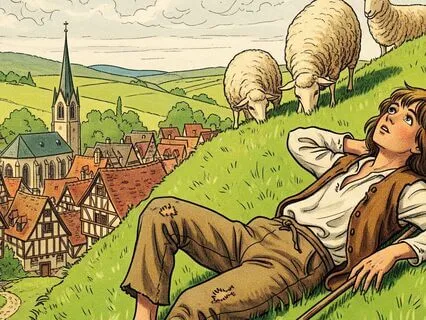
Elias was the son of a shepherd,
And when his father grew older and could no longer climb the hills easily,
The job of watching the flock fell to the boy.
The flock was not large,
About thirty sheep in all,
But they were the pride of the family.
Their soft wool kept the family warm in the winter and provided cloth to trade in the market.
Each morning,
Elias would lead the sheep up the winding path,
Beyond the village,
Past the fields,
Where women bent over rows of green vegetables,
And men worked with plows,
Until he reached the high meadow,
Where the grass grew thick and the air was cool.
It was a peaceful job.
Too peaceful,
Elias thought.
He would sit on a rock and watch the sheep graze,
Their soft bleats mixing with the sound of the wind in the pines.
Sometimes,
He would toss pebbles at the stream to see how big a splash he could make.
Other times,
He would lie on his back and watch clouds drift by,
Imagining castles,
Dragons,
Or great ships sailing across the sky.
But as the days went on,
To Elias,
The quiet began to feel like a heavy blanket,
No one to talk to,
Nothing exciting to see,
Just sheep eating all day long.
The only times the village came alive with shouts and urgency was when a wolf appeared.
Wolves were rare but feared.
They had been known to snatch a lamb or even a grown sheep if the shepherd was careless.
The villagers had an agreement.
If anyone saw a wolf near the flock,
They would shout and cry for help,
And the men would rush up the hill with sticks,
Stones,
And whatever else they could carry to drive the wolf away.
One sunny afternoon,
While Elias was sprawled on his back,
Watching a cloud shaped like a giant fish,
A mischievous thought crept into his mind.
What if,
Just for a little fun,
He pretended there was a wolf?
Imagine the villagers dropping their work,
Running up the hill,
Worried faces turning to relief when they found nothing at all.
Ooh,
It would be a good joke,
He told himself.
Well,
Something to break the endless boredom.
He stood up,
Cupped his hands around his mouth,
And shouted with all the force he could muster.
Wolf!
Wolf!
A wolf is attacking the sheep!
Down in the village,
Heads jerked up.
A blacksmith dropped his hammer.
A baker set down her dough.
The men grabbed staves and hoes.
The women pulled children from the streets.
A crowd charged up the hill,
Led by the village elder himself,
His long walking stick in hand.
Elias leapt up and down,
Pointing toward the trees.
It ran that way,
A huge one.
Its teeth were as long as my hand,
He exclaimed,
Doing his best to sound breathless and frightened.
The villagers searched the meadow,
Peered into the tree line,
And circled the flock.
No wolf,
Not even a paw print.
Then they turned toward Elias.
You saw no wolf at all,
Did you?
Said the elder,
Narrowing his eyes.
Elias grinned.
I just wanted to see you all run.
You should have seen your faces.
Some chuckled,
Others shook their heads in annoyance.
Don't waste our time,
Boy,
The blacksmith said,
Wiping sweat from his brow.
We have work to do.
They went back down the hill,
Muttering,
While Elias sat on his rock again,
Laughing to himself.
It had worked.
It was funny.
The next day passed slowly.
The wind was still,
And the sheep moved like slow clouds across the grass.
Elias's mind wandered again,
And by midday,
He was restless.
The memory of yesterday's prank came to him.
It had been too easy.
Why not try again?
He stood up and cried out once more.
Wolf,
Wolf,
A wolf is after the sheep.
In the village,
The alarm rose again.
People ran,
Grabbing whatever they could find.
This time,
More came,
Convinced that perhaps the boy had not lied the first time,
And the wolf had returned.
When they reached the meadow,
They found Elias doubled over,
Laughing so hard he could barely stand.
You should have seen yourselves.
He said,
Between bursts of laughter,
All red-faced and running like the wind.
Twice in two days.
The elder frowned deeply.
Elias,
This is no jest.
If you keep calling us for nothing,
One day there may be a real wolf,
And no one will come.
The boy only waved his hand dismissively.
Oh,
Come now,
It's just a bit of fun.
The villagers left,
Some grumbling,
Others shaking their heads in disapproval.
And when Elias sat back down,
The meadow seemed even quieter than before.
That evening,
Clouds gathered over the mountains.
By morning,
A cold wind swept through the valley.
The sheep huddled together as the day grew darker,
Though it was only midday.
Elias pulled his cloak tight and kept watch from his rock.
Suddenly,
From the shadows of the pines,
There came a low growl.
Elias's head snapped up.
Two yellow eyes glowed from the darkness.
A huge,
Lean wolf stepped into the open,
Its gray fur bristling,
Teeth bared.
The boy's heart pounded,
His hands shook.
Wolf!
Wolf!
A wolf is attacking the sheep!
He cried,
Louder than he ever had before.
In the village,
A few people heard him,
But they remembered the two false alarms.
Some shook their heads and went back to work.
It's that boy again,
Said the baker,
Kneading her dough.
He'll not fool me a third time.
Up in the meadow,
Elias shouted again,
His voice breaking with fear.
The wolf is approaching the sheep!
The wolf lunged at the flock,
Scattering them in all directions.
The boy grabbed a stick and ran forward,
Waving his arms.
But the wolf was quick.
It snatched a lamb in its jaws and darted back toward the forest.
Only then did a few men from the village,
Having decided to check,
Just in case,
Arrive breathless on the hill.
But it was too late.
The lamb was gone and the rest of the flock was trembling.
The elder looked at Elias,
His face grave.
Let this be your lesson,
Boy.
A liar will not be believed,
Even when he speaks the truth.
Elias hung his head.
The meadow felt colder now.
The air heavy with regret.
He had learned in the hardest way,
That trust,
Once broken,
Is not easily mended.
And from that day forward,
The boy never lied about a wolf or anything else again.
A moral of the story.
Lies may bring short-term amusement,
But they can many times destroy trust.
Once lost,
Trust is hard to win back,
Even when you're telling the truth.
Life can be lived much more happily when one can,
Whenever possible,
Be truthful with others.
THE END