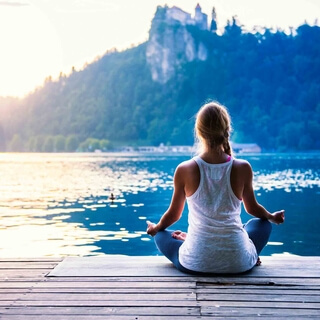
Just preparing for the transmission by relaxing in a quiet space,
Making sure that your technical devices are turned off and that you're just relaxed,
Sitting or lying down and ready for the transmission.
Taking a deep breath,
Just connecting to the body,
Scanning the body and relaxing any tension that may be there,
Present in any part of your body.
As you relax and scan your body,
I just want to communicate a little bit about living in the moment.
It's very misunderstood because what is a moment?
Living in the moment sounds very conceptual,
But in a practical way when you're sitting in meditation,
Living in the moment means being in touch with the flow,
Being in touch with what is really happening beyond just our awareness of thinking or our awareness of feeling.
So every time your mind worries or stresses about a situation,
Then you are actually moving away from the moment or from the flow.
You're getting caught in some part of the flow,
Which is of course thinking,
But forgetting the rest of the flow.
So it's like you're caught in a little aspect of an experience and that is your perception of the experience.
The little aspect is important,
But the greater perception,
The greater awareness,
The big picture,
That's what's really important,
Especially in meditation.
So living in the moment means that you need to just look at what your mind,
What your feelings,
What your physical body are caught up within.
What is pulling your attention away from the flow?
I call this practice presence.
So you're present to all aspects of yourself rather than just what is normal,
And that is thinking or feeling.
And that is a way of expanding awareness,
So as you expand awareness,
You become aware of your experiences.
So your experiences from the past and your experiences that you believe will happen to you in the future.
So as you expand your awareness in this way,
You're actually allowing for a flow that moves you beyond just the limitations that sometimes the mind gets caught up within.
Even though you may notice that as you expand and go deeper into the awareness of everything that's happening,
You may become aware that there are difficulties that you're letting go of.
There are situations that are coming up to the surface that you might find challenging or difficult.
So coming back to a state of presence isn't about everything just flowing in a positive way.
Very often,
The flow means that you become aware of the complexity of your experience.
And many aspects of the complexity come up to the surface and present themselves in a way that sometimes just doesn't help us feel good about ourselves,
Doesn't help us manage the situation in a positive way.
So this is where meditation needs some sort of guidance.
So as you go deeper and open up to the perception of experience,
It's important to be guided by consciousness,
By your intuition,
But also to be guided by someone who has the experience of opening up to the complexity of experience in this way.
And it's always much easier to work with someone,
Connect to someone who understands this state of consciousness,
Rather than try to do everything by yourself.
It's actually in mysticism and in the traditional way of teaching meditation,
It's actually a necessity to learn skills through the experience and through the knowledge that is transmitted by what is known as a teacher,
A spiritual teacher or mystic.
In the same way as very often it's much easier to learn music,
An instrument,
When someone shows you or helps you to understand that the way to come back to what is natural inside of us,
The talent and the learning is your learning,
But it requires a sort of guidance that is lost in today's world because we try to face everything.
We try to face the challenges,
We try to face everything from a very individualistic perspective,
Which isn't really helpful.
But just in case you don't have someone there or you want to do this by yourself,
I've created some tips that help create a guidance that everyone can utilize to move forward into this flow that I call the present moment.
So the first and most important step is to focus on whatever you're doing.
So in meditation this means that you focus not on your thoughts or your feelings.
They're there in the background,
There is a sense of mindfulness that is quite helpful to connect to when all the complexities of experience come up to the surface.
But the focus needs to be connected to one thing.
Now you know this already,
The focus can be either the mantra or the way that you breathe into your body.
These two paths are very well understood by mystics and spiritual teachers as powerful and useful in helping us to really connect to the communication that's happening beyond just the perception of thoughts or perception of feelings.
So this means that we activate the intuitive aspects that very often remain hidden in our personality and in our character in a way that we process information.
So the intuitive is empowered by this focus.
You're focusing on what you're doing.
So you're breathing or you're repeating a mantra.
And the reason you're repeating the mantra is because most of us are repeating a mantra in our brain,
Some sort of mantra that's like a script and not good enough,
That sort of an internal mantra that many people repeat without even knowing.
And repeating a sacred word,
A mantra such as om or amen or love or light or whichever mantra that you've received as a special mantra for the spiritual practice,
This helps you to move beyond the sort of script that is there in the background that the mind is continuously communicating within.
And you may not be aware of this script,
But everyone has this background noise,
I call it,
And it becomes very obvious when the situation is difficult or when you're challenged,
But it's there,
The subconscious is always underneath the level of perception that is obvious.
So it's underneath everything.
So when you speak,
There is internal communication that's happening.
When you think there is an internal communication that's happening.
When you read a book,
You'll notice that there is an internal communication that's happening.
This is one of the easiest ways to understand that when you're reading,
Actually you're reading inside of yourself as well as looking at the book.
And as you listen to what you're reading inside of yourself,
So if you're reading a book and you hear yourself reading the book inside of yourself,
Beyond that,
There is also a dialogue that's happening.
So you're reading and then some part of you says,
Oh,
No,
I don't believe that to be really right,
Or,
Oh,
Gosh,
That's wonderful.
And then there are other dialogues that happen even deeper.
That's the subconscious,
Very difficult to understand,
But it's there and we don't really need to understand it unless you're a philosopher or mystic.
The practice is what's important.
So focusing on whatever you're doing,
This is really very important.
And it allows for communication.
So when you focus on whatever you're doing,
You're helping the communication to be much more in alignment to the flow.
And this means a level of presence that's not normal.
That's not normally practiced by most people.
So it's not about giving your full attention.
You know,
It's not like struggling with your attention and saying,
Okay,
I have to focus on my breath and sort of struggling with your breath and your focus so that there is some sort of connection,
That sort of rigid or struggling attitude doesn't help us at all.
It will just encourage the mind to wonder.
So it's just in the same way.
If you want an example,
To help you understand this,
It's in the same way,
Do you know when you drink a glass of water,
You're very focused,
You're holding the glass,
You may have your thoughts drift into some sort of interesting scenario,
But you're very focused on the glass.
You're not falling asleep.
You're very present to drinking the water and your whole body,
Your whole mind is connecting to that experience.
That's what focus is.
And this is why,
For example,
In Japan,
They have the tea ceremony,
Which was part of the Zen Buddhist tradition.
And drinking was seen as very important,
A moment where you could get more easily in touch with the flow.
And drinking green tea or matcha is seen as a very,
Very special ritual.
And for me,
When you sit and you sense the taste of water,
Or if you're drinking matcha tea,
The taste,
And you're really focused on the sensations and the ritual of drinking,
The experience is totally different than say,
Having one of those drinks that you buy in airports to go,
You know,
One of those drinks,
And you're just quickly drinking before doing whatever else you need to do.
This is the opposite of what I'm talking about.
But still,
You have to be fairly mindful.
Otherwise,
You'll bump into someone or spill or drop or do whatever that creates an obvious communication.
Oh,
You're not really that focused.
You're not going,
You're not moving into the flow.
You're not really present to the moment you are lost in the stress of everything that's happening around you.
So the other thing that I would suggest is to reduce the activities that you're doing.
So multitasking is not a good thing,
Even though many people believe multitasking to be like a super efficient way of doing whatever it is that needs to be done during one's day.
It's not really very good,
Especially when it comes to wanting to move into a natural state of flow or presence.
So reducing the activities,
And the way I do this is by writing down those things that need to be remembered or those things that need to be addressed and creating a list of items that can then be scheduled later for clear focus,
Total focus,
So that really there is an efficiency that happens on a practical level,
But at the same time,
There is an honouring of the present moment,
The flow of the present moment,
So that whatever it is that you're focusing on becomes really that which you're doing rather than trying to multitask and do too many things.
So if you are used to watching TV whilst eating or if you're used to reading a book whilst eating,
Those things are typical of a society that honours multitasking as an efficient way to get many things done all at once,
But that doesn't work with our biology or our psychology.
So it's easy.
Turn off the TV.
Well,
It's not so easy because it creates a sort of tension in the beginning because you're running on adrenaline or running on wanting to keep going and entertaining your mind rather than focusing on the moment and enjoying the sensations.
So it may be difficult.
Many have the phone on,
You know,
Or play around with the phone whilst doing something else and to put that aside,
That's the first step that you can put into practice,
But in meditation,
Usually you're not sitting in meditation and checking your phone and if you are,
Then of course put it aside and know that that is not a good way to go deeper into the flow.
Now you can look at all other aspects in your life and try to see where,
What is capturing your attention and creating this sort of confusion in the mind and switching from one thing to another,
Trying to focus on one thing and then another actually creates a tiredness in the brain because we use up much more energy switching than actually focusing on the things that we're switching from.
So if you're doing two things,
You use up much more energy than say doing those two things in a very focused and in touch way.
The other thing that I would suggest,
And this is why we're here,
Is to actually go a little bit deeper into your meditation and to be mindful,
To scan your body and you can do this now.
So you just scan your body and just connect to different parts of your body and give those parts of your body the space to communicate what is important.
So you're honoring this part of your body.
So say you wake up feeling a little bit tired or a little bit grumpy and place your hand on top of the liver and just give the space for the organ,
The liver to communicate to you.
Now don't expect anything,
Just give it the space like you would if you have a child,
You just give the child the space to talk.
Most of the time it can be about nothing,
But the child then feels honored and acknowledged and nurtured by this sense of presence and your organ will react in the same way when you stop yourself from being so busy and you connect to the organ as you're doing now,
The liver and just listen,
Be present.
Deep breath.
This is an extension of being mindful and looking deeper,
Looking deeper at what is truly going on.
Everything is done in an effortless sort of way.
You're not pushing,
Not trying to understand or trying to force your liver to communicate something profound.
You're just scanning your body,
Looking deeper.
As you look deeper,
Just giving energy to focusing on one thing at a time.
So as you focus on the liver,
You know,
Just be aware that your liver may communicate through sensations,
Through just symbols,
Through feelings that come up.
You may feel good.
You're focusing on the liver and the liver says at last,
You're giving me the space to release energy or the liver may be agitated by the attention that it's getting because it's already in an agitated state.
So just watch.
Don't spend too long focusing on one part of the body.
Understand all your body and know that as you do this,
That you're embracing the spaciousness that is around you.
So the flow,
The flow is the big picture,
The awareness of what's going on beyond just one little thing,
One thought or one feeling.
So as you look deeper,
You're embracing the flow,
You're embracing the awareness that extends beyond yourself into the space that is around you.
This is a wonderful thing because as you do this,
You're connecting,
You're creating unity,
You're creating a sense of connection to the space that's around you that then allows you to be open and receptive to the healing that comes through you,
Through your thoughts,
Through your feelings,
Through your awareness,
Through the stillness that you're creating in your meditation,
Through this sensation of just being part of something much greater than yourself,
The unity that then becomes very fundamentally part of your meditational experience,
Becomes a fundament that you can sort of sink into that helps to stabilize the energies in your body,
Create a sort of equilibrium that becomes obvious throughout your day.
Deep breath as you look deeper in this way,
Knowing that we're all interconnected,
That everything is interconnected.
As you look deeper in this way,
You're just opening to this unity that allows you to just relax into the moment and create a presence of the flow.
Deep breath,
Breathing in,
Breathing out,
Letting go and relaxing.
You may wish to continue in stillness for a few more moments,
Relaxing,
Integrating the experience of unity,
Connecting to the healing forces all around you,
Just enjoying this for a few moments.
Thank you.