Dear friends,
You are very welcome to this meditation where we take a look at the four noble truths which come to us from the Buddha.
First of all,
Make sure you are in a comfortable position.
Your eyes can be opened or closed,
Whatever suits.
If opened,
It might help to avoid distraction if you look down and focus on some object of your choice.
To begin,
I'll explain the formula for this meditation.
First of all,
We will have a short meditation on the breath to help bring us into the present moment.
Then I will explain a little about the Buddha's life.
We move on then to take a look at the four noble truths.
I'll give a short talk about each,
Slowly so that we can better take it in.
And then after each talk,
We'll have a period of quiet reflection.
And finally then,
A closing thought will bring the meditation to an end.
So now,
Let us have a period of quietness to allow ourselves to come into this present moment.
Have you ever been doing one thing but your mind was miles away?
Maybe eating your breakfast and worrying about work,
That sort of thing.
So we want to just calm ourselves and allow our bodies and minds to come into the same place,
This place where we are just now.
So let's take a few deep breaths and notice that we are breathing in.
Breathing in,
I am aware that I am breathing in.
Breathing out,
I am aware that I am breathing out.
Let's take a little while to concentrate on the simple fact of our breathing.
During the next few breaths,
Remind yourself that you are here sitting in this room.
You are not worrying about jobs to be done or bills to be paid.
These things can cross our minds,
That's only natural.
But if that happens,
Don't beat yourself up.
Just say to yourself,
Thanks for the reminder,
I will look after you later.
And then,
Return to the breath.
During the next few breaths,
We pay attention to our bodies.
For example,
You might simply notice the fact that your feet are resting on the floor.
Next,
Pay attention for a moment to your hands and your arms.
Just notice them.
Maybe flex your fingers.
And then,
Really turn your attention to your hands and your arms.
And now,
Notice how when you breathe in,
Your chest rises.
And notice how your chest falls as you breathe out.
Pay attention for a few seconds to your wonderful life-giving breath.
The idea of that little exercise is to help us become aware of our bodies and help us concentrate on the gift of our existence.
It's an amazing thing to be alive.
Awareness helps us to be grateful for this fact.
So now it's time for part two,
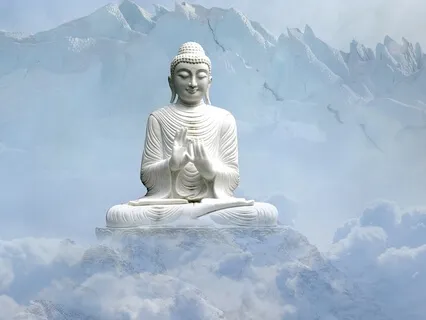
Some information about the Buddha.
I teach suffering,
Its origin,
Cessation and path.
That is all I teach.
This was said by the Buddha 2,
500 years ago.
Most scholars agree that Siddhartha Gautama,
Who became known as the Buddha,
Which means the awakened one,
Was born in 623 BC in the area of Lumbini in southern Nepal.
We are told that Siddhartha was born into a royal family.
Unlike Jesus,
Whom it is said was born in a stable,
We are told Siddhartha was brought up in a palace.
His father wanted his son to be a great king,
And he is said to have shielded him from religious teachings and from any knowledge of human suffering.
But at the age of 29,
Siddhartha went outside the palace,
And he discovered some difficult truths about life that previously had been hidden from him.
He saw someone sick,
And when he inquired what is this,
He was told,
Yes,
Human beings are subject to illness.
We get sick.
That is just the way it is.
Then he saw an old man,
And he was told,
Yes,
We all grow old,
And we grow weak,
And as we get old,
Our body parts begin to wear out.
Finally,
And for the first time in his life,
He saw a dead body,
And Siddhartha was shocked to hear that sooner or later we all die.
He had never been allowed to see a sick or an old person,
Never mind a corpse.
So here was the realization,
We are all subject to illness,
Old age and death.
Later on,
The Buddha would summarize this truth in what is called the Five Remembrances.
The Buddhist monk and peace activist Thich Nhat Hanh translates the Five Remembrances into modern day English in this way.
I am of the nature to grow old.
There is no way to escape growing old.
I am of the nature to have ill health.
There is no way to escape ill health.
I am of the nature to die.
There is no way to escape death.
All that is dear to me and everyone I love are of the nature to change.
There is no way to escape being separated from them.
My actions are my only true belongings.
I cannot escape the consequences of my actions.
My actions are the ground upon which I stand.
So now let us take a few minutes to reflect on the Five Remembrances.
I am of the nature to grow old.
I am of the nature to have ill health.
I am of the nature to die.
All that is dear to me and everyone I love are of the nature to change.
There is no way to escape being separated from them.
I cannot escape the consequences of my actions.
We are told that as well as the sick person,
The old person and the dead body,
Siddhartha saw a monk meditating and he noticed that the monk appeared to be happy even though the monk had no possessions.
This gave Siddhartha the idea that a life of extreme deprivation was the way to overcome what he had seen as the suffering of the world.
So Siddhartha tried a life of extreme deprivation before coming to the conclusion that extreme deprivation was not the solution to the problem.
Then we are told he set off on a retreat determined to deeply reflect on these things until he would come up with a remedy.
And that remedy is expressed in the Four Noble Truths.
1.
The fact that suffering exists.
2.
The origin or cause of our suffering.
3.
The possibility of an end to suffering.
And 4.
The path we might take to lead to the end of suffering.
So next we are going to take a look at each of these with a pause for reflection after each one.
So we look first of all at the First Noble Truth,
The fact that suffering exists.
Suffering comes into our lives in many forms.
The three obvious kinds of suffering are old age,
Sickness and death.
We all grow old.
Sooner or later we all get sick.
And finally,
Although it is hard to believe it in relation to our own selves,
When we look around us we see that everyone finally dies.
So we must figure out that that is likely to happen to us too.
But according to the Buddha,
The problem of suffering goes much deeper than those three hard facts of life.
In the first place,
Life is never really ideal.
It often fails to live up to our expectations.
We human beings are subject to desires and cravings and even when we are able to satisfy those desires,
The satisfaction we experience is only temporary.
We find ourselves on this treadmill thinking that all will be well when I grow up,
When I get through school and college,
Get my own food,
My own place,
Find a partner who loves me when I have children.
We can be lucky and achieve some or even all of these desires,
But how long does the happiness last?
That is the question.
Because when we get something,
Even if it makes us very happy,
We always have the uncomfortable feeling in the back of our minds that we might lose it.
We know that everything changes and we rightly fear that we will lose that something in the end.
I imagine most of us here are not unfortunate enough to be very rich.
I say unfortunate,
That's not a mistake,
Because the very rich need even more to keep them feeling happy and secure.
More accountants,
More lawyers,
More security people,
Bigger houses,
Bigger gates,
More security devices and more possessions so that they can demonstrate their success to their rich circle of friends.
Pleasure and enjoyment are very nice,
But even pleasure doesn't last.
Sometimes it seems to last,
We take it for granted and then it becomes monotonous.
So we get bored and then we seek new enjoyment.
And in any event,
Pleasure is always accompanied by the deep-seated fear and knowledge that it will,
That it must come to an end.
Just think back on some of the good things which people have been lucky to have in say the last 50 or 100 years.
Material things that gave people pleasure for a time and were beyond the wildest dreams of earlier generations.
Radio was a novelty not that long ago and even electric light was new to some people who are still alive today.
Then we had what were called gramophone records,
Big black discs that sat on a turntable and played music.
It was magic.
That changed to cassette tapes.
They were more convenient,
More portable.
Then we had CDs with better sound and thought to be less destructible,
Even indestructible.
And now we have mp3s and digital music.
No hardware at all,
Only software.
So we see that what was a miracle in one generation became a museum piece in the next.
There was a time when very few people had telephones,
Even telephones that plugged into the wall,
Never mind mobile phones.
The first mobile phones were magic machines,
But you needed a small case in which to carry them.
The same happened with television.
Tiny snowy black and white screens,
One or two channels.
Then better black and white screens,
Then colour screens,
But the TV was still deeper from front to back than the screen was wide.
Then bigger screens,
Flat screens,
High definition,
Ultra high definition,
Surround sound.
And now hundreds of channels,
And most of them supported by the advertising of even more things designed to assure us that we will be happy once we buy even the most expensive TV.
And so it goes on and on and on.
So in the absence of deeper meaning,
There is an unsatisfactoriness and a transitoryness about these things that we chase after,
Believing that they are the key to our happiness.
And even when we are not suffering from the big fears,
Illness,
Bereavement,
We remain unfulfilled and unsatisfied.
This dissatisfaction illustrates the reality of suffering,
The first noble truth.
So let's pause for some minutes of undisturbed,
Quiet music to allow us to reflect on these things if we wish.
Or we can just be present,
Using the quiet time,
Whatever way we feel we need just now.
Welcome back.
Now we take a look at the second noble truth,
The origin of suffering.
The Buddha teaches that the root of all our suffering is craving or misplaced desire.
We want things and we want to control things and we want to control the people around us.
We have this wish for possessions and this wish to be in control.
When we are at one place,
We often wish to be somewhere else.
We have the fear of missing out.
When we get what we were searching for or working for,
Then we have a fear of losing it.
So we want good things to remain the same,
But still we want bad things to change for the better.
We want to enjoy good food,
Entertainment,
Happy times.
Yet none of these can give us complete and lasting satisfaction.
After the meal has been eaten,
The beautiful music has been heard and the pleasant company shared,
We are still not content.
We want to enjoy these pleasures over and over again and for as long as possible.
We are like children in a toy shop.
And as we know,
Children are fascinated by all the attractive things they see around them,
Especially in somewhere like a toy shop.
But just like children,
We soon become dissatisfied with what we already have and we wish for something else,
Something bigger or something better.
At times we can hardly eat or sleep until we get what we want.
We imagine and we plan and we save and we borrow,
And yet when we succeed in getting what we want,
We still find that the happiness is short lived.
We worry about the security of our new possessions.
We all know the sinking feeling,
The new car is scratched for the first time or the new gadget breaks down.
Yes,
We were happy for a while,
But now we suffer loss.
The desired object wasn't so good after all.
And besides,
There is a better improved version promised for next year.
So we are immediately discontent with the current version.
Sometimes gadgets that are designed to make life easy only add to our clutter and add the pressures of life even more.
Instead of possessing things,
We find that our things are possessing us.
And now that we have all these new gadgets,
There is the problem of where to put them.
We need a bigger kitchen or even a bigger house.
We find ourselves on a treadmill of searching which can lead to greed,
Jealousy and anger as we try to keep up with the Joneses.
These cravings can cause us suffering and mental and physical harm.
The message of the second noble truth is that the root of all our suffering is craving or misplaced desire.
So now let's pause again for some minutes so we can have an opportunity to reflect on these things.
And again,
If we want,
We can just be present for a rare moment of quietness.
Music Music Music Music Music Welcome back for a look at the Third Noble Truth,
The remedy for suffering.
The Buddha thought that the way to extinguish the desire and craving which causes suffering is to free ourselves from attachment.
He calls this liberation Nirvana and he says it can happen to anybody,
Anywhere,
Even here and now.
And the key to ending all suffering is to remove all desire,
To remove ill will and to overcome our lack of real knowledge.
Thich Nhat Hanh talks about Nirvana in the same way as Christians talk about the Kingdom of God.
He calls this state of mind the Pure Land of the Buddha.
He says we can experience the Pure Land,
The Kingdom of God,
In the here and now,
That it is not something that we are waiting for in some future existence.
So how can we overcome our craving for things and how can we overcome our wish to hold on to what we have?
Here are some ideas.
One,
It helps if we notice the disenchantment that goes with having possessions,
If we can come to realise that they do not bring us lasting happiness.
When we look back over our lives and ask ourselves when have we acquired something that has led to lasting happiness?
In other words,
Just reflect on the disenchantment that goes with having and holding.
The second idea is to try to become aware of the inconsistency of things.
Try to become aware of the inconstancy of things.
We are inclined to place confidence in things and situations as if they are permanent,
But nothing is permanent.
So while we express,
And we should express,
Gratitude for what we have,
We should not become possessive.
What we have,
We have just for now,
And that thought should make us appreciate it even more.
But don't let us be deceived by thinking something is ours forever.
A third suggestion for learning to let go of our habitual craving is to direct our craving to a different object.
An example is this.
We have a craving to smoke a cigarette.
If we can instead set up a desire to have a holiday,
We can overcome one desire and replace it with another.
Just think,
With the money we save by giving up smoking,
We can have a holiday.
Instead of wanting one thing,
We see if we can turn our attention to wanting something else instead.
Now a word of caution is needed here.
This is still wanting.
This is still craving.
But it helps to demonstrate,
It helps to show how we can control our wants and how we can redirect them to a more beneficial object so that,
Through practice,
We can want less overall.
If we can redirect our wanting,
We can stop our wanting.
Another thought is to notice how good we feel when we overcome a craving.
An example would be the success that we feel when we succeed in giving up cigarettes or when we overcome laziness and we take up a fitness plan.
Yet another help is to consider the disproportionate effort that the craving causes.
If we think of the pain caused by our craving,
We would realise very often that it's just not water.
Imagine if you are in a relationship with one person but you have a craving to have an affair with someone else.
Think of the stress,
The lies,
The thought of getting away,
The deceit.
If you think of it mindfully and rationally,
You realise that it makes no sense.
So if we can become aware of the disadvantages,
We realise that an unlawful pleasure is not worth the price.
What is the real price of lust or greed?
How much of our lives has to be put into this seeking?
The price of anything is not the cost in money terms but the amount of the limited time of our lives that has gone into acquiring it.
All this is to help us let go of things.
Changing the habits of a lifetime is not easy.
Not easy at all but it can be done.
But there is no need for worry if we find that difficult.
It's not easy but it is necessary if we are to achieve true happiness and we can work on this one step at a time.
And sometimes when we turn over a new leaf there can be nostalgia for the old ways but we have to try to let go of that nostalgia as well.
So we realise that happiness can be found in an appreciation of the here and the now.
So let's take another few minutes for quiet reflection.
As we come near to the end of our meditation we take a look at the fourth noble truth,
The path to the cessation of suffering.
This final noble truth is the Buddha's remedy for the end of suffering.
It is a set of principles for life which he called the Noble Eightfold Path.
It's also called the Middle Way.
It avoids both indulgence and severe deprivation.
The Buddha tried indulgence and severe deprivation and he found neither of them to be helpful in his own search for enlightenment.
So he gave us the Eightfold Path which is this.
Right understanding.
Right thought.
Right speech.
Right conduct.
Right livelihood.
Right mental attitude or effort.
Right mindfulness.
Right concentration.
These eight principles require a separate period of examination so that we see how they can help us live a happier,
More contented life.
But that will be work for another day.
For now we just remind ourselves that suffering exists,
That there is a cause of suffering and the good news that there is a remedy.
May your suffering be lessened by all the good you do in this amazing existence that we share together.
Let's end with a prayer for humanity.
This was composed by Shantideva,
An Indian Buddhist sage about 700 AD.
It is a prayer that is said each morning by the Dalai Lama.
May I be a guard for those who need protection.
A guide for those on the path.
A boat.
A raft.
A bridge for those who wish to cross the flood.
May I be a lamp in the darkness.
A resting place for the weary.
A healing medicine for all who are sick.
A vase of plenty.
A tree of miracles.
And for the boundless multitudes of living beings,
May I bring sustenance and awakening.
Enduring like the earth and the sky until all beings are freed from sorrow and all are awakened.
Namaste.
Wannabhihim you