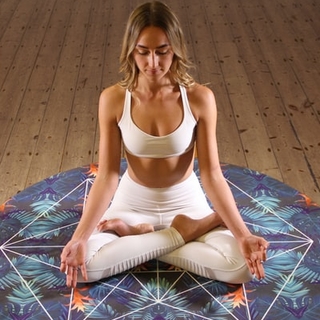
Sitting for a forward bend.
Standing with your legs straight out in front feels restrictive.
Even using your breath it's hard to relax the muscles of the back.
You're reminded of Vanda Scaravelli's dictum,
Never bend without lifting first.
She says,
By activating the hips at the base of your back,
The weight of the body is going to sink down heavily.
From the waist upwards the movement is the opposite,
Giving freedom to the upper part of the body and thereby increasing the opening and expansion of the lungs,
Which will give greater potentiality to the breathing.
So imagine breathing to the back of the body to gradually lighten it.
There is a two-way movement from the ground underneath,
A sense of the sacrum and lower part of the body going down from the waist,
And a sense of the upper body moving away upwards.
Feel the space in your vertebrae,
Especially in your neck.
Use the purchase of the ankles to widen the hips and become aware of the tailbone.
You can place your fingers near the hip joints to feel whether the muscles are releasing there,
Moving them into the space as you inhale,
Or possibly put your hands in prayer position behind to focus attention on the shape of your back.
Take away any intention of bending.
Your spine is still extending,
And you can encourage the vertebrae to keep going up towards your head.
Then on an out-breath,
Pivot at the hips and fold the chest towards the thighs,
Maintaining a collected feeling as the spine moves through a wide skeleton,
The neck feeling long.
As you fold forwards,
The tailbone slides backwards.
The more you are connected to the ground,
The more the upper spine releases.
The head has no ambition to touch the knee.
It is just another vertebra.
Your base is wide and solid,
Supporting a light upper body with a long back.
It's not about keeping your legs straight.
It's about folding from the center.
It's a forward bend.
Your ribs and thighs are moving closer,
But there is a release of muscles giving space around the hip joints.
Release the shoulders as well as the hips,
Keeping them wide.
The more you are connected to the ground,
The more the upper spine releases.
Wherever the hands make contact,
They inform the shoulder blades to slide down towards the waist.
Think upwards,
Not forwards.
Feel the hip sockets free,
Not jammed.
Let the heels feel far away.
Be aware of your breathing,
Creating more space in your hips with each in-breath and moving more into it as you exhale.
When there's no more space to be had,
No more muscles to release,
Come back with your shoulders in the light.
You can try doing it with your back against a wall without any ambition to move far forwards,
Just being aware of the support given to your back by the wall and notice particularly your tailbone and its tendency to slide back as you begin to bend forwards.
Other alternatives are to have one leg outstretched and the other one bent,
Either outwards or upwards or inwards.
So once more on an out-breath,
Pivot at the hips and fold the chest towards the thighs,
Maintaining a collected feeling as the spine moves through a wide skeleton,
The neck feeling long.
As you fold forwards,
The tailbone slides backwards.
The more you're connected to the ground,
The more the upper spine releases.
The head has no ambition to touch the knee.
It's just another vertebra.
Your base is wide and solid,
Supporting a light upper body with a long back.
It's not about keeping your legs straight.
It's about folding from the center.
It's a forward bend.
Your ribs and thighs are moving closer,
But there is a release of muscles giving space around the hip joints.
Release the shoulders as well as the hips,
Keeping them wide.
The more you're connected to the ground,
The more the upper spine releases.
Wherever the hands make contact,
They inform the shoulder blades to slide down towards the waist.
Think upwards,
Not forwards.
Feel the hip sockets,
Free,
Not jammed.
Let the heels feel far away.
Be aware of your breathing,
Creating more space in your hips with each in-breath,
And moving more into it as you exhale.
And when there's no more space to be had,
No more muscles to release,
Come back with your shoulders light.
You could also start with both knees bent upwards.
This allows you to feel the way the lower spine can ease backwards.
You'll find it easy to fold the chest onto the thighs in this position.
Then,
With each breath,
Gradually straighten the legs by moving heels forwards and sitting bones backwards.
You can start from the wrist and the hands.
You can start from anywhere,
But you have to find how it brings you to the spine,
And how the spine releases you back again.
The quality of attention you bring to the practice in each moment prevents it locking itself into a method.
Remember child pose is a kneeling forward bend,
And is a gentle alternative.
Less is more.
Your body may tell you something about letting go that wouldn't be possible for you if you were being more ambitious.