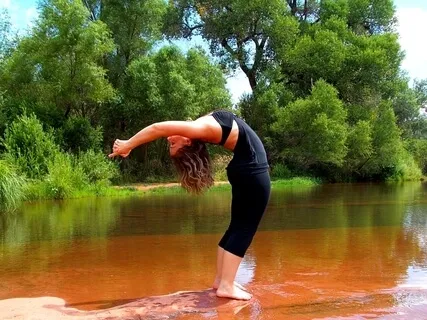
Standing for backbend and warrior one.
Standing a foot away from the wall facing away with your feet hip width apart,
Let the shoulders feel light with the heels growing roots into the ground.
The outer edges of your feet are parallel to each other pointing forwards so that you create some space in the sacroiliac joint and the lower spine can move more freely.
Gravity is pulling the lower half of your body down like sand in an hourglass and the upper half lightens,
A rebound enables uplifting growth into the sky.
Scaravelli says it's like a tree spreading its branches outwards and upwards at the same time.
Your legs feel strong and solid,
Reclaiming space for your internal organs and giving a strong sense of an alert self.
You are aware of the arches in your feet,
Especially across the base of the toes.
If you lift them all up and then put the little toes down and the others one by one towards the big toe with as much space as possible between them,
Your soles seem to cover a wide area.
Your kneecaps are floating,
Your hamstrings released.
Your pelvis is balanced over your ankles,
Not tilting forwards or backwards,
Not doing anything but undoing everything around it.
Let the spine extend and take the weight of the arms and legs as they release away from the shoulders and hips.
Notice that the uplift in the upper body is maintained as on an in-breath,
Space is created by releasing the muscles at the tops of the thighs.
Activating the outer arches of the feet helps you become aware of the tailbone's location.
Feel the spine extend from there to the top of the head.
The little toe gives a connection to the lateral arches of the feet to give a strong base.
Let the heels feel far away.
There are no big surface muscles trying to tense,
The skeleton is supporting all your weight,
No muscles are getting tired and you could be like this for a long time.
This is Tadasana,
The mountain pose.
On an out-breath,
Allow your arms to float up to shoulder height,
Weightlessly like wings.
They don't finish at the shoulder but go all the way to the spine which still supports their weight.
Again,
On an out-breath,
Let the hands float towards the ceiling,
Taking with them the wrists,
The elbows and leaving behind the shoulders.
The rotator cuff muscles are released and the bones in the arms seem to move through a sleeve of muscle.
The more vertical they get,
The less you need to use big surface muscles.
If your neck muscles start to tense,
Just move your head,
Possibly backwards,
To release them.
Move your shoulders to release tension there.
Feel as if you're hanging from your hands and all the weight is dropping down.
If your hands happen to touch the ceiling or a beam,
It's a surprise to find the release of tension possible from this contact.
With each in-breath,
The uplift in your upper body increases and your legs are feeling strong and solid.
You feel the spine extend from the tailbone to the top of the head and between the shoulder blades.
You might feel it take the weight out of the arms as they release away from the shoulders.
With the next out-breath,
Let the heels feel far away and really make contact with the floor.
Feel really tall with the next in-breath as you imagine the breath coming up the front of your body to your forehead.
And you feel as if you're about to dive.
On the next out-breath,
Bend your knees and really feel the contact of your heels as you imagine the breath traveling down there from the back of your lungs.
Your pelvis and belly are over your legs.
Your thighs extend up and not forward.
As gravity takes your weight,
Sinking to the heels,
You rebound and fly up and backwards.
Imagine that you're going backwards over a huge globe.
Each in-breath makes you taller and you're still diving.
Each out-breath takes you back using all your vertebrae,
Not just a few in the lumbar area.
You may find your hands get close to the wall and eventually make contact with it.
Your head may make contact at its sitting bones.
Allow the contact to release all your muscles down the back of your body.
Feel the lightness and uplift coming from roots going deeply into the ground from the heels.
If you start to feel uncomfortable,
The safe way to come out of the pose is to take tiny steps backwards and bend the knees.
Vanderskaravelli describes the themes of this movement very well.
Let the gravity of the earth take hold of your body.
Heels,
And especially the back of the heels,
Are gravitating deeply downwards.
The soles of the feet remain in contact with the ground as if there was glue under them.
The outside of the legs,
From the hips to the little toes,
Turn inwards.
The whole of the legs,
Like two solid columns,
Hold down the lower part of the body from the waist down.
At the same time,
The upper part of the body,
From the waist up,
Is becoming lighter and lighter,
Lifting all the time vertically towards the ceiling.
If you're still feeling comfortable,
Take tiny steps forwards as your hands continue to make contact.
If you're far enough forwards,
You might be able to turn your hands around and allow them to walk down the wall.
Go as far as your body likes.
And then finally,
Step backwards to the wall,
Bend your knees and relax.
And perhaps go into a kneeling forward bend and notice the way you're breathing.
When you feel ready,
Stand in the middle of the room.
And then take a step forward with your right leg and allow the right knee to bend.
Feel your weight balanced in both feet,
But be especially aware of the back heel.
The tailbone keeps moving towards the floor.
Stay aware of your breathing.
And then allow your arms to be like wings,
Not rigid but light,
Supported by the spine through the shoulders.
And allow them to come up,
First to shoulder height,
And then so that the hands face each other.
Allow the front knee to go forwards in the direction of the little toe.
Go as far forwards as your body likes,
So long as you're anchored through your back heel.
Now begin the same extension of the spine as before,
Using all the vertebrae,
As if over the top of a great big globe.
Your gaze may travel up the wall and across the ceiling,
But the head is just an extension of the spine,
Just like another vertebrae.
It's not craning back.
Each in-breath you can still imagine coming up the front of your body,
And you're about to dive.
With each out-breath,
Ground yourself,
Breathe and release,
And go as far as your body likes.
And then come back gently to Tadasana.
When you feel ready again,
Take a step forward with your left leg,
And allow the left knee to bend.
Feel your weight balanced in both feet,
But be especially aware of the back heel.
The tailbone keeps moving towards the floor.
Stay aware of your breathing.
Allow your arms to be like wings,
Not rigid,
But light,
Supported by the spine through the shoulders.
And allow them to come up,
First to shoulder height,
And then up towards the ceiling with the hands facing each other.
Let your left knee go forward towards your little toe.
Go as far forward as your body likes,
So long as you're anchored through your back heel.
And then begin the same extension of the spine as before,
Using all the vertebrae.
With each in-breath,
Imagine you're about to take a dive.
With each out-breath,
Ground yourself,
Breathe and release.
Your gaze may travel up the wall and across the ceiling,
But the head is just an extension of the spine,
Just like another vertebra.
It's not craning back.
Go as far as your body likes,
And finally come back gently to Tadasana.