Chapter 2 When Time Began To become truly mindful about how we spend and invest our time,
It helps if we get an understanding about what time is and where it came from in the first place.
This might sound like scaling a mountain,
Rather than tackling a molehill,
But it is a fundamental undertaking if we truly desire to change our relationship with time.
This chapter might at first sound overly scientific in scope,
So I've done my best to keep it simple and descriptive.
Our astronomers and cosmologists have done the most fabulous detective work.
Over the last few hundred years,
They have identified our place in the universe,
Both in space and time.
As light takes time to traverse the universe,
We can look back in time and see elements of the early universe and work out what it was made from.
The smoking gun of what is thought to be the beginning of space and time,
The Big Bang,
Has even been detected.
The reason this is possible is thought to be that the universe is expanding,
And the speed of light is relatively fixed.
So,
For example,
When we see the Sun,
Which is 93 million miles away,
We see it just over eight minutes late.
The light from the nearest stars gets to us in just over four and a half years after it left.
Given a sensitive enough telescope looking at the right part of the spectrum,
We can now see back over 13 million years ago in time.
This is an amazing achievement for science.
What is also significant,
As you will discover in the fourth quarter of this book,
Is that all time exists at the same time.
As our minds are part of the universe too,
We just have to tune them in to when we want.
This amazing achievement by science has been brought about by using and establishing what they call cosmic yardsticks.
Apparently,
We live on a small rock that we call the Earth,
Which spins on its axis once a day.
Our spaceship Earth revolves around a medium-sized star once in what we call a year.
This star is either a third or fourth generation star.
This means that two or three sets of stars before it have exploded in cataclysmic supernovae.
The remnants of these star deaths have re-coalesced to make our Sun,
Its planets and us.
Yes,
We are literally star dust.
Our star sits on the spiral arm of a galaxy,
About 27,
000 light-years from its centre.
Our galaxy is what we call the Milky Way.
It is around 100,
000 light-years across and contains 400 billion other stars.
And our galaxy is one of billions of other galaxies,
The nearest being Andromeda,
Which is about 2.
5 million light-years away.
The universe is massive.
It's guesstimated that the whole visible universe we see today came from no thing in a big bang about 13 to 14 billion years ago.
That was one hell of a bang,
Which incidentally made no sound at all and had nobody around to hear it.
What's interesting about this model is that we use a local and variable yardstick to measure and help us get our head around it all.
We use the notion of a year.
This is somewhat ludicrous.
As for starters,
Our Earth-years have varied over time as the Earth's orbit has altered.
Secondly,
Go to another planet like Mars,
And years are around double of ours.
Lastly,
Earth-years didn't even exist at all for the majority of the life of the universe.
This is a bit like measuring the height of a tree using a whole load of paper clips of varying sizes.
Apart from it being a little impractical,
You would only be measuring half of the tree anyway by ignoring its root system.
In passing I should mention that the light-year,
The distance that light travels in a year,
Is also a little arbitrary in its use as a cosmic yardstick.
The speed of light changes under gravity and has changed over time as the universe has become less dense.
Referencing and measuring the whole of creation using a local time constant,
Which is not that constant though,
Does allow us at least to get our heads around the enormity of the universe we live in.
Before the first stars formed,
Time as we know it did not exist.
Only when nuclear processes really fired up did the components of the universe have any sense of one event leading to another event.
For a time after the Big Bang,
The universe remained totally dark and had no light at all.
Cosmologists postulate that first light,
As they call it,
Came around 380,
000 years after the Big Bang.
As there was no Earth with no years with which to measure it,
Putting any length of time on that period is somewhat nonsensical and meaningless.
A better way entirely to describe this period is that everything from Big Bang to first light happened at the same time.
During this time or period,
Elementary particles were working out how to form the matter that we are all made from.
When enough of this new matter coalesced,
It expanded greatly and exploded in a burst of light.
Around this time,
The three dimensions of space and one dimension of time were created.
Before then,
There was really no up,
Down or sideways,
And not much of a when either.
As the matter and light streamed out,
They formed the cosmos we see today,
And what is called the backdrop of the space-time continuum over which we experience our lives.
The first generation of stars emerged relatively quickly from this first light and shone brightly.
They formed primarily from hydrogen and helium and only lived a few million years.
They contain none of the heavy elements that we are made from,
Although measuring their life in years is a little academic,
As there were no planets around and time as we know it today still didn't exist for such a star.
While the dimension of time for sure existed,
With no observer or yardsticks to measure it by,
The notion of any passage of time is somewhat academic.
When these stars exploded and made second generation stars,
Some of these stars captured gaseous nearly stars that then rotated around them.
If you were around then on one of these stars,
Only then may have you been able to count the days and years as the planets rotated on their axis and around their foster parent of a star.
Only when this second generation of stars exploded did heavier elements form,
Such as the atoms like silicon and the metals that rocky planets like Earth are made from.
The fourth most abundant element of the universe was also made at this time,
Which is the carbon that life on Earth is based upon.
Incidentally,
The third most abundant element in the universe is oxygen.
These heavier elements then formed into accretion disks around the next generation of stars that looked like a giant pair of fried eggs sandwiched together.
The heavier elements in these disks subsequently coalesced into rocky planets like the Earth.
Gases formed planets like Jupiter and Saturn.
If you were to look down on one of these rotating disks,
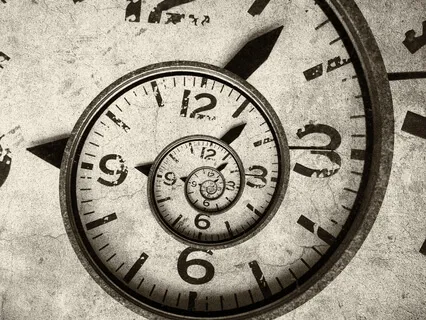
You would have then seen what looks like a large spinning clock face.
The rotating planets had started to mark out time.
It then took about 10 billion Earth years or so after the Big Bang,
Before solar systems like ours with heavy rocky planets formed.
Let's just imagine for a moment that out of all the planets around all the stars in all the galaxies,
Life as we know it took hold on just one planet.
Of course,
This does sound ridiculous if you think about it.
Anyhow,
On good old planet Earth,
A billion years or so after it formed,
Around 3 billion of our years ago,
Something rather magical happened.
Around some super-hot volcanic vents deep at the bottom of the ocean,
Some molecules got clever and learned to replicate themselves.
The successful molecules got their timing right too.
They knew when to replicate and when to die.
Those that chose the most optimum timing thrived.
The ones that were out of time faded away.
The most successful are the conglomerations of molecules,
Then learn when to evolve to more complex life forms.
As sunlight may not have penetrated to these depths of the ocean,
They would have been working to few external temporal references.
I should stress that this part in the model of how life gained a foothold,
As well as the cosmology above,
Is just a model.
I can guarantee that I'll be writing this chapter differently in just a few hundred years from now,
If not sooner.
What this model suggests happened next,
Was that more complex life forms adventured from the bottom of the ocean and towards the surface.
As they did so,
They experienced a new type of clock.
Near the surface,
As the planet rotated,
The light level they experienced would go up and down.
Some life forms started beating to this clock and altered their biochemistry as a result.
The life in the sea regulated the atmosphere,
So life on land could grab a foothold.
The light of the sun regulated planet life from the get-go.
When flowers blossomed,
They opened up to greet the morning sun and tracked it across the sky.
The inclination of the earth gave rise to the seasons and the cycles of growth and decay.
Life on earth followed the ticking of a clock.
Fish,
Back then,
As they do today,
Learned to spawn in time with another timepiece.
They got in tune with the moon.
The moon orbiting the earth and the earth's rotation on its axis and its orbit around the sun kept the clock beating for life on earth for billions of years.
As you will see,
It still does,
But we've largely forgotten about it.
At some point in the development of life on earth,
Some of its inhabitants became self-aware.
These humanoids became our ancestors.
In passing,
It's worth bearing in mind that it's more than likely we're not the only self-aware life forms on the planet,
And one day we might learn to talk to dolphins and whales,
And some species who might surprise us even more.
This amazing ability for some stardust to become self-aware only happened quite recently,
Some millions of years or sun orbits ago,
Which is a blink in the cosmic clock of time.
These self-aware life forms developed language and a set of sounds that correlated to physical objects and internal feelings and senses.
The details of such proto-language haven't been recorded,
But we can imagine they would have sounds for food,
Water,
Sun,
Moon,
Rain,
Happy,
Sad,
Hurt and anger.
By this time,
Such life forms were incredibly complex,
And inside the bodies of these creatures,
And as today,
Lay a myriad of clocks.
These clocks governed cell birth and death,
A clock to beat their heart,
A clock telling them that they were hungry,
A change in biochemistry that informed them they could procreate,
A clock that told them when the time came to die.
In the same way that the nature of time altered the universe as it evolved,
Our personal relationship with time changes over our lifetime.
As for the universe before first light,
Preconception,
The sperm and egg that we are made from,
Have no concept of time.
Everything just was.
When we are in the womb for nine months or so,
We have a relatively timeless existence.
This is rather similar to the experience of time that the first stars would have had.
For the first year or so after birth,
However,
We might disrupt the time clocks of our parents,
While our biological clocks are needing to be fed and changed,
Run riot.
When early humanoids came down from the trees and became farmers,
Ways of counting time became essential to help us both plant and harvest at the optimum times.
Counting of days and moon orbits proved easy.
The inclination of the Earth gave rise to the illusion of constellations of stars coming and going from the night sky.
Along with the position of the sun in the sky,
This allowed humankind to work with the seasons.
At some point the need to measure time during the day must have arisen.
Again,
The sun provided the answer.
As any girl guide and boy scout should know,
In my day at least,
You can make a guess at the time of day by the position of the sun in the sky.
When it is directly overhead,
It will be around midday.
Some enterprising earthling must have noticed that the length and angle of the shadow behind a tree could also be used to mark time.
On cloudless days at least,
Humankind had its first clock.
People noticed that the moon phase changed over a fixed period,
And from that marked out time to months or moons.
Over the course of a year,
They also noticed that the pattern and position of stars at night would repeat across the seasons.
This allowed certain predictions to be made about what was coming.
What is perhaps of more significance is that as this collective self-awareness of time grew,
Enslavement by time also developed.
Humans could count the years,
Which meant they knew how old people were.
As a result,
They can now predict how many years it might be until their demise.
People developed a sense they'd better get a move on.
The clock was ticking.