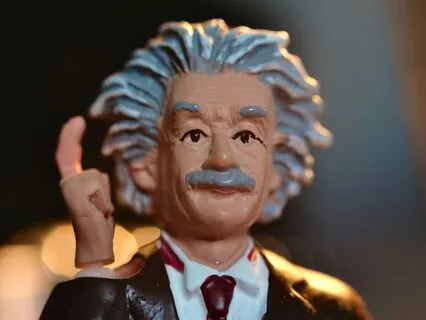
Waking up your inner genius.
Tom,
What do you make of this?
Well,
I think the first thing is that we've all got an inner genius waiting inside of us,
In the same way that everyone's got a book trapped inside of them waiting to come out.
So,
There is stuff that we don't know about bubbling within,
Is that what you mean?
Well,
I think that everybody on the planet has got a unique and amazing talent,
And that might,
It's not always just academic talent,
It might be in sports,
It might be in music,
It might be in art,
And everyone's got a talent.
Now,
A lot of people though,
Because of the pressures of modern life,
This talent is often suppressed,
And sometimes the educational system is not great at bringing it out,
And so we've got a whole millions of people out there that have got this genius just waiting to explode and be released on the world.
So,
You reckon everyone's got a genius,
A piece of genius within them?
Absolutely.
Right,
And many people just aren't allowing themselves to access this in some way.
That's right,
Yeah,
And some of this will be because of pressures of life,
But some of it will be because of fear,
You know,
Some of this fear's built up when we're children,
You know,
Maybe if you had an essay or some poetry you wrote as a child and it had got a bit of a black mark at school,
That might make you worried about exploring your artistic side,
Or if someone laughed at you or something like that,
That might make you suppressed.
And so people sort of,
I've worked a lot with writers where they're very inventive,
Oddly enough,
At not writing,
And if they spent some of that inventiveness focused on the writing as opposed to inventing reasons why they couldn't write and why they're procrastinating,
Amazing things would come from it.
Yeah.
So I guess if once we acknowledge that there are many reasons why people suppress showing up their genius,
And it can be,
I think schooling is a really good example.
I think a lot of people are encouraged in school not to step out of the box or be extraordinary,
But to be similar.
And there's this almost a sausage machine mentality where the similarity is safe,
And to be extraordinary makes you stand out.
My son,
For example,
Is in a school where in his class there's a maths genius,
And he's taught separately,
And he's made fun of,
Actually.
He's a very bright guy.
He got some A-levels very early on and very young.
Yeah,
He has a difficult time.
So that's an example of where being extraordinary doesn't always work in one's favour.
That's very sad,
Isn't it?
I know that I've been looking at schools for my godson recently,
And a lot of schools purport to be very open,
But I think the pressures of modern-day schooling and just pressures on teachers and on pupils actually means that sometimes when you get into the real world they can't be quite as flexible as they'd like to be.
Yeah.
So if we wanted to wake up the inner genius and decide to break the mould and go for it and really examine and explore and pull out the things within that could take us to a place where we're demonstrating our genius,
How would we go about that?
Well,
One of the tools I use,
Which seems to work pretty well all the time,
Is the technique of mind mapping.
And what a mind map does,
You know we've got our left and right brains,
And this education system we're talking about largely favours the left brain.
And the left brain works very predictably.
It sort of handles repetitive tasks for us,
You know,
Like essentially the two-times table or the three-times table or what have you.
And it does need a bit of programming,
And it gets programmed from the right brain.
So the right brain learns something first,
Like learning to drive,
And then it hands it over to the left brain to run so the right brain can start working on the new stuff that's coming in.
What mind maps do is they allow the left brain and the right brain to work in synchronism.
So the left brain says,
Look,
I do the maps around here,
I do the navigation,
I love maps and let me do the map.
And then while the left brain's busy,
The right brain can kind of sneak under its radar and be completely creative.
Right.
So do people not do this as a matter of course,
Use the left-right balance?
I think what's happened is in traditional Western culture,
We've started to favor the left brain.
We find that cultures where the pictogram is used for language tend to have a slight right brain bias.
And it's not that the right brain is better than the left brain,
Because you get a lot of people that are right brain only and they might have their head in the clouds and never get anything done.
And the converse is someone that's very,
Very left brain and has got this amazing attention to detail.
But they chase every single penny,
Let's say,
And then never get anything done because they're always nervous about doing things.
So it's not about left brain or right brain being one being bad or the other being good.
It's about having them both in balance.
And kind of what happens is when you get the left and right brain working together,
You get a situation where one and one makes three.
So by using the mind map,
This triggers more use of the balance of the right and the left.
That's right.
And what other tips for waking up the genius?
Mind mapping is a brilliant example.
What else could we do?
Well,
There's actually something that's a bit more basic than mind mapping.
And it's something we all do to stay alive.
It's called breathing.
Now,
We think of breathing purely in the context of staying alive and bringing oxygen into our bodies.
But it's actually more than that.
If you think about breathing,
Most people don't even realize this,
But we only speak on an out-breath.
Are you aware of that?
Oh,
Okay.
Yeah.
I'm just checking as I'm speaking now.
Just try and speak on an in-breath.
No.
There you go.
Right.
Okay.
Wow.
So we don't speak.
And I had a light bulb moment about this is that the word inspiration is actually,
Inspiration is half the breathing process.
And what I found was is that the ideas tend to come in easier on an in-breath.
And then on an out-breath,
You can then voice them or write them or whatever.
And you find that there's a bit of a flow to ideas.
Now,
What happens?
Most of us breathe very,
Very shallowly.
So we don't even use our diaphragm.
But as soon as you start to use the diaphragm in a better way and breathe like a baby,
So your belly goes up and down,
It seems to generate.
.
.
One,
It oxygenates the brain.
So you get more blood flow into the brain.
So there's more nutrients going into the neurons,
Which should be like your thinking muscle.
But it seems to generate ideas coming in.
And there's one particular breathing technique I teach,
Which is to breathe imagining that the breath is flowing up the back of the spine on the in-breath and down on the inside of the spine on the out-breath.
And that seems to generate ideas.
And ideas seem to pop in to your brain.
And they either pop in through the back of your brain,
The cerebellum,
Or the very top of your brain in the crown,
It seems to be.
And you can always imagine that these ideas are coming from an external source.
And that's a technique that comes up in many different forms through Eastern traditions and mystical traditions with looping the loop and all sorts of different terms from different traditions.
That technique you've described is an extremely powerful one for creating and connecting with the energetics of creativity for lots and lots of reasons.
It's a genius method.
Isn't it great?
Isn't it great how some of the best things that we're finding nowadays are as old as the hills,
If not a little older?
And free.
And free,
Yeah.
And guess what?
By breathing a bit better,
You become a bit healthier.
So how does that link into let's take a walk to get the answer?
I do.
If I've got an issue or a problem,
I'll go for a walk.
And I'll make sure I go out in nature,
Around trees,
Lovely landscape,
And just take the dog off.
And suddenly,
When I come back,
Things feel a lot better.
And often I've got a solution up my sleeve as well.
Yeah,
I totally agree.
And I think that if you're in the creative industry,
Having a couple of dogs is definitely a really good asset for you.
Because it makes you get out every day.
The dogs don't respect the calendar or the weather system.
So you've got to get out there.
So creativity,
A bag of crayons to do your mind mapping,
A couple of dogs to take you for a walk,
And a lot of breathing.
You've got it.
That's a great start.
Yeah.
To answer that original question,
Though,
You're out in fresher air.
So the oxygen is less stale.
As you walk,
What happens is you swing your arms.
And you can actually accentuate this by swinging your arms across the center line.
And what happens is it moves the cerebrospinal fluid from one side of the brain to the other.
So it moves the mind stuff around inside your head.
And it creates this left and right balance,
Which is pretty,
Very important.
And you heard that phrase where I'm in two minds about something.
And that's kind of good because one side of your brain is saying one thing and one side is saying the other.
So you might want to be gung-ho about a great idea you've had.
But then the left brain might say,
Well,
Hang on a minute here.
Let's be a bit cautious.
And what's actually fascinating,
A lot of this stuff's in our collective mythology.
If you look at Tom and Jerry cartoons,
For example,
Where the devil appears on one shoulder and the angel appears on the right,
The devil always appears on the left shoulder,
Which is the sinister side.
Left is sinister in Latin.
And the angel's always on the right saying,
Oh,
Go for it.
And the devil's saying,
No,
No,
You don't want to do that.
I'll do something bad.
And these things are ingrained in our culture,
Which is absolutely fascinating.
Yeah.
Wonderful.
Tom,
Thanks so much for that inspirational idea,
Hot pot,
That we can dip into.
Thank you very much.