I'll offer a few reflections on this path for your consideration.
The first one is that the truth of who we are,
Our true nature,
Or sometimes we say our Buddha nature,
Is not something that we search for.
In fact,
Searching itself can be misguided in the sense that who we are fundamentally is not someone else than that person that's right here,
Right now.
And in fact,
If you start believing that in some way you have to change yourself or improve yourself in order to find your Buddha nature,
Then you can end up actually just suffering.
Papaji,
In the quote I circulated this morning,
Has this great saying which is,
Call off the search.
Call off the search for that person who you think you should be,
Or you think is the person that has Buddha nature because that person is actually you.
That it's right here,
Really,
In the nature of human experience,
In the nature of awareness,
In the fundamental characteristics of what you just might simply call being in the world.
And we all know this actually from birth.
It's not hidden.
And we all know that we change throughout life,
Sometimes quite dramatically,
From being born to growing up,
Going to school,
Working,
Relationships,
Family.
But that essential characteristic of being alive and alert is the same one that you had on the first day that you were born.
I know for myself that I had this experience in college where I was walking by a mirror in my dorm room and suddenly caught a glimpse of myself.
And I thought,
Who is that guy?
He looks like a grown-up.
It's like,
It can't be me.
I'm not a grown-up.
I don't know who that is.
Or more recently,
With some frequency when I'm on a Zoom call and I look at the screen of myself and I say,
Who is that old guy on the screen?
It's obviously not me.
So there's a sense in which obviously everything changes,
But that quality of just aliveness,
Of just being,
Is actually the same throughout all of these experiences.
So it's just simply this awareness,
This alert aliveness that is naturally free,
That you cannot improve upon,
That is who you really are.
Next,
I would say that this truth,
This Buddha nature of who you really are,
Reveals itself to each person either in gradual ways or can be sudden sort of aha moments when you understand this.
I think for me,
Those aha moments are not so much,
At least up to now,
Haven't been very dramatic or earthquake flashes of light,
But just simply this sort of,
Oh yeah,
Kind of sense of,
Oh right,
I get it.
It's so simple.
It's so straightforward.
And that those moments,
Even those aha moments,
Are not something that you can force or feel like,
You know,
Okay,
Today I'm going to have one.
I'm going to get all the way there today.
There's a saying that those sudden realizations can happen only by accident,
And it's in daily practice that you make yourself accident prone.
So all of this also plays out in an individual way for each of us,
Like nobody's story,
Nobody's path is the same.
And I think,
At least for me,
Having read many,
Many meditation books down through the years,
There's always a temptation of reading a book and then,
Or hearing a story from someone and feeling like,
Well,
I want that experience,
Whatever that is.
And sometimes experiences are extraordinary,
So you can even want them even more.
But there is a sense in which this path unfolds for each person in a very organic and natural way that also can't be rushed.
And that each moment on the path is itself where you're supposed to be right now.
Everyone has their own history.
Everyone has their own conditioning.
As Ram Dass,
The author of that famous 1970s spiritual classic,
Be Here Now,
Said,
Everyone has their own curriculum on this path to follow.
So then,
What is required of us,
I guess,
Is the question.
What is required of us?
And one teacher expressed it as two very simple instructions.
One is,
Point in the right direction and keep going.
Point in the right direction and keep going.
So really fundamental,
The most fundamental thing is this intention,
Like this desire,
Which I think is born of attraction or some excitement about this journey itself.
And it's that intention that then guides the entire unfolding process.
There were two researchers who decided to study extremely happy people in the world.
And they wrote a book called Nine Choices of Extremely Happy People.
I think it's still in print.
And if happy doesn't work for you,
You can try fully realized or fulfilled or awakened,
Whatever language works best for you.
So their technique was to go different parts of the world,
Different cultures,
Different languages.
And they would go to,
Let's say,
A village and they would ask around,
Well,
Who's the happiest person in this village?
And often people,
Everybody would agree.
It's like,
Oh,
She's right down here.
So they interviewed these people and they tried to find the characteristics which were similar across cultures.
And they found that remarkably,
The characteristics were very similar across different languages and cultures.
The first characteristic,
Which was most similar,
Was intention,
Was intention about the way that they wanted to direct their life.
And here's a quote from the book.
Unlike most forces in life that are out of our control,
Our intention is fully in our control.
In other words,
We can't always choose our circumstances,
But we can always choose our attitude and our reactions to things around us.
Unfortunately,
In today's world,
Most of us fail to capitalize on that reality and simply stumble from one activity to the next,
All because we are unaware of our intentions.
So just for a moment,
I invite you to pause and you can close your eyes or keep them open,
But just think of a time for yourself when you acted in accord with what you felt was your true self or your best self or your highest aspiration,
What you truly desired to be.
Something that felt right,
Good,
And maybe a time when other calculations would have led you someplace else.
And ask yourself this question,
How did that feel?
Or how does it feel to act from that authentic self?
And you can just feel for a moment into the body and just feel what that sense is.
It might be located around the heart or someplace else.
And just recognize for yourself how that feels.
And I offer this quote from Jonathan Faust.
Have you noticed that the happiest season of your life often correlate to when you maintain a dedicated focus on what matters most to you?
Again,
Have you noticed the happiest seasons of your life often correlate to when you maintain a dedicated focus on what matters most?
And you can come back now.
So I think the question for all of us is then can we identify this intention?
What is this intention for us,
This most important thing?
There's a saying that the most important thing is the most important thing.
And what does that mean?
That means that if you can identify for yourself what the most important thing in your life is,
Then the only thing that you need to do after that is just remember.
Remember,
What is that thing?
And keep reminding yourself.
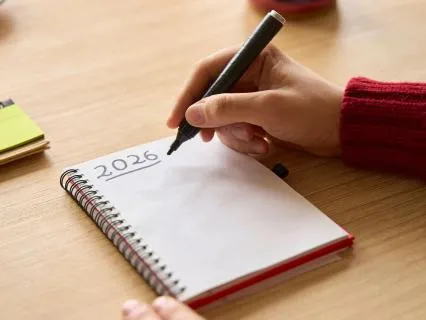
So we'll do one more practice together where we'll look at that intention for yourselves in the year ahead.
So you might just take your pad again and your pen.
And for this exercise,
We'll all choose three words that you would like to guide yourself this year.
Guide your choices,
Guide your actions.
These little guideposts when you're trying to think about something,
A choice you're going to make,
You can just refer back to these.
I've actually done this exercise several years.
And I have a post right by my desk at work with my three words on it.
And so I'll get to glance at them pretty frequently.
So I'll give you a moment.
And what I'd like you to do is start with just jotting down words.
And they shouldn't be a phrase,
Just a word.
They can be noun verbs,
Adverbs,
Adjectives,
Simpler the better.
Don't worry about when you're going to do this first list of words,
Anything about what you're saying that can make no sense to you.
It's just a word that will resonate for this prompt of what are these words,
These three words eventually that will guide us.
But for this first one,
Just you're going to write as many as you can until you don't have any more.
And I did this last time myself.
So here are my words I started with.
I started with love,
Peace,
Equality,
Generosity,
Calm,
Heart,
Giving,
Sadness,
Help,
And hope.
So it's just,
I mean,
Those are not recommended.
Those are just the ones that came to me.
So I'll just give you a minute right now and just write as many of these words as possible to this prompt.
What words will guide me this year?
And you can get started.
Right.
So for the second part of this,
I ask you to select three words.
You're going to select your three words.
And to do this,
You can just look down the list of words as you've just written and just try to pick out the three that most resonate as you read through them again.
You might read through them several times.
For me,
Again,
This is just me last night.
I ended up with peace,
Heart,
Help.
Again,
They don't need to make any sense to you,
But just the ones that really call to you most.
So go ahead and take a moment and see if you can select those three for yourself.
All right.
And having chosen those three words for yourself,
We'll do one last practice together.
So again,
If you just want to find a comfortable way to sit and a way that supports you,
You can keep your words handy and just take a few full,
Deep cleansing breaths.
And from the three that you selected,
Just choose one and let it be your anchor for a moment.
And silently,
You can breathe in with that word.
And with each breath,
You can allow it to expand,
Fill the space.
You can feel that word welcome you,
Embrace you.
Just get a sense of the beauty of that word.
And again,
You can go inside the body.
Just know the sensations or the colors,
The images that arise as you welcome that word with each in-breath.
You can sense where you feel this most strongly in the body.
And just allow it to be as big as it wants to be.
And just feel it filling the space.
And as you slowly open your eyes,
You can look down at your paper and look at the three words together and just,
You can remember them.
You can hold them as your anchor and your guide for this year ahead.
Thank you.