We can begin by gently arriving here.
Just welcoming all that's here.
And this meditation in particular is one that you can do with either eyes open or eyes closed,
Depending on your preference.
You can begin with your posture and just check to see how your body is aligned right now.
You can check up through the alignment of your spine to the top of the head.
You might just feel into a sense of lightness in your head and how it gently rests on top of your spine and just find a place moving back and forth and side to side where you can rest gently there.
And you can feel down into your shoulders,
The space inside your shoulders.
Feel down through the space inside your chest,
Through which the breath passes.
The space down within your abdomen.
Feel the gentle movement with each breath through the abdomen,
Down through the space inside your hips.
And the space down through your legs.
Releaching all the way to the floor and feeling there the contact between the feet and the floor.
Simply relax into this moment without trying to do anything or make anything happen.
Can you simply pause?
Pause and feel what's within the pause.
The space there.
It's a space we don't have to create.
It's open,
Non-judgmental.
And within this pause and this space,
These small gaps that open,
There's a stillness that falls.
Notice that the quiet of meditation is always present.
It's there before you look for it.
Try to improve on it in any way.
Notice the quiet that already exists here.
And you simply open to it.
This deep quiet,
Which is naturally luminous.
It's awake and aware without us doing anything.
And receive the quiet into your body.
Pervade the body.
Extending out to fill what's here.
Let it pervade the mind.
This space that's there exists before we bring any questions or intentions.
You can just let go of conceptualizing or thinking about what meditation is.
Just opening ourselves to this moment.
The quiet immensity within you,
Around you.
Stillness of doing nothing.
Doesn't need words or ideas.
And without concern for what comes next or what it means.
Without any problem to solve.
Without concern for whether this experience will last or not.
Just a space that simply opens to us.
When we pause this moment and let all things just gently rest.
The stillness might come and go.
It's here for a moment and then slips away.
And it appears again.
As we pause.
And even if hidden,
It's still there.
Just quietly abiding.
The smallest gap in experience and the stillness shines.
And what becomes of us in this stillness?
All of us is there without any conflict or dispute.
Still point around which all else is balanced.
All things are aligned.
Simply still.
Ever still.
Balanced.
Simple.
Non harming.
Peace.
Still.
The in breath.
The out breath.
Perhaps getting lost for a moment and then coming back.
Arriving back.
You may feel within this space of warmth that starts to surround your heart.
Surrounding your heart with each in breath and out breath.
Bringing you back to stillness.
And now gently coming back.
Opening your eyes if they've been closed.
And if you feel comfortable,
You can turn your camera on.
It's nice to see you during the talk.
You're comfortable doing that.
I'd like to explore with you in this talk,
How we use effort in our meditation and the experience of effortless mindfulness.
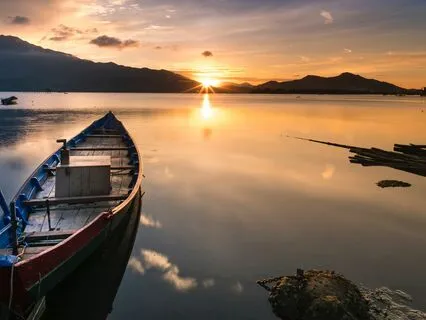
The teacher Gil Fronsdale offers an image of being out on a still lake in the evening.
And sometimes needing to paddle quite vigorously.
And then sometimes just putting the paddle down and allowing the boat or the canoe just to glide on the water.
And in meditation,
Often to hold the attention,
For example,
On the breath,
Requires effort to develop concentration,
To help develop a more unified heart and mind.
Consciously developing this mindfulness muscle within us can require effort to maintain focus on the present moment.
There are also moments in meditation where we can just put the paddle down and just see if we can glide.
And there's also a very sweet moment when we just start to meditate,
Where this marvelous thing happens,
Where we decide to turn our attention to the meditation.
And just at that moment,
There is a pause in our other experience.
And in that small moment,
Even before we start meditating,
There is a kind of a stillness where everything else is quiet for a second,
Without looking for anything or trying to change anything about our experience.
And if you if you start to examine this closely,
You can see that there's this intention to meditate all by itself,
Then helps to kind of turn a corner with the mind and open up this space so that something else can happen.
When we're first learning to meditate,
I think we all then can rush forward with whatever method or technique we have,
For example,
You know,
Attention to the breath,
Or to the body or to sounds,
Or the hard practices,
Knowing that that the thinking mind,
If you give it just an instant,
It will kick in and start to fill the head with all kinds of thoughts and feelings.
And opinions and worries and anxieties and so forth.
So certainly those techniques have an important role to play.
But there's also something about that recognition that it's just simply turning taking that turn or that pause from experience,
That there is this space that opens up all by itself.
And in that space,
There is a kind of stillness.
That in itself can be cultivated.
And when conditions are right,
You can actually drop the techniques themselves and just allow yourself to glide.
And with that,
There's a sense that,
You know,
That stillness is actually the natural state of our mind that is playing in the background all the time.
And with our techniques,
And with our meditation methods,
We're trying to get in touch with during the practice.
And the techniques are,
Of course,
Needed because,
You know,
We all have a shakiness to our heart and mind.
And so there are times where you really have to pick up the paddle and you have to go to work to hold concentration.
You can think of the sky,
And the clouds passing in the sky,
Of all of the experience,
The thoughts in the mind,
And just stop to think,
Well,
What's the sky itself?
What's that spaciousness that's holding all of the experiences,
Including the experience of meditation?
Zen master Dogen suggested that you take the backward step and turn the light inwards.
Take a backward step and turn the light inwards.
In a similar way,
St.
Teresa of Avila describes three stages of prayer.
She likens prayer to irrigating a field or a garden.
And you start by throwing a bucket down the well and hauling up the water,
And then pouring it on the garden,
And then to nourish the plants so you can begin to grow.
And then next,
You learn how to dig a ditch that will divert water from a nearby stream that can regularly flow into the garden when required to nourish the plants with a lot less effort.
And then she describes the last stage is when it begins to rain,
And the plants are nourished without us doing anything.
And so too with meditation,
That the effort that we use often has a place,
But then the question is,
Are there gaps?
Are there places where we can just simply allow it to rain?
And the marvelous thing about this is that if we start to pick up on these moments,
You can just start to see that this gate is actually always open.
And for me,
Sometimes it's only an image that can take me there.
I've noticed this in our,
In our daily five minute meditations that we play Lorelei or Yuan,
Amanda,
Kirsten or others play for us.
And sometimes there's that background image either of some mountains or of a lake,
Or the sound of a stream flowing.
And that itself is a trigger for the relaxation response in before listening to the words of the meditation that suddenly some space opens.
So in this story about the Buddha,
He grew up as a prince,
The life of ease,
Sheltered from really anything that would disturb him.
And one day he asked his charioteer to take him outside the palace walls because he was sort of curious about what's going on there.
And he saw on the side of the road in succession first,
An old person,
A sick person,
And then a corpse.
And each time he asked his charioteer to explain to him what he was seeing and charioteer explained,
Well,
That's old age,
That's sickness,
That's death.
And that's what all humans will experience.
And he was shaken by this,
Because he had lived a very protected life.
And then finally,
He saw a wandering aesthetic or a monk and asked his charioteer,
Well,
Who's,
Who's that?
And he said,
Well,
That's a renunciate,
That's a person who has dedicated himself to spiritual practice.
And that image stirred something within that Buddha.
That's interesting.
I wonder what that's like that possibility of spiritual awakening.
And soon thereafter,
He left the palace on his own on this path of discovery that led to his awakening and then for the next 45 years of his life is teaching others what he had learned.
So you can take this backward step really at any time.
And maybe I'll just provide some pointers about when that might happen.
First,
I would say,
You know,
You can start paying attention to just little gaps in your day,
Wherever they are.
It could be that you're unexpectedly waiting somewhere,
Whether it's at a stoplight or in front of the copy machine or the microwave or what have you,
Or you're waiting for your computer to boot up,
As I had to today.
And instead of feeling that frustration about things being delayed,
You can just welcome that moment and think even for the next 10 seconds,
Can I take that pause and maybe take a breath or two or maybe just turn to feel that stillness that exists when you simply pause for a second from your experience.
Or some people set a timer for,
Let's say,
Ringing a bell every hour.
And when it rings,
Just for that instant,
You take a pause,
A sacred pause in your day.
You don't even have to get into a meditation posture or do anything.
You can keep your eyes open,
Just can remind yourself of that desire to pause and just kind of take that backward step into some stillness.
For the advanced practice,
You can try when tensions are rising in a meeting or when you're having a difficult conversation with someone.
And instead of following your thoughts,
You can just consciously also pause for a second.
And again,
Rest back into that stillness for a moment before responding.
And then for the truly advanced practice,
I've tried this myself,
Is when a whole bunch of people are in a conversation or in a meeting,
And you feel the urgent need to say something and correct your colleagues on an important point.
And you're trying to get into the conversation,
You're not successful.
I've tried waiting for the next person to speak.
And when they're finished,
Pausing before trying to say anything,
And just watching to see what I can hear from that person.
So why don't we conclude by just going back inside for a second.
And you can just for a second,
Go back and feel again what happens when you pause for just a moment without trying to do anything.
Just sensing that stillness that's already there.
Taking that backwards step.
Utterly open and alive to what's happening.
Putting the paddle down for a moment.
Allowing yourself to just hide across the lake.
And concluding with these words from the poet,
Jane Hirshfield.
Only when I'm quiet for a long time and do not speak,
Do the objects of my life draw near.
Again,
Only when I'm quiet for a long time and do not speak,
Do the objects of my life draw near.
On your own time,
I invite you to come back.
You can open your eyes.
You can close your eyes.