Hello,
Sweet friends.
Welcome to today's meditation practice.
My name is Tiffany and I'll be your guide.
Today's practice is all about harmony and balance.
And we're going to be using a method called the anchor.
As usual,
If you haven't done so already,
Make sure you're in something comfy.
Make sure you have any necessary props to keep you comfortable during your practice.
And whenever you're ready,
Meet me on the cushion.
So welcome back to today's meditation on harmony and balance using the anchor method.
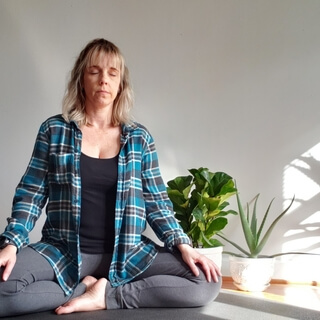
So let's start by coming into a comfortable and seated position.
Or if you prefer,
You can lie down.
If your body tends to get a little achy when it's sitting or lying down for any length of time,
Pause this meditation.
Take a few moments to take care of yourself.
This may look like placing a pillow under the thighs or the head.
Maybe the feet or anywhere else that might need relief.
And this will help the body to stay relaxed,
Making it a little easier to stay in the meditation.
And when you feel settled,
Allow the eyes to close,
Take a couple of deep breaths to encourage the mind and the body to relax also.
Today's practice is about promoting the internal quality of harmony using an anchor meditation,
Sometimes referred to simply as just a breath meditation.
However,
For various reasons,
Not everyone naturally gravitates to their breath as an anchor.
And there is no rule to say that you have to use your breath,
So I'm going to share with you some other options.
We can also use body sensations,
So you might feel some tingling or vibration sensations in the body.
Many often feel this in their hands or their feet,
Or you may feel this in the body as a whole.
This can feel very grounding.
And both of these options can be used as a gateway back to the present moment.
But maybe you're drawn to sounds,
And this too can be an anchor.
Listening with curiosity and openness to all of the different types of sounds or the vibrations within the musical note,
The tones,
The transitions.
Or maybe the sounds are a little more practical.
Maybe an air conditioner,
A dog barking,
Birds chirping.
And it can even be the lack of sounds that you're aware of,
Noticing the silence around you.
So now that we've went over the anchors,
As you're sitting through your meditation,
You may even notice that you're able to hold on to your anchor only but so long.
And then you discover that you're caught in the thinking mind or an emotional wave.
And this is a moment of celebration.
We don't want to use no judgment here.
This is the purpose of the practice,
Training the mind to come back over and over again to our chosen anchor.
This is our gateway to step out of the trance,
As many might call it,
And step back into the space of awareness.
The space of awareness is the anchor in that internal quality of harmony.
So let's begin.
Take your awareness as far outside of yourself as you can attain by listening for sounds far away.
This may be sounds on the street,
The birds chirping,
Music playing in the background.
Maybe it's the weather,
The rain or the thunder.
If it's nighttime,
You may hear the sounds of crickets or passing cars.
Become aware of this experience.
Bring your awareness in a little closer.
Noticing the weight of the body.
Maybe you're noticing any clothing that you might be wearing.
The temperature of the skin.
Any tingles or vibrations,
Maybe in the hands or the feet.
You can systematically allow your awareness to begin at the feet,
Rising up through the body.
Just notice in different areas that might stick out.
Maybe a toe,
A knee,
A belly,
Maybe the ears.
Now allow this awareness to move inward as you begin to notice the breath.
As you notice the breath,
If you have the tendency to try to control the breath,
Maybe taking a couple of breaths here,
Then allowing the breath to breathe naturally.
Noticing where the breath is.
So maybe you notice it in the belly,
The rise and fall of the chest,
The swirling in the back of the throat,
Or maybe the subtlety in and out of the nostrils.
Noticing where the breath is.
And now that we've went over the three most common anchors,
The sounds,
The body,
The breath,
Which did you naturally gravitate to?
So you can't get this wrong.
And some people might even anchor to two.
So you might anchor to the body and the breath.
You might even anchor to the sounds in the body.
It's very common to have two anchors at a time.
With your chosen anchor,
We're going to sit quietly for just a couple of minutes,
Allowing all of our focus to hone in on that anchor of choice.
And if you find the mind wandering,
It's perfectly natural.
The mind's going to wander.
Just allow that awareness to be there,
That the mind has drifted off into thought.
It opens up that space of awareness and gives you that that gateway back to the present moment of either your chosen anchor of sound,
Body,
Breath.
So let's begin that now.
F Where are you at at this moment?
If you found that your mind is drifted off into thoughts,
Just take a few moments to celebrate this awareness,
Opening that space of awareness,
And then coming back to your chosen anchor.
Now go one more time.
Coming back to the breath,
The body,
The sounds over and over.
Again training the mind to come back to harmony and balance no matter what's going on around us.
In just a few moments you're going to hear the sound of the bell.
There's no need to jump up or move quickly out of this meditation.
Just allow yourself to rest in the presence of the sound of the bell.
Stay here for as long as you'd like or you can allow the eyes to open and then when you're ready proceeding on with the rest of your day or evening.