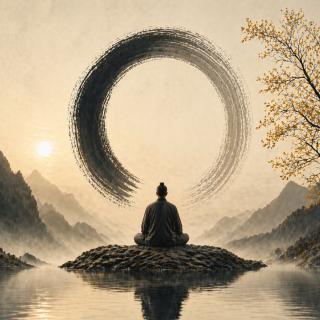
This space is meant to be a space for cultivation and for seeing one's true nature.
In the spirit of that,
We'll begin an examination of Zen koans.
This examination of Zen koans is based off of Yi Wu's book,
The Mind of Chinese Chan.
What's important for us to know in this examination is that we approach a Zen koan in a certain way.
A Zen koan is meant as a public record of a moment of enlightenment.
A Zen koan is an interaction between pupil and master.
When each Zen koan begins,
The master or pupil initiate a special dialogue.
Then the other one recognizes the importance of this moment.
The moment is that of seeing one's true nature.
The pupil may begin by asking a question and then the master understands that this is the moment when the pupil has come to fruition.
The pupil is ready to see his true nature.
Then each enter into this sacred conversation in a way that the master brings forth enlightenment in the pupil.
As we are cultivating a similar space of cultivation here,
We should also approach these in the same manner.
We should approach them in a meditative state.
We should approach them as a moment to find enlightenment.
Now sometimes the pupil may hear the master's words and not achieve enlightenment until much later.
Often the pupil hears the master's words and suddenly sees their true nature.
Our first case we will just briefly introduce and then we will contemplate until next time.
We'll follow this pattern for each of these Zen koans.
In this case,
It's case one,
It's Bodhidharma's vast emptiness.
Emperor Wu of Liang said,
Since I came to the throne,
I have built countless temples,
Copied countless sutras,
And given supplies to countless monks.
Is there any merit in all this?
The master answered,
There is no merit at all.
The emperor asked,
Why is there no merit?
The master replied,
All these are only the small accomplishments of men and gods.
They are causes of an outflow which follows them as the shadow follows the body.
Although the shadow seems to exist,
It is not real.
The emperor asked,
What then is true merit?
The master replied,
True merit is a subtle and complete pure wisdom whose substance is empty and still.
But this kind of merit cannot be pursued according to the ways of the world.
The emperor then asked,
What is the first principle of the sage truth?
The master replied,
Vast emptiness with nothing sage-like in it.
Finally,
The emperor asked,
Who is it before me?
The master answered,
I do not know.
So we'll contemplate on this one until next time.
Thank you.