Last time we introduced the following koan.
Emperor Wu of Liang said,
Since I came to the throne,
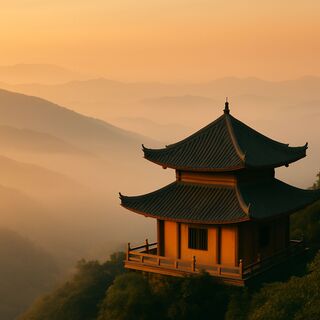
I have built countless temples,
Copied countless sutras,
And given supplies to countless monks.
Is there any merit in all of this?
The master Bodhidharma answered,
There is no merit at all.
The emperor asked,
Why is there no merit?
The master replied,
All these are only the small accomplishments of men and gods.
They are causes of an outflow which follows them as the shadow follows the body.
Although the shadow seems to exist,
It is not real.
The emperor asked,
What then is the true merit?
The master replied,
True merit is a subtle and complete pure wisdom whose substance is empty and still.
But this kind of merit cannot be pursued according to the ways of the world.
The emperor then asked,
What is the first principle of the sage truth?
The master replied,
Vast emptiness with nothing sage-like in it.
Finally,
The emperor asked,
Who is it before me?
The master answered,
I do not know.
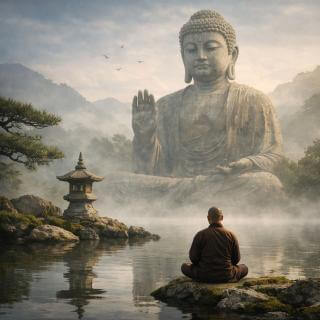
Bodhidharma was the first patriarch of Zen or Chinese or Chan Buddhism.
He came from India.
When he came from India,
He had such a reputation that he was destined to meet with the emperor.
And the emperor had such a curiosity for Buddhism and such an acute mind for Buddhism that he also wanted to meet with Bodhidharma.
We see in the very beginning of this koan that the emperor has a great desire to do well,
To have his mind reach a high level,
To accomplish merit according to Buddhism.
He speaks about how he's built countless temples and whatnot.
And this shows that he's making a great effort.
But Bodhidharma knows this is a huge trap,
That if the emperor identifies with these efforts and merits and with his power as an emperor and all his so-called good deeds,
His mind will be stuck on that.
His mind will not be allowed to be free.
His mind will not be able to empty to see its true nature.
So he replies to the emperor,
There is no merit at all in these deeds.
Of course,
The emperor answers in a logical,
Reasonable way of words.
Why is there no merit?
The master replies,
All these are only the accomplishments of men and causes.
We've heard their outflow.
This means that he's actually maybe potentially losing energy,
Putting effort into all these things that are not helping him to see his true mind.
Now we see that the dialogue is deepening.
This is an example of a Zen koan.
We're not quite there yet.
This is a reasonable,
Logical,
Typical type of conversation so far.
So then the emperor asked in a typical,
Logical,
Reasonable way,
What then is the true merit?
Then Bodhidharma also replies in such a way,
True merit is a subtle and complete pure wisdom whose substance is empty and still.
But this kind of merit cannot be pursued according to the ways of the world.
Now the dialogue is deepening.
Not be pursued according to the ways of the world.
Now we see we're looking at something completely different.
This is the unique characteristic of Zen Buddhism.
What will happen next?
The emperor realizes that the conversation is deepening.
He asks a very deep question.
What is the first principle of sage truth?
Now we're getting to it.
Now we're going to the terrain of Zen Buddhism.
Now the master replies,
Vast emptiness with nothing sage-like in it.
He replies this way to help the emperor completely empty his mind,
To let all attachments fall away.
When all attachments fall away,
This is the moment when Zen can come,
When sudden enlightenment can come.
Now the emperor,
Who has a deep understanding,
Who has talent,
Who has ability to see this kind of enlightenment,
Asks a very deep question and thinks he's going to entrap Bodhidharma.
If all of this is non-attachment,
If everything is emptiness,
The emperor then asks,
Well,
Who is it before me?
The master Bodhidharma doesn't fall for this trap.
The master Bodhidharma understands this is a moment for the emperor to become enlightened.
The master Bodhidharma replies,
I do not know.
This moment shows that even the highest level monk,
Even the highest level emperor need to have complete emptiness in their mind before they can achieve sudden enlightenment.
Bodhidharma does not attach to his identity.
He encourages the emperor to not attach to his identity.
He encourages the emperor to become completely empty for the true nature of his mind to arise.
Now we will introduce the koan for next week.
The next in this series.
This is number two.
Hui Ke says to Bodhidharma,
My mind is not at peace.
Would you please put it to rest?
Bodhidharma answered,
If you bring me your mind and show it to me,
I will put it to rest for you.
Hui Ke replied,
I have searched for my mind,
But I have been unable to find it.
Bodhidharma said,
I have put your mind to rest.
Contemplate on this koan for next time.