The Five Pillars of Islam These are the foundation of Muslim life and Muslims are required to observe them with utmost devotion.
Just like a building lacks stability without strong pillars,
A believer's relationship with God lacks focus without observance of the Five Pillars.
These pillars form the foundation and starting point for all other good deeds and acts of worship to God.
So here are the five pillars.
Pillar number one.
Belief in the oneness of God and the finality of the prophethood of Muhammad peace be upon him.
Second pillar.
Establishment of the five daily prayers.
Pillar number three.
Charity.
Pillar number four.
Self-purification through fasting in the month of Ramadan.
Pillar number five.
The pilgrimage to Mecca for those who are able to do so.
So let's take every pillar one by one.
Pillar number one.
The declaration of faith or Shahada.
I'm going to recite it to you in Arabic language and then I'm going to translate the meaning of it.
أشهد أن لا إله إلا الله وأشهد أن محمداً رسول الله There is none worthy of worship except God Almighty and Muhammad is the last and final messenger of God.
This declaration of faith is called the Shahada.
A simple formula that all the faithful pronounce.
The significance of this declaration is the belief that there is no one worthy of our worship or our pray except our own creator God Almighty and we believe that Prophet Muhammad is his last and final messenger of God.
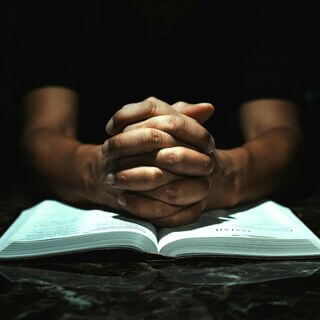
Second pillar is prayer or Salah.
Muslims were commanded to pray five times a day and prayer is a direct link between the worshipper and his or her creator God Almighty.
There is no mediator or interceder or priest in Islam.
Prayers are led by a learned person who knows the Quran or part of the Quran and is generally chosen by the congregation.
Prayers are said at dawn,
Midday,
Late afternoon,
Sunset and nightfall.
This is like a meeting or an appointment with your creator at different times of the day.
These five prescribed prayers contain verses from the Quran and are said in Arabic language,
The language of the revelation and through this both the Quran and Arabic language was preserved because millions and millions of people memorized the Quran from cover to cover.
Personal supplications however can be offered in one's own language and at any time.
Although it is preferable to worship together in a mosque,
A Muslim may pray almost anywhere as long as it's a clean place such as fields,
Offices,
Factories,
Universities,
On a plane or in a car.
Pillar number three.
Obligatory charity or zakah.
An important principle of Islam is that everything belongs to God and that wealth is therefore held by human beings in trust.
The word zakah means both purification and growth.
Our possessions are purified by setting aside a portion for those in need and for the society in general.
Each Muslim calculates his or her own obligatory charity individually.
This involves the annual payment of 2.
5% of one's capital.
An individual may also give as much as he or she pleases as voluntary charity and thus so preferably in secret.
Such charity is not limited to financial giving.
The Prophet peace be upon him said,
Even meeting your brother with a cheerful face is an act of charity.
He also said,
Charity is a necessity for every Muslim.
He was asked,
What if a person has nothing to give?
The Prophet peace be upon him replied,
He should work with his own hands for his benefit and then give something out of such earnings in charity.
Pillar number four.
Fasting.
Every year in the month of Ramadan,
All Muslims fast from dawn until sundown,
Abstaining from food,
Drink and sexual relations with their spouses.
Those who are sick,
Elderly or on a journey and women who are menstruating,
Pregnant or nursing are permitted to break the fast and make up an equal number of days later in the year if they are healthy and able to do so.
Children begin to fast and observe prayers from poverty,
Although a lot of them may start earlier.
Although fasting is beneficial to our health,
It is mainly a method of self-purification and self-restraint.
By cutting oneself from worldly comforts,
Even for a short time,
A fasting person focuses on his or her purpose in life by constantly being aware of the presence of God.
God states in the Quran,
O you who believe,
Fasting is prescribed for you as it was prescribed to those before you that you may learn self-restraint.
So here we have the real meaning why the fasting was prescribed for us is to learn self-control,
Self-restraint and also it states that this is not new to Muslims.
Fasting was prescribed to Jews,
Christians and other nations before us,
Before Islam.
5.
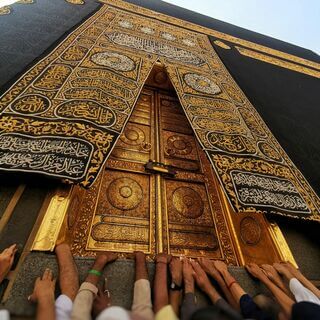
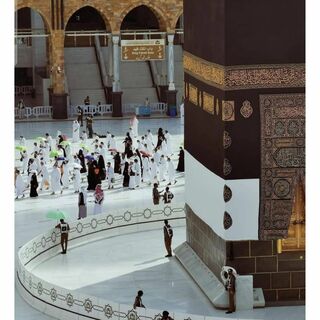
Pilgrimage or Hajj The pilgrimage to Mecca is an obligation only for those who are physically and financially able to do so.
Nevertheless,
Over 2 million people go to Mecca each year from every corner of the globe,
Providing a unique opportunity for those of different nations to meet one another.
The annual Hajj begins in the 12th month of the Islamic lunar calendar.
Pilgrims wear special clothes,
Simple garments that stripped away distinctions of class and culture so that all stand equal before God.
The rite of Hajj was originated by Abraham and the house of worship,
Kaba in Mecca,
Was built by Abraham and his son Ishmael for the sole purpose of worshipping one God.
The clothes of Hajj is marked by a festival called the Eid of Adha,
Which is celebrated with prayers and the exchange of gifts in Muslim communities everywhere.
Eid al-Adha or the festival of the sacrifice also goes back to Abraham when he was asked to sacrifice his own son but God sent instead Ram and Ram was sacrificed.
As you can see,
Islam has many similarities with other Abrahamic faiths like Judaism and Christianity.
I would love to hear from you and let us know what is the foremost important pillar in Islam.
In the next lessons,
We will look into each pillar individually.
Make sure to check them out as I explain every pillar in more details.