Alright,
Welcome.
Thanks for joining me on this meditation.
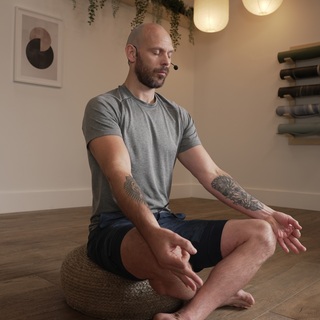
Once you get comfortable into a seat of your choosing,
It can be seated,
You can even lay down if you so need,
Whatever you fancy.
Begin to breathe in and out through your nostrils and just start to feel settled in.
So while you're taking your time there,
Just get nice and relaxed,
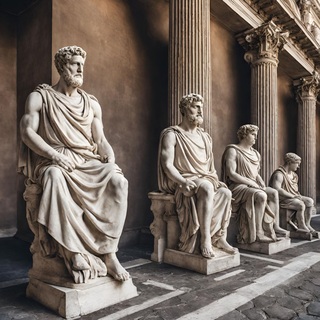
I'm going to tell you a story and I'll start with a quote of probably the most famous Stoic slave.
This was of course,
Epictetus.
He writes,
Don't let the force of an impression when it first hits you,
Knock you off your feet.
Just say to it,
Hold on a moment,
Let me see who you are and what you represent.
Let me put you to the test.
What he's speaking about here is our capacity to not simply react to things,
To instead take a moment to examine an experience,
A sensation,
An emotion or even a thought.
Now Epictetus knew all about making choices because he had so few.
Epictetus was a slave so he did not enjoy many of the freedoms that me and you now have or rather even those that were his fellow citizens had.
He was constricted in many ways.
So he doubled down on the freedoms that he did have left and by doing so,
He liberated his mind and that's what we're going to focus on together now.
So to start,
Let's do it with the breath.
Let's put that breath to the test.
Breathing in,
Easy right?
But let's take this a level deeper.
What is this sensation like?
Is it relaxing?
Is it easy?
Is it a little bit unusual?
Is it hard?
Furthermore,
Where do you feel it?
Mostly in your nose,
Maybe it's your throat,
Perhaps it's your belly.
Now start to realize what happens when you focus on your breath,
When you start to watch it,
When you start to put it to the test.
Does the amount of time it takes to breathe in and breathe out change at all?
Does it slow the whole function down?
Were you even aware of the sensations that come with breathing before this moment?
One part in particular I want you to focus on is this gap between the inhale and the exhale.
Almost like when you throw a ball up in the air.
You know how it hovers just for a moment before it comes back down.
It's almost like the ball is deciding it's going to come down.
There's this perfect moment of weightlessness.
Can you build in that pause into your breath now?
Making sure there's this lovely gap between inhale and exhale and exhale and inhale.
Just finding a little bit of space.
Let's move to the body now.
As you sit there,
There may well be a desire to fidget,
To move about,
To fix your hair.
Well,
Not in my case,
Of course,
But those of you lucky enough to have hair.
Maybe you want to scratch an itch that just keeps coming up.
Maybe you didn't and now that I've said there may be an itch,
You have one,
But just hold on a moment.
Before you do,
Can we put it to the test?
What happens when you don't just react and instead watch it?
What does that piece of hair in your face really feel like?
How is it that your body generates the sensation?
Where do you feel it?
Is it in the skin?
Is it deeper than that?
What the heck is that itch anyway?
As you get curious about your own sensation,
About your own experience,
Not only are you making the whole process higher resolution,
But you may find the sensations themselves go away.
So whether it's a desire to fidget,
Whether it's to fix your hair,
Whether it's to scratch an itch,
Can you just watch it for a moment before you react?
Can you find the space between stimulus and response in the same way you found a space between your inhale and your exhale?
And after you find that space,
If you still need a scratch,
Then go ahead.
I'm just asking you to play with finding that space.
Now the next level up from this is your thoughts.
So inevitably a thought will begin to develop in your mind.
Instead of shunning it or focusing on the breath or trying to push that thought out,
To start with,
I just want you to put it to the test.
What the heck is a thought?
Where do you see it?
How do you see it?
Did you choose this thought or did it come to your mind randomly?
Can you feel this thought?
You may begin to realize that thoughts are continually generated by our mind.
Just in the same way the lungs want to breathe,
The mind wants to think.
Sometimes these thoughts are automated and sometimes they are consciously chosen.
But they are generated by the mind continually.
But here's the thing,
A thought is not a fact,
It's just a thought.
And yet we let these puffs of random consciousness often dictate our lives.
We treat them like facts,
Like visions of the future or accurate depictions of the past.
Epictetus tells us whenever we experience something that causes us to suffer,
There's a good chance that we are suffering not because of the thing but because of how we perceive it.
So what we're doing here is deconstructing these thoughts.
So just as before we use that gap between inhale and exhale and then that gap between stimulus and response.
Can we use that same gap from a thought coming into our mind to us reacting to that thought?
Can we give ourselves space in that moment?
Now that we recognize what a thought is and that we have space before we need to react to the thought,
Well let's test it a little bit further.
Is it a thought you want to have?
Is it a useful thought?
Does it represent who you want to be?
And if not,
Can you choose to let it go?
Can you use that next exhale to let it dissipate out your body along with the carbon dioxide that you don't need?
As Epictetus writes,
When we blather about trivial things,
We ourselves become trivial for our attention gets taken up by trivialities.
You become what you give attention to.
He later writes,
If you want to be beautiful,
Well have beautiful thoughts.
The stoic slave recognized that even when his body belonged to someone else,
His mind was free.
He could not be compelled to think anything.
Epictetus tells that we are free in our opinion,
Our pursuit,
Our desire,
Our aversion and in a word,
Whatever our own actions,
But we are only free when we exercise this freedom.
So exercise your freedom by finding this pause before you react,
By putting things to the test like finding that gap in your breath.
Now in this instance of course we can't always control what thoughts come in,
But we do control what thoughts we give residence to in our mind.
And just like anything else,
The more we practice,
The better we get.
So for the next few moments,
Practice giving yourself space,
Whether it's in the breath between the inhale and the exhale and the exhale and the inhale,
Whether it's in not reacting straight away to a sensation that you feel,
Or by recognizing what thoughts you're having,
Putting them to the test and only choosing those that serve you.
Alright,
Great job.
So to sum up,
Epictetus tells us to put every sensation and thought to the test.
By doing so you can give yourself space between stimulus and response.
Then think as Epictetus tells us,
First say to yourself what you would be and then do what you have to do.
Each action we take is in our control and each action moves us closer or further from our ideal self.
Choose wisely,
Use the space that you have.
Namaste.