My Six So Today and tomorrow we're going to be learning about two new aspects of the technique that carry us all the way through the technique.
Awareness and equanimity,
The two pillars of the passion.
All the way from the beginning to the end we'll be practicing these so it's important to become familiar with them.
And today in particular we're going to learn how to go into heightened awareness.
Very simple trick that we can continue to use throughout the practice and we will.
That will make us more and more sensitive,
More and more aware of everything going on in the body.
Tomorrow we'll learn about equanimity.
But first let's be clear about what we were practicing yesterday,
Why we're practicing and how useful it is for us.
Mastering the mind is the most useful thing that we're going to learn on this course.
If we don't do that then everything else we learn is going to be on shaky foundations.
If we start to practice deeper layers of meditation and we're still at effect then we have the possibility of being thrown off balance.
We have the possibility of feeling threatened by experiences that could come our way.
Subtle experiences to do with energies and other higher states of consciousness that naturally start to get accessed as you meditate.
And more mundane experiences,
Things that we face in regular life that we feel threatened by.
And as we work on our awareness we're naturally going to start to feel more.
And so the field of what we could be threatened by becomes wider.
So the only way that any of this can become dangerous and threatening to a practitioner is if we don't learn that first skill.
To be at cause.
To win that initial tussle over our mind.
The first day is difficult,
Exactly for that reason,
But for a couple of others too.
It's the first day that we're doing a long period of meditation unless you've been in a practice before this.
And so naturally the body starts to ache,
The mind starts to struggle.
Also because we're tapping into our unconscious patterns and we're starting to feel this cycle of unconscious activity and bringing our consciousness to it naturally creates a bit of friction.
But the main reason is because the nature of the practice is one of brute force.
That's why the first day is the most difficult.
Because it takes a victory of consciousness over unconsciousness to be able to move forward.
After this things become a bit more cooperative.
But that initial battle does need to be won.
Because we need to know that if we're going to make a choice to do something we can do it.
Otherwise we can't apply our mind to anything consistently.
So if you feel like this first skill hasn't fully been integrated or learnt it's the most important thing to do for the entirety of this course.
Because if we can walk away from this being entirely at cause,
Being free,
Then that's enough.
Because from there we can choose to do anything else that we want to do.
That's the foundation that we want to build.
Whereas if we're not free,
If we don't have choice,
Then regardless of what wonderful things we might learn,
What amazing experiences we might have,
We're always going to be victims.
Because we don't have creative control over what we're doing with our lives.
That's the first transition we want to make.
So regardless of whatever else I might talk about on this course,
That's the most important thing to go back to.
And if you feel you haven't fully integrated that,
Then just practice that.
Like I said,
Some monks practice anapana for their whole lives.
And then some 80,
90 year old monks who still just sit and practice anapana.
And still just work against that unconscious conditioning and work towards that bright mind.
That bright,
Clear,
Happy mind.
And when you get there,
It's a beautiful thing.
I can understand why people stick with the practice.
Because once it's no longer a struggle and a tussle,
It becomes a beautiful,
Peaceful perch for you to enter.
We can get continually more and more observed,
Absorbed into your breath,
Into the light that comes from it.
We talked about starving the body of its complexes.
The Buddha called them sankaras,
Mental formations.
So how do we starve a complex?
We take its food away.
And what we're doing with that first practice and why it feels like such a struggle is because the complexes want to stay alive.
They want to be fed.
So they'll produce resistance to us removing their food.
Their food is our awareness.
So if we're moving our awareness towards our unconscious habit patterns,
We're continuing to keep them alive.
We're feeding them.
So all we need to do to starve them is move our awareness away from them.
And that's what we're doing by being fixated on the breath.
Move our awareness to the breath.
We're entirely feeling the breath.
And our awareness can no longer be feeding those parasites.
Any one of them may seem easy to deal with.
They seem manageable.
Maybe it's little songs we like to sing ourselves.
Maybe it's a little bit of reactivity to people making noise outside the hall.
They don't seem like big things.
They seem like things that we can let lie.
But the volume of them on mass is draining us of our energy.
And we need that energy.
And we need that control if we're going to choose to do something with ourselves.
If we're going to choose to go deeper into meditation.
Last time I was teaching one of these courses,
A sparrow hit my window while I was eating breakfast.
I got momentarily knocked out.
I went to check on it.
It was waking up and it was fine.
And then a few minutes later,
I went to check on it again.
And it was covered by ants.
It was surrounded by about 200 ants.
And it had about 100 of them on top of it.
It looked like it had a second layer of skin,
Moving skin.
Any one of those ants was too small to have any effect on that sparrow.
But the sheer volume of ants that were covering it was going to take it down.
And even though now it started to recover,
It couldn't shake them off.
It was trying to.
But there was too many of them on top of it.
So I shook the sparrow and I put it on my shoe,
Gave it a bit of sunlight and let it shake off the last few of the ants.
And then it flew away,
Happy and healthy.
And that's all we're doing here.
We're starting to feel the massive parasites that we've let cover us.
And we're learning how to shake them off,
Slowly shake them off so that we can be free too.
And we can choose what to do.
It's good to take that seriously.
Because it's easy to let the mind continue to move to lots of different areas and to think it doesn't matter.
The more we can draw our focus back to the breath,
The more we starve out these parasites.
And we can experience,
Maybe for the first time,
What it's like to have a clear and sharp and active mind,
Not a reactive mind.
That's why the four postures are so important.
Yesterday we practiced laying meditation and throughout the course we're going to practice all of the four postures.
Standing,
Walking,
Seated,
Laying.
Because throughout the day we transition through these postures.
And as we transition through them,
The nature of our sensations,
The nature of our distractions change.
So we need to learn to be able to bring our consciousness to all those situations.
Laying down,
It's very easy to fall asleep.
It's also very easy to lay there and be frustrated that we're not falling asleep.
So then meditating becomes a useful thing while we're in that state.
Keeping our awareness,
Keeping our consciousness active.
And then maybe you'll find that you can carry that consciousness into sleep,
Into the dream state.
And you can actually have an unbroken consciousness that allows you to be more rested regardless of the sleep that you get.
We want to blur the boundary between when we're sitting here practicing and when we're living because the two things are the same thing.
We emphasize coming into the hall and focusing because that is when we're entirely practicing.
But the principles for practice here are exactly the same as the principles for practice out there.
If we're able to maintain focus here,
Keep our awareness on our breath,
But the moment that we go outside we get distracted by all the different things happening.
We get thrown off balance.
Then we haven't correctly trained ourselves.
We've drawn too hard a line between the inside and the outside,
Between our practice space and the real world.
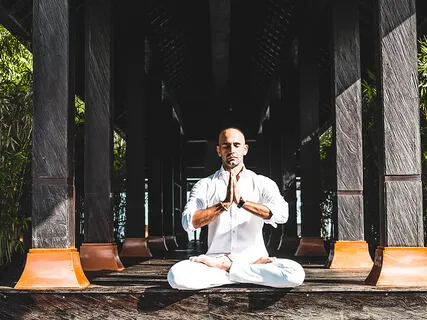
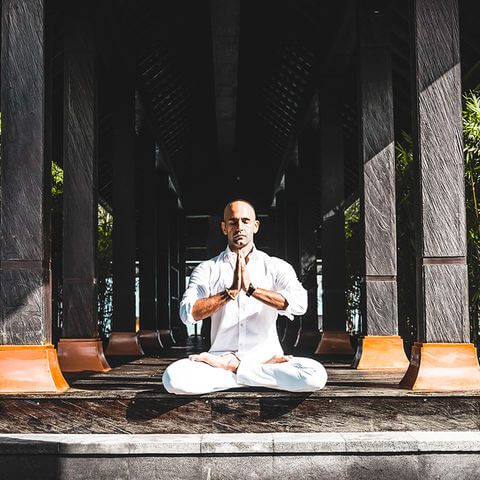
It's one of the reasons why I built the meditation center like this is because I wanted the world to bleed into the practice space,
To have an open hall.
Those of you listening at home,
There is an open space behind us with a cliff face and a swimming pool where people are regularly jumping in,
Distracting us,
And a spa and a fireplace where people are sitting around talking.
This isn't by accident.
I've spent a lot of time meditating in rooms alone or rooms with silent people where there are no distractions except for the internal ones.
It's a wonderful way to practice,
But at some point we need to choose to be able to take our practice everywhere and to acknowledge the fact that everything that we experience is part of our practice,
Including people jumping in the swimming pool so that we can focus throughout all of this.
There was a wonderful teacher called Daisets Tataro Suzuki who's one of the key figures of bringing Zen to the West and he gave lectures about it.
He said,
One of the things that was missed initially when Zen came to the West was the difference between the way that the Japanese approach Zen and the rest of the world approach Zen,
The Western world approach it.
And he said a good example of this is the Japanese garden versus the Western garden.
The Western garden is separated from the house by a wall,
Usually a brick wall.
So there's the garden and I'm in my house and I'm looking at it through my window or through my door.
They're two separate entities.
You have to go through a barrier to get to the garden and when you're in it you're not in the house.
When you're in the house you're not in the garden.
Whereas a traditional Japanese house has a whole wall that you remove away so that the house opens up and slowly bleeds into the garden and the garden slowly bleeds into the house.
And you can hardly see where one begins and the other ends.
There's a patio space.
There's plants.
There are stones.
And then suddenly you're in the house and there are similar materials between the two.
And he said this is the way that traditional Zen is approached.
As something where the two bleed over and there's no start or beginning of one to the other.
They're naturally connected.
We're not in Japan and this isn't a Zen monastery.
And I feel the same about this,
That this being open here behind us,
In front of us,
Gives us a chance to allow the practice to bleed over into life and life to bleed over into the practice.
So we have a chance to see what we're triggered by while we're sitting here and to be able to feel the reality of how we're going to react when we face distractions.
As opposed to having an artificial idea of what our practice is like when we lock ourselves up in a room alone and we sit there like good little meditators and then we go outside and get thrown off balance so easily.
It's important for the two to come together.
So today we're learning something again very simple that can do something very wonderful,
Heightened awareness.
It's so simple you can sum it up in a sentence.
The narrower the area of awareness,
The sharper the awareness becomes.
Our mind is so pliable and so capable.
All we need to do to make it sharper is to give it a boundary.
If we give it a wide boundary,
A broad boundary,
It stays gross and it's unable to perceive things in a sharp way.
If we give it a narrow boundary,
Then it becomes sharper and it can perceive them.
It's just a matter of patience and time.
When we rest our mind on a small area,
We just need to give it the time to adjust,
To come and focus entirely on that area.
And we need to be consistent in the instruction we give it to be able to stay there.
So today we're going from the larger triangle,
From the top of the nose down to the corners of the mouth,
To the smaller triangle,
From the tips of the nostrils to the top of the upper lip,
An inverted triangle.
And then after that we're going to go to a small circle beneath the nose.
Matilda has the perfect example of it right there.
And then after that we'll go to a little pinprick beneath the septum,
Beneath the nostrils.
And then from there if we want to we can go to the tip of the nose,
A tiny point on the tip of the nose.
And we're just slowly shrinking down the amount of space that we allow our mind to exist within.
And we're seeing how it reacts when it does that.
And what we'll find is that the mind is like a very powerful lens.
It can be wide view or it can be microscopic depending upon the instruction we give it.
It's just that we don't usually give it that instruction.
We've trained our minds to react to the gross,
To react to the obvious.
We perceive loud noises and we get distracted by them.
So on this course we're going to reverse that and we're going to train our minds to move towards the subtle and away from the gross so that we undo this conditioning.
An example of how it works is easy to see everywhere.
When we look at the hall at first we see a hall,
A total building.
Then if I look a little bit closer I see a bunch of meditators and yoga mats in the hall.
A little bit closer I see the planks of wood that make up the hall.
A little bit closer I see the grains of wood on each of those planks.
And a little bit closer I see the fibers that make up those grains.
And you could keep on going further.
What we're going to do today is we're going to show ourselves that we can go from the hall to the fibers.
We're going to start to feel the fibers that we're made of as opposed to be distracted by the image that we have of ourselves,
The idea.
That's why it's so important in this practice not to engage our imagination.
Not because the imagination isn't a wonderful thing that we can do great things with,
But because it fixes us to a perception of reality.
If we have the idea of being a body,
Of being a certain shape,
And of our features looking a certain way,
As we start to perceive them and move around them,
As we will do later,
We're going to carry that idea with us.
The idea of the way we look,
Of the shape we are,
Of what we think we're made of through external examination.
What we want to do here is we want to figure out what we really are made of through internal examination.
What is our body like as experienced?
What is our mind like as experienced as we start to go finer and finer?
This is why direct experience is such an important part of this technique.
Direct experience and practical application.
So we've experienced exactly what it is we're talking about.
We're not simply following theory and we know how to apply it.
We know what to get from it.
We know how to use it in the world.
So we want to first off get the direct experience of the breath coming in out of the nostrils.
We want to get the direct experience of our conditioning pulling us away from that and to know what it's like to pull it back.
We want to get the direct experience of being able to hold our awareness here despite that tug.
We want to get the direct experience of being able to hold it here naturally and gently while the tug no longer applies to us.
And we want to get the direct experience of our awareness being entirely fixated here without any effort at all.
It naturally rests here as a bright mind.
Today we want to get the direct experience of what it's like to use this lens of the mind to make it more microscopic,
To zero it down.
Similarly following on what we were saying yesterday this can lead towards some heightened states of awareness.
We should approach those exactly as we approach every other state of awareness.
They are simply phenomenon in the background to our practice.
That doesn't mean they're not important.
Traditionally the Buddha would use them as markers of development.
As you go through certain stages of awareness you experience certain phenomenon.
Simple as that.
In the Buddhist sutras they're discussed widely.
If anyone here is interested in the mystical side of this and the nature of the universe as the Buddha saw it then you can read the Abhidharma,
One of the three books of the Tripitāpukha,
Three sets of books.
And it gives a complete exposition of the mystical universe as the Buddha perceives it.
Within the traditional practice that wasn't shied away from.
Within the modern practice where perhaps less people are experiencing these things and we have a very fixed conception of what reality is.
This is pushed to the side a little bit.
But as we start to practice we might experience some things outside of that.
Some different higher states of consciousness.
We should be open to these but not distracted by them.
Remember that it's the practice that takes us to being able to perceive those things.
So if we let the practice go whenever one of those higher states of consciousness arises then we're basically letting that become another one of our unconscious habit patterns.
To be able to be thrown off our practice by something else.
Still thrown off by a more subtle object but it still is being thrown off by an object.
So the whole time regardless of what we experience we want to maintain our practice.
We want to be able to keep using it.
So what does heightened awareness do for us besides potentially magical experiences?
In the physical world it is the key skill that we need for pattern recognition.
The key skill that we need to strategize.
So if anyone here is interested in learning how to strategize.
How to be able to analyze and understand things in a way to carry out a plan.
This is the skill that we need.
It works within every field.
My Tai Chi master was actually a very accomplished person.
Despite turning towards Tai Chi and letting everything else go towards the end and becoming relatively useless.
He was a monk when he was younger.
He was a drug dealer before that actually.
Then he was a monk.
Then he was a prisoner for being a monk.
Then he was a fashion designer.
I don't know how that one happened.
And then he met a couple of old Chinese Tai Chi masters that saw the power he accumulated in him from being a monk when he was younger.
And they took him on as a real student.
And he became a Tai Chi master.
And like I said he was wonderful and beautiful while practicing.
And whenever he'd practice and demonstrate a position,
A posture,
A movement.
He would tell us all,
Take a photo.
And he didn't mean take a photo.
He meant take a photo.
He meant your mind is the most powerful camera you have.
Watch me now and your mind is going to catalog this movement in detail and you're going to be able to bring it back later.
Because I'm about to show you how to do it.
And then so we'd look at him and he would demonstrate it precisely.
And so if he was showing a movement,
Us all being beginners might just see two frames.
The beginning and the end.
Whereas he being a master from here to here would see 10,
000 frames.
He would take 10,
000 photos of this same movement instead of just two photos.
And if we do that,
We gain a precision in our awareness,
A precision in our life that we don't have if we only have the two frames.
If one of our complexes is coming at us and we only see two frames,
We see the start point and the end point,
Then we're going to get hit by it very easily.
But if we see 10,
000 photos on the way towards it getting to us,
It turns into slow motion.
And by the time it comes here,
I'd have to be an idiot to get hit by it because I can just move back and it can pass me by.
And then life becomes more like a dance than it does like a fight because the complex is no longer threatening.
If I've seen it move all the way on the path I know it's going to follow every step of the way,
Every fluctuation,
Then I can predict it and I can take action ahead of time.
And we get rid of the threat.
So we can do this to all of our complexes,
All of our unconscious habits.
Right now they might be threatening because we're so big and they're so small they can distract us easily.
Which if we make ourselves small,
If we make our awareness sharp,
Then we can start to perceive more frames of reality.
We can start to perceive more frames of the complexes that are coming at us.
And they stop being threatening distractions.
And they start just being things in the background to our meditation.
We no longer even need to worry about them because we can sit here and practice without being affected by them.
We can slip through the net.
And that's what this does for us within the practice.
Outside of the practice,
It can be applied to everything.
Every single thing that we focus on,
That we choose to minutely analyze with this heightened awareness that we're developing,
Is something that we can turn into mastery.
We can gain mastery over.
This is the skill that leads towards mastery.
Malcolm Gladwell talks about the 10,
000 hours.
Malcolm Gladwell,
Robert Greene,
Towards mastery.
The hours are important to put in the time.
And then what mastery looks like at the end is having the frames,
The frames of a situation.
On a more mundane,
Human level,
I remember after my first year of practice,
First year of practice of Vipassana,
I went back to London to see my family.
And my brother and I are very close together in age,
Just a couple of years apart.
So we were very competitive when we were younger.
We used to fight a lot.
And we'd know how to push each other's buttons to be able to make each other lose our tempers.
And we do it often.
We grew up in a house where there was always this constant competition,
Conflict between us.
And I remember going back to London.
And I remember a normal argument starting between us how it normally would.
And I remember feeling the buttons my brother was pushing on me.
And I could feel what he was doing.
And I could still feel the emotion inside from me wanting to react.
But I no longer did react.
An interesting thing to watch was how the drama continued exactly the same despite the fact I didn't react.
So my brother basically played out the drama like a broken program despite the fact I wasn't playing my part.
And that gave me a clear image of how unconscious conditioning can take over.
Where he's just playing out an unconscious pattern.
It depersonalizes it completely.
Because even without me responding the way I'd normally respond,
Even without me continuing the drama with him,
He was doing the same dance.
And it was almost,
It was almost psychedelic to watch.
To watch him play this out.
It was surreal.
And I realized why it happened is because one of my complexes is this relationship with my brother.
Or one of my unconscious habit patterns.
The way I would normally act in relation to him.
So while I'd been meditating for the past year,
I had gone through that in my head.
And I'd felt the trigger points.
And I'd become immune to them.
Because I'd seen our interaction 10,
000 times.
And so by the time I was there talking to him and this was playing out,
It didn't feel like a threat anymore.
Him pushing a button didn't feel like a negative thing anymore.
Just a sensation.
Just another thing that could potentially distract me that in that moment no longer did.
And that's how it can work for us.
Everything we're going to encounter,
Everything we're going to encounter,
Inside and outside,
Is just going to be another version of that.
Another version of some pattern of reactivity that we've created,
That we've allowed ourselves to give into.
And we can allow ourselves to not give into it.
And we do that by familiarizing ourselves with it.
Learning to be able to see it in more detail to the point where it's no longer a threat.
It's a thing.
Which is what it always was.
And what's wrong with a thing being a thing?
It's only if we give it some form of importance or weight that it has power over us.
We were doing the mental notation in our heads yesterday.
In the writing time,
It would be good to use that to be able to note down any of these mental contents that we come across.
List our mental contents that we naturally move to so that we have them there.
We have them objectively written down so that in our break times when we do do our writing,
We can go and look over them and we can see.
We can see what our piggy banks are,
Where we've placed our coins.
And we can see day by day how we're doing,
Not reacting to any of them.
And this skill we're learning today is going to give us the ability to be able to do that in even more detail.
Don't spend too much time focusing on the habit patterns.
Just note them and come back.
Even though now you may be able to see them in more detail to the point where it's almost fun looking at them.
And maybe you can even keep your meditation half going while still looking at your habit patterns now.
But what that means is that we don't have 100% of our focus on our meditation.
That means we become capable enough so we can have 70% on our meditation,
30% on our habit patterns,
On our stories.
Which is great that we've got to that level.
But if we want to starve out the parasites,
We need to withdraw the food from them.
So it remains the same,
Even if we become comfortable with it.
So what we're going to do now when we practice is we're going to start with our awareness in the larger triangle.
And then slowly move it down to the smaller triangle.
The tips of the nostrils down to the top of the upper lip.
And if it's easy to focus within this area,
If we find we can feel the breath within this area naturally,
Then make a smaller circle just beneath the septum.
If you want to know what that looks like,
You know who to look at.
Smaller circle just beneath the septum.
And keep your awareness fixed within that area.
If that's easy,
Then narrow it down even further to the size of a pinprick just beneath the septum.
And what we're doing there is we're using the breath as a constant and we're using our area of awareness as the variable.
And as we get smaller,
The breath stays the same size.
But to our perception,
It gets bigger.
So while we're in a larger area,
It might be difficult to be able to feel the minute breath because it's so small.
But while we're in a smaller area,
The breath is a large thing washing over it.
And it might actually be easier to feel.
What we do with this skill is we sharpen our mind.
Because we're going to use this to be able to cut into the body,
To cut into ourselves later.
To be able to go through all the sensations of the body.
So we need to sharpen our mind as much as possible.
We've already started to do that with the breath because it's fine.
And now we narrow things down even further,
It's going to get even sharper.
This might bring more things up,
Which is natural.
And it's fine.
Because now everyone knows how to put up that resistance against unconscious conditioning.
We know how to master the mind now.
So if things start to come up,
They start to throw us off center,
We know which skill to use to be able to regain balance.
To stop the pendulum swinging and bring it back.
So let's all do this.
Let's be at cause.
Let's access the freedom of choice that we've been given.
And let's start to heighten our awareness.
Start to go deeper into ourselves.
Like I said in the beginning,
This whole path is a part of self-exploration.
About understanding the nature of the self,
Which helps us to understand the fundamental nature of reality.
The deeper we can go into ourselves,
The deeper we perceive the fundamental nature of reality.
And as we go further into this course,
We're going to take this skill and transfer it into every area of our lives.
But we need to start with our mind.
Because this is what we're going to be using to be able to do this.
So if anyone needs to go to the bathroom,
Needs to shake your legs out,
Let's do it now,
And let's get ready to practice.