Day one is our first serious day of practice.
We get the chance to wake up into silence and to be able to internalize our focus like we were talking about yesterday.
And every day we're going to be learning a new skill.
And today's skill is the foundational skill.
Without this one,
We can't learn the rest of them.
Because they all just become mental games,
Games of perception,
Without the true skill to be able to control ourselves.
To be able to go deep into anything that we choose to do.
That's what today gives us.
When I first started teaching,
I wanted everyone to do deep,
Long meditation courses to be able to access the skill in its completion.
And then I realized sometimes when I was traveling like a monk,
I'd meet someone at a train station or somewhere I'm just passing them for a few minutes and they wanted to learn to practice too.
They just had a few minutes.
They weren't going to go to a meditation center.
That's when I realized how important it was to be able to teach in sections.
Teach of the skills.
And to make sure that everyone's deeply understood every single aspect of the skill before they move on to the next one.
Like when we read a book.
If there's a few words that we don't understand,
It's no problem.
But then when those pile up sentence after sentence,
We lose the narrative.
We can't understand the rest of the story.
What we're doing on this course is an exploration of the self.
We're learning the language of the self.
And if there's too many things that we come across that we don't understand,
Too much vocabulary that we can't engage with,
Then we can't understand the story.
We can't communicate with the self.
We can't go deeper into the process.
So what's the language we're learning today?
The language we're learning today is simple.
It's really two things with this skill.
One is understanding the unconscious programming that we've put in us over the last however many years that we've been alive.
Two is learning to be immovable,
To not give into that programming when it pushes against us.
I had a Tai Chi teacher years ago,
A really good Tai Chi teacher.
He was terrible at everything else,
But he was wonderful at Tai Chi.
Whenever he started teaching,
It was like he became a different human being.
He would just go into the programming and be able to produce the movement beautifully.
And there's this game that he taught us,
Which is where two people stand together and one person pushes the other on their key points.
And it's a game to test to see where it is we can be moved.
If we're heavy somewhere,
If we've tensed up somewhere and we can't give there,
Then when someone pushes you there,
It's easy to move.
Whereas if we're light and fluid,
Someone will push and it will just move through us.
And then the push isn't a problem.
Somebody can come and push our buttons and we're not going to explode.
What we're doing today is exactly the same as this.
We're starting to feel where all the buttons are,
Where our mind can push us.
And we're learning to be able to feel them and become immune to them.
Well first,
We're learning to feel them and to see where we're reactive.
Our mind's going to come and push us from every angle to test and see if we're going to move or not.
And so what we're doing is we're learning the ability to not move.
To choose to be here,
Focus on our breath,
Which gives us a clear marker of whether we've moved or not.
If at any point throughout the day,
Whether we're practicing here or we're walking around outside,
Doing something else,
Eating,
We feel like we've started to be moved,
Just take a second.
Collect yourself and bring yourself back to exactly where you are,
To the breath,
And then continue doing the thing.
That's what we're training for,
To be immovable.
So why don't we want to control the breath to be able to focus more easily?
If we start to control the breath,
It's obvious that we get a clearer mind,
That we can be sharp and we can focus.
It's because of that first thing.
We want to access the unconscious.
Anapanna means respiration awareness,
Respiratory awareness,
Whereas pranayama is breath control.
If we use pranayama and we control the breath,
We can control the mind.
We can focus more clearly.
But what we miss is the opportunity to be able to see our unconscious conditioning,
Our unconscious patterns.
And if we miss the opportunity to do that,
We can't retrain the mind.
With pranayama,
We can focus in the moments.
We can focus the conscious mind.
We can gather our power right now.
With anapanna,
We're going deep into perceiving what our unconscious conditioning is so that we can retrain it at the root.
And that's what we're doing today.
As we start to focus on the breath,
The breath becomes a bridge.
Perceiving the breath becomes perceiving the mind.
Being aware of the breath is being aware of the mind,
As I'm sure you've all noticed over the past few hours.
As we focus on the breath and we get to know it,
We get to know the movements of our mind too.
The Buddha gave us a skill to be able to do this more thoroughly and efficiently.
It's called mental notation.
He said that we should learn to perceive thought as thoughts,
Mind as mind,
Just as we're perceiving breath as breath.
So I'd like to add something to the technique today.
As you start to focus on the breath and you feel that your mind is gone somewhere,
Don't engage with where your mind's gone,
But note where it's gone.
Has it gone to a sound?
Are you always reacting to external noise,
Things happening around you?
What type of sound?
Just catalog that and then come back to the breath.
Is it to a memory?
What kind of memory?
What's the nature and the flavor of that memory?
Just note it so you're aware and then come back.
Instead of a thought,
An emotion,
A fantasy,
A sensation,
Notice what your triggers are.
Notice where your mind moves.
And slowly we become immune to it.
And we also start to realize that our mind is very predictable.
It's going to push us from every angle with everything that it can think to push us with,
But there are only a certain number of types of things it can push us with.
And once we start to realize what those are,
Then it becomes very easy to note,
Oh,
It's just another one of those.
Just another one of those.
Just another sensation that I'm being reactive to.
Just another sound that I'm being reactive to.
Just another person jumping in the swimming pool that I'm being reactive to.
Once we know that and we know that we're consistently giving in to that particular stimulus,
It's easy just to note it and come back to the breath,
To be immune to it.
And then the whole day becomes a little bit like a game.
It's this game of am I balanced or is my mind pushing me off balance?
Zero and one.
We just have those two options.
There's nothing in between.
Have I collected my focus and am I balanced right now?
Or has my mind caught me in a moment where it can throw me off balance?
Am I here right now?
Am I here right now?
Or am I somewhere else?
If we're somewhere else,
Then we are off balance.
The founder of Aikido,
Murai Hayao Shiba,
Was a beautiful old martial artist who studied a bunch of things before he made his own martial art.
And he used to move amazingly.
And he was asked once in an interview,
Do you ever get off balance anymore?
And he laughed.
He said,
I'm off balance all the time.
I just recover my balance so quickly that no one ever notices.
And what happens is when we practice this is that we notice we're going to be off balance a lot.
But then we slowly start to minimize that swing of what it means to be off balance.
It goes from being this,
From a massive pendulum,
To a tiny little fluctuation that only we notice that our mind slightly moves somewhere.
And then we bring it back.
And then we collect our focus.
We get better at playing this game of walking around and seeing,
Am I aware?
Am I here?
Am I focused?
Am I focused on my breath?
And for how long was I taken away to be focused on something else?
So that's the skill we're going to be learning today,
To train the mind.
And like I said,
The breath is a bridge and the mind is a muscle.
If we learn to be able to flex that muscle,
It becomes very easy to make it stronger actually.
And then we develop this skill to be able to bring the mind back whenever we want at will wherever it's gone.
Until eventually it's just anchored here,
Just waiting for us to call on it to help us out.
So it's a new word in our vocabulary,
That muscle.
And just as when you start going to the gym and you start lifting weights or doing some other form of exercise,
You might ache in places you don't expect because you didn't realize those muscles existed.
But then when you start flexing this muscle,
You might start to ache in certain ways.
And then eventually they become familiar.
They become aspects of yourself that you have control over and can use at will.
So that's what we want to do today.
Twelve hours seems like a long time to meditate in a day.
But what if for meditating twelve hours today,
By the end of it you could have complete mastery over your mind?
Would it be worth it then?
What if instead of giving in to little pushes from the mind,
We were really strict with ourselves today?
We really focused and we really pushed ourselves so that we reset this balance that we've created our whole lives.
Because that's what it is.
If we let more happen where the mind is pushing us off balance,
Then we weight the scales in that direction.
If we have more presence every second,
We weight the scales in our direction.
And right now we've trained our minds,
We've conditioned our minds to believe that they're in control of us.
The mind is also like an animal.
And anyone here who's had a dog in particular will realize that if you have an untrained dog in your house,
It's going to go crazy.
It's going to mess everything up.
It thinks it's the king of the house.
It can do whatever it wants.
It doesn't matter whether it's a big dog or a small dog,
It's going to be a terror.
And it's going to be doing things you don't want it to do.
Whereas when you start to train that dog,
It becomes your best friend.
Does anything you want it to do.
It just wants to please you.
It just wants to be part of the pack.
The mind is part of our pack.
And we need to reset that balance so it realizes that it's our best friend.
It's not a little terror waiting to mess up our house.
Waiting to run around in all the different directions.
And that's what we're doing today.
We're starting to understand what kind of dog do we have?
What kind of dog have we trained?
And what do we need to do to retrain that dog?
Luckily,
The Buddha already answered that question for us.
The training of the dog is simple.
We just train it with consistency.
If we can consistently pull that leash to bring the dog back to the path,
Eventually it will learn to do it on its own.
My mother had a dog just like this.
There was an absolute terror.
And like all the worst dogs,
It was a tiny little dog that thought it was massive.
It thought it ran the house.
My family thought it was untrainable.
When I went back to London to live with my mother for a while,
When I was in this monkish phase,
I took it as a task upon myself to train this dog.
And I was surprised at how quickly he became pliable.
All it took was a little bit of consistency to stop him being immovable and wanting to please.
Wanting to help out.
At first,
I'd have to drag him back to the path in the park.
It's easy to do because he was a Pomeranian,
But he would have his legs skidding against the ground as you're pulling him,
Pulling up all the resistance he could.
And then I would just give a tiny little tug on the leash.
And he'd just feel it and he'd come happily back.
And then eventually something funny happened.
I would just think about tugging the leash without even twitching my wrist.
And he would just come back to the path.
And then we wouldn't even need the leash.
Then I would just think in his direction.
I'd see his ears twitch up and he would be right there.
And the same with our mind.
Eventually,
We just need to twitch at the thought that we want our mind to come back and be present.
And it's going to be right there for us,
As it should.
Imagine if we'd let any other part of ourselves be so untrained.
Imagine if I let my hand do whatever it wanted to do all the time and it was just here being ridiculous while I was talking.
You know,
Slapping me in the face while I'm trying to give a talk on the internet.
It would just be silly.
Our mind should be exactly the same.
We should be able to use it at will to do what we want to do with it so it doesn't slap us in the face at the wrong time.
The Buddha said something I love.
One of the things that brought me to focusing on Buddhism,
Actually.
Just a simple couple of lines.
It's that irrigators guide water.
Fletchers carve arrows.
Carpenters bend wood.
And the wise tame themselves.
That's what we're doing on this first day.
We're starting to tame ourselves.
Tame this internal animal that we've been training our whole lives to be a terror without realizing it.
Training it to be pliable and supple.
And work in cooperation with the whole self.
It wasn't just the Buddha that talked about this.
You find it throughout great thought,
Throughout history.
Nietzsche said that we are both masters and slaves at the same time.
We are masters of ourselves and we're slaves to our conditioning.
So we're continually in this balance,
Giving and taking orders from ourselves.
So let's just be aware of who's giving the orders and who's taking them in ourselves.
Let's not be slaves to our conditioning.
Let's start to use this day to understand our programming.
Understand the movements of our mind so that we know if it's taking us somewhere that we want to go or if it's dragging us somewhere unwillingly.
And we want to retrain that.
Of course,
We don't want to be this tight and strained with our mind for the rest of our lives.
We don't want to walk around restricting it from going to all the beautiful places the mind can go.
But we do want to use a day of our time to retrain it so that we have the choice whether it's doing that or not.
In NLP,
Neurolinguistic Programming,
They have another way of putting it.
They say that at any one time,
You're either at cause or you're at effect.
Simple as that.
Same concept,
Different language.
Right now,
You either have free choice what you're going to do.
You have the choice to act,
To step this way or step this way,
To say one thing or the next or you are at effect of something else,
Of the external environment of your internal conditioning.
At cause is being in a powerful position.
At effect is being in a powerless position.
It's binary.
It's as simple as that.
And so what we want to do today is by the end of today,
We all want to be at cause.
We want to put as many coins in this jar and take as many coins out of this unconscious jar to be able to make sure that things are weighted in our direction.
By the end of the day,
We are more at cause than we are at effect.
And then whenever we want to tap into this skill,
It's there available to us.
That's my goal with this day.
That's our goal with this day,
Is that we want everyone to finish this day with a new skill that they're fully capable of using whenever they want to use it.
The skill that will help us to master our mind.
As simple as that.
An important part of that is understanding what the real world benefits are.
It's all good sitting here meditating,
Thinking about mastering our mind.
What's going to help us to carry this into our world is knowing that there are real world benefits.
There are things that we can do with this.
And if you can't think of them yourself,
Then I'll give you a few examples.
It's pretty obvious.
One is that it makes us a stable and strong character.
If we are at cause and we can choose what we want to do when we want to do,
Then that means we can do anything.
So we can apply this in any field.
Whatever kind of work we do,
Whatever kind of relationships we're in,
Whatever we want to achieve and build,
This is the skill that gives us real world power.
This is the skill of successful people.
To be able to choose a thing and get it done.
Simple as that.
So if all you came here for was to learn how to be a successful person in the material world,
This is the skill you need.
I used to be the type of person that had lots of brilliant ideas or so I thought.
And I would always start them and stop them.
I'd always be doing one idea,
Then another idea,
Then another idea.
Getting lost somewhere along the way and then giving up.
And when I was like that,
I was living in poverty.
Like I said,
I was raised in a very poor family.
We didn't have anything.
A lot of other negative things around as well.
And then there was a clear change in my life.
I lived like a monk for a few years.
I practiced these techniques that we're practicing.
This one in particular.
And I steadied myself.
And then when I came back and chose to come back to the regular world,
Everything changed.
Then I could just pick a thing and happily do it.
Because it was just a part of this game.
And then everything we do is just an extension of this game.
Whatever skill it was,
Whether it was starting to build houses,
Started to build houses,
It would just be a fun day.
How much can I focus on these singular tasks I need to do to be able to put this thing together?
Whether it was some kind of financial skill,
Later started to do little financial things.
It's just another skill.
It's another thing I need to put my mind on and be able to rest my mind on until the task is done.
And consistently get better at.
And then about three years after I came back from being a monk,
I was a millionaire.
And I didn't even know how it happened.
I just slowly started to pick skills,
Put them into action,
Until things just started to come towards me.
Anything I picked I could focus on and eventually learn to do well.
Just with this skill.
It's as simple as that.
Because if the whole world were to learn one skill that would take them out of suffering,
I would say this is the one.
And that's why it's day one.
That's why it's the foundation of everything else.
Because this is what takes people out of the state of victimhood,
Being at effect,
And into creatorship,
Being at cause.
That's what we want to be,
Right?
We want to be creators of our world,
Creators of our life.
I wouldn't even say it's what we want to be.
It's what we are,
Regardless of whether we want to be it or not.
It's just whether we're doing it consciously or unconsciously.
This skill teaches us how to invest.
Tony Robbins says that we're all investors.
It doesn't matter if you're investing in stocks,
Shares,
Currencies,
Or if you're buying candy from a convenience store.
You've just invested your money.
You've put it somewhere and you've got a result back from it.
I'd agree with that,
And I'd say where we invest our money is very important.
But I think where we invest our awareness is much more important.
And what we're going to see today as we start to observe the patterning of the mind is where we've invested our awareness.
For the rest of our lives,
We've been placing pennies in different piggy banks.
And today we're going to see where we've put the most of our pennies.
Where have we placed the most of our awareness?
And is it where we want to be invested?
Or do we want to liquidate our assets and recollect our power?
So that's what we're doing.
We're going to have a look through all of our investments today and decide if we want to reshuffle our portfolio,
Bring our awareness back to ourselves.
Personally,
I think it's always a good idea to be able to collect the awareness and to pull back in your fluid capital,
Especially in times of uncertainty.
And then we can choose what to do with it afterwards.
Choose where we want to distribute it.
So that's one of the real world results that can come from this practice.
And that's what we can use it for.
And of course,
We're talking about balancing our financial ledger.
But we're also talking about balancing our energy,
Our awareness,
Our conditioning.
And that's what our happiness depends upon.
That's what how we feel depends upon.
Maybe we've got certain mental patterns,
Mental habits that we continually go through that aren't serving us,
That lead us into negative cycles of thought that we didn't even realize are there.
Some patterns of reactivity.
And once we start to realize,
Oh,
My mind went there 20 times in the last hour,
Then we start to realize that it's a chronic problem.
It's something that we need to solve.
And we can start to pull the weight of our awareness away from doing that.
We can start to invest consciously.
There are four Cs that I think it's good to be able to remember to be able to internalize this skill.
Consciousness,
Conditioning,
Creating,
And circumstances.
Our conditioning channels our consciousness to create our circumstances.
You can reshuffle the words if you want.
We create our circumstances through conditioning our consciousness.
That's what we're doing.
And today we want to start doing that consciously.
We want to realize how we've unconsciously been conditioning ourselves and to start doing it consciously instead.
To be able to bring the awareness back and choose not to let our mind go off in other directions so that by the end of the day,
We are all at cause and we are not at effect.
So we can all be happy,
Healthy,
Powerful.
And even if anyone here runs away on day two,
Then they've got a useful skill that they can apply to do whatever they want for the rest of their lives.
Sound good?
All right,
Wonderful.
Let's do it.
Let's practice.
Let's master our minds in 12 hours.
But if we want to do that,
We really have to play that game with ourselves of being strict.
Aaron and I aren't going to walk around with one of those sticks up there and smack anyone who's not meditating.
We're just here to create the space where you can discipline yourself.
We're all playing a big game as adults here.
We're pretending we have to sit here for 12 hours a day and meditate.
We don't.
We can do whatever we want.
But if we do sit here for 12 hours a day,
We have a chance to reset that balance in one day instead of taking a lifetime to do it.
Wouldn't that be wonderful?
So let's use this day effectively.
Let's use it seriously.
Let's come back here and focus.
If we need to recover,
The reason why I answered the way I did to Josh and Matilda yesterday,
We want to go through these set patterns that we've put in place for a very specific reason,
Because we don't want to give in to any past conditioning.
So if we have actions that we take that are part of our past,
We want to decondition them.
We want to go into the unconditioned state.
They may be things that are wonderful for us,
And we can choose to pick them back up later and engage with them later.
But while on this course,
Let's give ourselves a set number of activities that we're allowed to take.
And so we know that even if we're moving from one thing to the next,
We're moving into a thing that we've chosen beforehand that we can engage with consciously that isn't going to recondition us.
So that's what we're doing.
There's another reason as well,
Which is that any time our mind moves away from our focus,
From our presence here,
The mind will read it as it winning.
So it's tempted you away with something.
To you it might matter what it's tempted you away with.
To it and to the balance,
It doesn't.
It just means it's got one,
You've got zero.
That's it.
So we want to move away as little as possible.
We want to keep our focus here as much as possible.
And when we're away,
We want to snap that leash so that the dog comes back quickly and it becomes our best friend.
That's what we're going to do for the rest of the day.
So everybody,
Please pick a comfortable posture and let's get back to practicing.
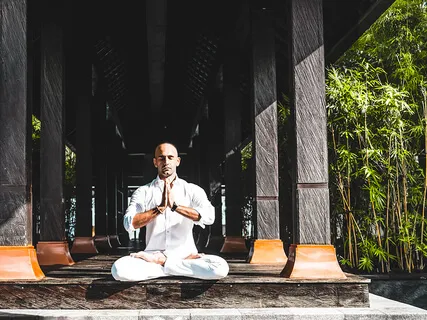
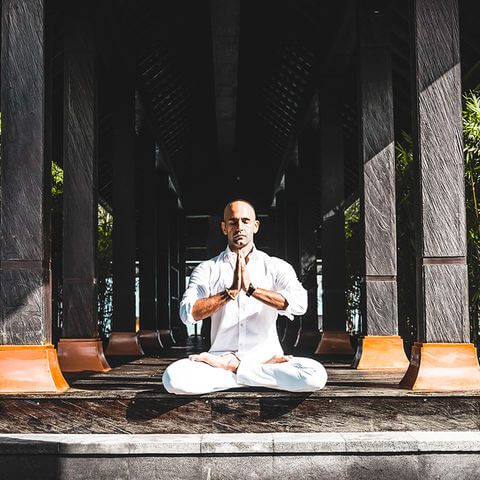
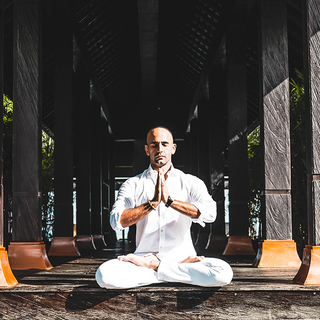
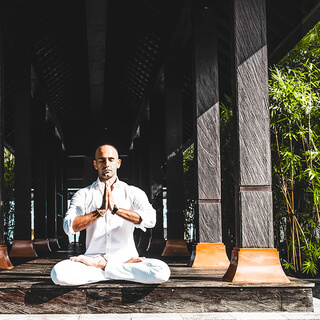
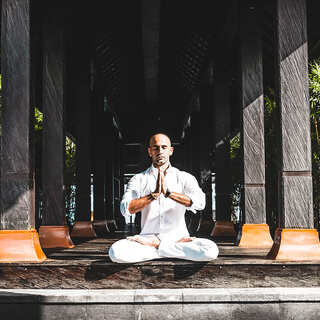
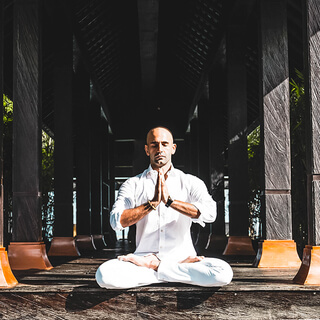
A note on sitting and how to sit.
The Buddha taught us how to sit.
He gives a great example of how to use this skill the night that he became enlightened.
He sat underneath the Bodhi tree and he made a vow to himself.
He said,
I will be enlightened tonight and I'm not going to move.
I'm going to pick this posture and I'm going to stick to it until I'm enlightened.
Even if my skin peels off,
My flesh starts to rot and my bones turn to dust,
I will not move.
That's not going to happen even if you sit here for all 12 hours today.
You're going to survive.
But what the Buddha did is he gave us a model for how we should practice in every sit.
We have a chance to emulate that for the hour that we sit,
For the hour and a half,
For the two hours.
So what I'd say is slowly start to build that up.
Choose a timeframe within which you can make that same vow to yourself.
The Buddha made it for a lifetime.
Maybe we're not there.
Maybe we can make it for 30 minutes.
Maybe we can make it for an hour.
Maybe we can make it for an hour and a half.
We choose what timeframe we're working within.
But start to make that vow to yourself.
And my advice on this is to use something I call the sandwich sit,
Which is that when you sit first,
Choose a comfortable position,
Ready to get serious and make that vow to yourself.
Pick your best position,
Your most stable position.
And then before the end of the sit,
Come out into a relaxed position again.
We're generally sitting for about one hour,
30 minutes to two hours.
So that means that you could have a few minutes at the beginning,
A few minutes at the end,
And a long sit in the middle where you really focus.
And that gives you the chance to both end and begin in a relaxed fashion,
But in the middle to intensify the process as much as you want.
OK.
So pick your best position,
And let's start to practice again.