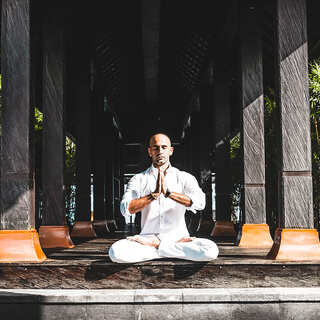
So,
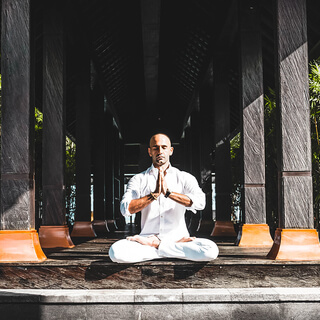
We're entering the silence.
Day zero has begun.
Some people are afraid of silence,
And it's one of the things that puts them off from doing courses and retreats like this.
And actually,
The silence is one of the most beautiful parts of this whole experience.
My brother,
My elder brother,
Is also a Vipassana practitioner.
Most of my family practices this technique.
And he's a big talker.
It might be one of the reasons why I was thinking of spending my life in silence as a monk,
Because my brother talks so much.
When he first went to a meditation center and spent time in silence,
He was worried he wouldn't be able to hold it.
But then when he came back,
He said something to me.
He said that he never realized how much energy he wasted talking until he had the opportunity to spend time in silence.
When he came back,
He was a different person.
I could see he was more self-contained,
And he was learning to manage his energy better.
So this thing we're doing with silence,
Noble silence,
Is not something that's being imposed on us.
It's something that we're each of us doing for ourselves.
And here,
Those of us who are practicing together,
We're helping each other to do it as well,
To build this bubble of silence around us,
So that we can be self-contained in our practice,
Without anyone coming and bursting our bubble.
If you're at home practicing this on your own,
Or in a house full of other people,
Then do your best to maintain that bubble.
However circumstances or other people might attempt to provoke you,
Don't give into it.
Maintain the silence.
It's your choice how you choose to engage with others.
Even on site here,
People might attempt to talk to you or disturb your practice.
Take responsibility for the silence you're building yourself to keep it around you.
It's only 10 days,
Only 120 hours,
Getting closer to 119 by the second.
It helps us to entirely internalize our experience,
To begin to explore ourselves in a way that we haven't done before.
And that's basically what this technique is.
It's a technique of self-expiration,
Where we can focus the entirety of our awareness on ourselves,
Not on anything else.
Not on wasting our energy,
Communicating with other people,
Thinking of responses,
Getting lost in thought patterns,
But to become entirely introverted for the next 10 days,
To turn our focus towards ourselves and let everything else go.
I said earlier that the Buddha did something extraordinary 2600 years ago,
And I really mean it,
And I'm still amazed by it today,
Even though I've been practicing this for a long time,
And it's what I spend most of my time doing.
When I sit to think about it,
I'm amazed.
For two reasons.
One is he created an internal technology nearly 2600 years ago that still hasn't been better today.
A lot of people have attempted to teach derivations of Vipassana or other things that sprouted from it,
And I think most of them would agree that none of them has surpassed what Vipassana did.
It's so simple,
You can teach it to children.
I've taught it to three year olds before who pick it up like that,
Because the instructions are simple.
The thing that we face when we practice that produces resistance is simply us,
And if we learn to face that,
Then there's nothing in our way.
Imagine if another technology created 2600 years ago was as good as one that was created today.
Transport would still be in horses and carts,
Or in elephants if you're from India or Nepal like the Buddha,
And now we've got space shuttles,
Rocket ships,
Writing things in stone or on papyrus.
Now we have a record of everything created by humans in the modern age stored on the internet.
But this internal technology has not been bettered.
It is so simple,
And it's available to everyone.
The second reason why it amazes me is the thing that makes it available to everyone,
Is it's a completely egalitarian approach towards transformation.
It's an internal revolution of thought,
Because the Buddha teaches us a mystical skill in a muscular way.
We can use a mundane method and a muscular method to be able to reach the mystical.
What do I mean by that?
I mean that Vipassana is something that can be practiced by repetition.
We simply need to follow a few steps and it can take us towards the sublime.
We don't need to drink a potion,
We don't need to say 108 prayers,
We don't need to have deep insights into the universe waiting to pull us out of ourselves.
We can sit here and do a reliable practice and we will get towards the mystical.
And on the way to that,
We will get through our suffering and we will be liberated from our suffering.
That amazes me to this day.
When I was younger,
I wanted to be a Shaolin monk.
And I always dreamed of meeting a wise old man who would be able to teach me the secrets of the universe and all these magical skills that I knew existed as a child.
I didn't meet a wise old man,
But I did meet this technique.
And this technique is exactly what I was looking for as a child.
It is a way for every single person to be able to take steps towards magic.
And that's all we need to do.
We don't need to take big leaps.
Small steps climb the mountain and they will reliably take us there.
In my own life,
I've seen it happen to thousands of people.
And for the last 2600 years,
It's happened to millions upon millions of people.
If we're willing to take the steps,
We can get somewhere magical with this.
And maybe you're not interested in the magical.
Maybe you're simply in pain and you're suffering and you want to wait through it.
Maybe you're confused and you want more clarity.
Well,
These are all things that we achieve along the way.
There's a big misconception in a lot of modern circles that comes up about meditation nowadays,
Which is that it's an aimless practice,
That we should sit here and have no intention.
That's not what the Buddha taught.
The Buddha had a very specific intention for practicing.
It was to end suffering,
Both for himself and for humanity.
There is a purpose to this practice.
There is a reason why we're doing it.
And there are goals along the way towards getting to that ultimate goal of liberation and enlightenment beyond that.
The first goal that we're going to focus on on this course is mastering the mind.
It sounds like a big one for the first goal,
But actually it's not that big.
What does it look like when we've mastered our mind?
It looks like a mind that does what we want it to do.
If we can choose what we want to do with our minds,
Then we're in control of them.
If we can't choose what to do with our minds,
We're not in control.
The mind has mastered us.
We have not mastered it.
That's why this is the first goal,
Because it's the goal that allows us to make choice.
And until we can reliably make a choice,
How can we take responsibility for our lives?
So this is the first step,
The first step towards liberating us from our pain.
Why was the Buddha so concerned about pain?
Because he realized that it's a universal condition.
Suffering is universal.
It doesn't matter if you're born a prince like the Buddha was and lived a charmed and blessed life.
At some point,
Suffering will touch you.
It will touch us all.
I'm sure we've all come in contact with things that have made us go deep into our own suffering.
And so the Buddha realized the issue isn't fixing the conditions,
Because even if you master the conditions,
You become a prince of the world,
Then it doesn't mean you're not going to face suffering.
Whereas if you can master how to face suffering,
Then you don't need to be a prince of the world.
You could be anything and face it happily.
Face it with your whole heart,
Completely.
The Four Noble Truths express a lot about what the Buddha wants to teach.
The first of them is that life is suffering.
It's inherent within life.
I was lucky enough to find this out very young.
I was born into a situation where addiction,
Abuse,
Suicide,
Violence were surrounding me.
And there are many people that will be born into much worse situations than that.
Genocide,
Many other things.
And even if we're born into relatively privileged surroundings,
I'm sure very early we come in contact with that suffering.
So for me,
The mission became exactly the same.
I hadn't heard of the Buddha back then,
And I didn't know what his mission was.
But I knew that what I wanted to do with my life was find a way to get out of suffering,
And find a way to help alleviate the suffering of my family as well,
And the people I loved around me.
That's when I realized the first noble truth,
Life is suffering.
Then when I was 14,
I was lucky enough to realize the second noble truth,
Which is that there is a cause to suffering.
And what I realized when I was 14 is that I was the cause to my suffering.
I thought that it was everything else.
I thought it was the people bringing violence into my life,
The fact that we had no money,
The fact that I wasn't being supported in the way I wanted to be supported by my family,
By my friends,
I blamed God,
I blamed the government.
And then one day,
I realized that that was all a lie,
That I was the one who created my own suffering.
Because if I didn't meet all of those things halfway,
Then none of those things could come into my life.
And from that day forward,
I felt free.
Because I was no longer a victim of circumstances,
I realized I was a creator of my own suffering.
And if I was creating suffering,
I could also create something else.
I could change the ingredients that I put into my cake and get a different end result.
So from that day forward,
I started to look for ways out of suffering.
And I found things that did work,
That did help to alleviate the pain.
That's the third noble truth.
There is a way out of suffering.
There is an end to suffering.
But the fourth noble truth,
I didn't fully realize until I found Vipassana,
Which is that this is the way out of suffering.
And it's not a skill specific to Vipassana.
It's something that anyone can learn on their own.
It's just that Vipassana is the most complete and simple expression of it.
And it's simply this,
That the point where the world meets us that has an effect over our internal state is our response to the world.
It's not the stimulus that we receive that dictates how we feel.
It's how we respond to it that does.
And the art of Vipassana is the art of mastering that response,
Of learning how best to respond to the world.
How best to respond to our internal world,
Which is where we're all living.
It may look like we're living in the same external world,
But I'm sure we all see it very differently.
Our internal world is the more important one.
And if we can choose to explore this internal world and master how we're responding to the external world,
Then we can take ourselves out of suffering.
That's the skill that the Buddha passed on to us.
And that's the skill that we're going to practice.
So the first thing we need to do is we need to reliably be able to make a choice.
So how do we do that?
It's really simple.
We're going to focus on our breath.
As we start to meditate tonight,
We're going to bring our awareness from the top of our nose down to the corners of our mouth.
This will be called the larger triangular area.
And we're going to tell our minds not to move out of this space.
And so it's a test to see how much control of our mind do we really have.
Is our mind listening to us or is it not listening to us?
Can our mind follow our instruction when we give it to it or not?
So we're going to keep our mind in this larger triangular area,
And every time it moves away,
We're going to bring it back.
Within this triangular area,
We're going to focus on the breath.
We're going to let the breath be entirely natural.
We're not going to control it.
We're not going to attempt to breathe deeply or calmly.
We're simply going to feel it.
And our only job is to sit here and feel the breath without our awareness moving.
If our awareness does move and our mind goes somewhere else,
Then we simply bring it back.
And this isn't a problem because actually we want to be exercising this muscle.
If the mind goes away,
It gives us an opportunity to exercise the muscle that helps to bring the mind back.
And this is a muscle that we're going to become very familiar with.
So in the early stages of this practice,
It's actually good for us if our mind starts to move away because then we can become familiar with what we need to do if we need to bring it back.
At first,
It might feel a bit awkward,
Like when you're using a part of your body you've never used before.
You're using a muscle you haven't identified before.
But then eventually it becomes simple.
It becomes automatic to where you hardly even need to twitch that muscle and your mind will come back.
And that's what we're going to work first.
We're going to build this bubble of silence around us and contain our energy so it's entirely focused on us.
And then we're going to create a smaller bubble here and we're not going to allow our awareness to move out of here.
And if it does,
We simply do one thing.
We bring the mind back.
That's it.
What is outside of this space?
Sounds are outside of this space.
So if we're focusing on some noise somewhere,
We're not focusing here.
We're not focusing on our breath.
Sensations in the body are outside of this space.
So if we start to move to another position of our body,
Then we're not focusing on our breath.
Our memories,
Our thoughts,
Our dreams,
Our fears,
Our fantasies are all outside of this space.
So if we find ourselves in any of those,
Then simply bring yourself back.
We just want to be here and now.
Here and now.
In this practice space.
Our practice space is no longer on that.
Our practice space is the larger triangle.
So anything that you could be doing that can take energy away from that and out of this bubble that we're building,
Slowly identify what it is and shut it down.
As your mind starts to move,
Slowly identify what that feeling is like of your mind moving and cultivate the ability to bring all of your awareness here.
And then you'll find that the mind is much easier to train than we think.
And that 120 hours is more than enough time to master the mind.
In fact,
We're going to master this mind very quickly.
And there are more goals on this retreat that we're going to carry out.
This is just the first one.
But it's also the most important.
If you never learn another skill on this retreat,
Then this one is enough to be able to allow us to live a happy life.
Because at least then we have that sense of freedom that we're choosing what to do with our lives.
And at least then we gain the knowledge that it's us that's responsible for creating our lives.
Because if we're letting something else dictate the movement of our minds,
Then we're giving over our power.
This single skill can change so much.
How do we apply it in day-to-day life?
In fact,
We're applying it all the time.
Whenever we want to do anything,
We need to apply this skill.
We need to make a choice to be able to carry the action out.
Otherwise,
All of our action would be unconscious.
If we want to communicate with another human being and express ourselves,
We need to be able to choose what it is that we want to express.
Otherwise,
Gibberish would just come out of our mouths.
If we're working a job supporting ourselves and our families,
We need to be able to sit there and carry out tasks that we've chosen to be able to finish incomplete.
If we can't do that,
How can we function as a healthy,
Happy human being?
This first skill makes us stable,
It makes us confident,
And it makes us strong.
It gives us confidence in our ability to do what we want to do.
We might not yet be digging into all of our trauma and all of these things we carry inside and releasing them from us.
But what we are doing is we're making ourselves the person who has the ability to be able to dig into that.
We might find at first that our mind is a little bit more difficult to train than we thought,
But then slowly we become partners with our mind and it becomes our ally,
A very powerful ally that can help us to do and get anything we want in the world.
So even if you learn nothing else,
Then this is a powerful skill to be able to take away from this course,
Mastering the mind.
And some people,
Some monks,
Spend their whole time,
Their whole lives in monasteries simply practicing Anapanas and simply practicing this skill.
Anapanas is the skill that took the Buddha from a seeker to enlightened,
Not Vipassana.
Vipassana is the skill that he learnt whilst he was in deep meditation as the answer to help others overcome suffering.
He said he rediscovered it in deep meditation and it's what all the Buddhas taught when they reached Buddhahood.
But this skill that we're about to practice now is the thing that took him to enlightenment.
So it has the power to take us all the way.
It's just much more of a rigorous and focused practice than Vipassana is.
And so what we're doing now is we're starting to feel what our mind is like,
Starting to feel what kind of animal we have trained it to be,
And to see if we can make friends with that and become partners with it and reset the balance of our mind.
So then when we leave this course,
We have another ally to help us do what we want.
And when we leave this course,
We know that whatever we choose to do,
No matter how difficult,
We can focus the full force of our mind on it.
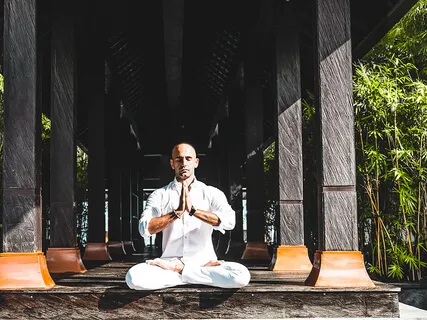
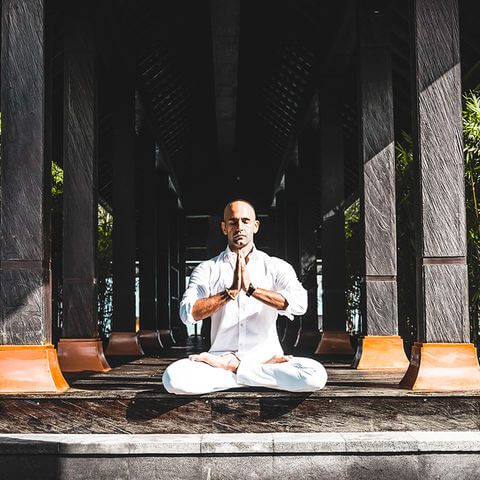
So let's start to practice now.
If you haven't already,
Then pick a comfortable position.
If you're not familiar with sitting for long periods of time,
Then what I'd recommend doing is first just relaxing entirely,
Just completely relaxing your body,
And then slowly straightening up and physically holding yourself in a very tight and rigid position,
And then finding a halfway point between those two,
A point where we have a straight spine and a straight neck so we can maintain focus,
But we're not entirely tense.
We're relaxing into a composed position.
Once you've done this,
Slowly settle into your mat.
Let your body find a natural balance as your weight sinks into the floor.
Close your eyes and start to bring your awareness to the larger triangle,
The point from the top of your nose down to the corners of your mouth.
Mark this area out with your mind.
Mark this as the boundary of where you're allowing your mind to move.
And let's start this path of inner exploration with getting to know the nature of our mind.
What does our mind do when we give it an instruction like this,
When it has to stay in one place instead of go where it wants?
As the mind starts to rest here,
Slowly bring your awareness to the breath within this larger triangular area.
Feel the breath moving in and out of the nostrils.
The natural breath,
Not interfered with,
Controlled or manipulated.
Vipassana means to perceive reality as it is,
Or literally to see things clearly.
So everything that we're going to observe on this course,
We're going to observe as it is,
As they are.
The same for the breath.
We want to feel the breath without any interference,
Without any alteration.
And then we begin to perceive an aspect of ourselves as it is.
If our minds move,
Then we simply flex that muscle to bring them back.
Bring them back to the breath,
Back to the triangle.