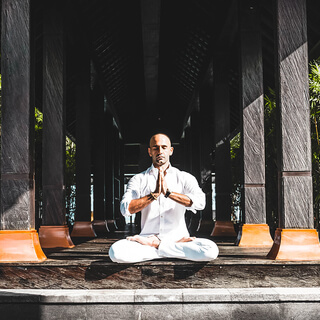
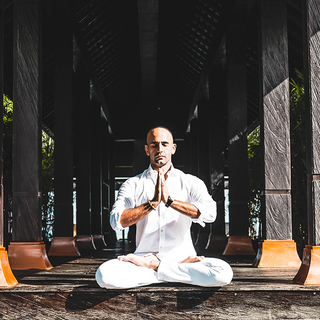
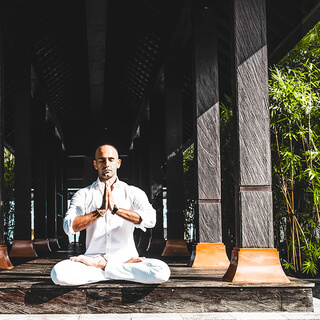
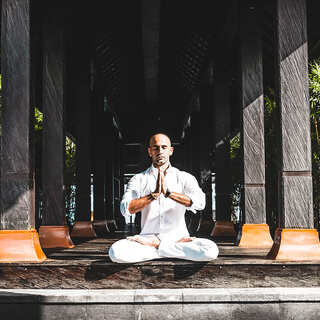
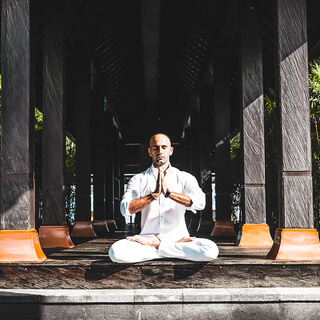
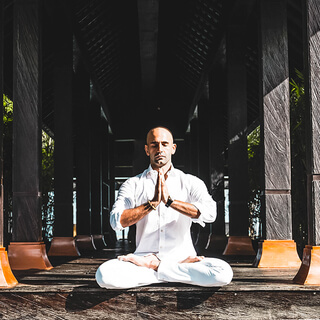
If everybody could just find a comfortable position,
We're not going to do much serious meditation now.
Just get yourself relaxed.
Grab any extra cushions you need to grab,
Any towels.
We're just going to have the commencement talk.
Then we'll have a little break so you can get all your stuff away,
Have your last conversations with the world you need to have,
And then we'll start the meditation after that.
We're just waiting for these two gentlemen at the back to be ready to go with the live stream to the people who are meditating with us from home.
Everyone comfortable?
No more cushions needed?
Good.
So,
Welcome,
Everybody,
To the Yogi Lab 10-Day Vipassana Retreat.
We're here because 2,
600 years ago,
The Buddha did something absolutely amazing.
He dedicated himself to finding the solution to human suffering.
And he spent the rest of his life after what he found and thought to be the solution,
Teaching other people how to practice this.
And the technique associated with it is called Vipassana Meditation.
It's a technique that allows us to be able to feel our internal states and explore what we have going on inside of us and to find the root cause of suffering within us.
And to be able to end the reactivity that produces this suffering.
Since the Buddha,
Up until today,
There have been a lot of amazing teachers bringing this to the world.
And one of the reasons we've continued to do this is because we've all benefited at Yogi Lab from this technique.
And it's the number one method that we use to be able to guide us and to be able to take us deeper into practice.
And what we're going to be focusing on for the next 10 days is teaching you the application of this.
Not just the technique,
But how to take it and to apply it into all areas of your life.
The Buddha's teaching was a very practical teaching.
He didn't want to create Buddhists and turn it into a religion.
He wanted to create Buddhas.
And so we want to continue that tradition.
To be able to take this skill and show how it's not something that begins and ends on the mat,
But it's something that is actually a way of life.
And as we start to learn how to practice,
It starts to touch every single area of our life.
And we're going to do that over the course of this retreat.
We have 120 hours to practice.
And I know when you practiced before,
That seems like a long time.
And people start to count down the hours and the days.
But 120 hours isn't that much time.
12 hours a day.
What if we're going to learn a life-changing skill and we're going to do something truly amazing?
The clock's going to start ticking very soon at 7 o'clock today.
And that's when we start counting down our practice time.
So the first thing I'd like to urge everyone here to do is to take the practice hours seriously.
Within the course,
It's going to get painful.
It's going to get awkward.
You're going to feel sensations within your body that you might not be comfortable feeling.
But all of that time we're giving ourselves to be able to practice is there for us to be able to create a pressure cooker-like situation so we face our internal states and we produce stress that allows us to re-experience trauma that we've got trapped within the body.
If we can turn up the heat on ourselves and re-experience this trauma and learn to face it without reacting,
Then we can learn to become immune to it.
And that's what we're going to use these 120 hours for.
So every single one of them is an opportunity to intensify the practice a little bit more.
And that's what we want to do.
One way we can do that is by creating ritual space.
And I'd like it if everyone here agreed to make this space that we're sitting in right now ritual space.
Cultures all around the world have used the idea of ritual space to be able to give extra importance to a place when they step into it,
To a situation when they step into it.
If you look to the entrance over here,
There is a torii gate at the entrance.
That's the Japanese symbol of stepping into a sacred space.
I don't think it's made sacred because there's a torii gate at the front.
I think the torii gate is an excuse for us to step into a situation and to say,
Right,
Now I'm going to treat this situation as important.
I'm going to bring my focus here and I'm going to take this seriously.
And so for everyone here who's on the live course,
If you want to use a trick like that to turn yourself into that state of mind,
Then feel free to come through the front,
Walk through the torii gate.
And then as we walk up here,
We're entering into ritual space.
So then when we come into the hall,
We're already done with everything else we need to do.
We come in here ready to practice.
We come in here focused and ready to be able to bring our best to the mat.
If you're sitting at home watching this right now,
Then you can do the same thing with your practice space.
As you approach your mats,
As you get ready to sit down,
Then slowly and train yourself into a more serious state of mind.
Bring your focus to the practice,
Bring your awareness to the breath or the sensations later in the course,
And then start getting into a frame of mind that allows you to be able to engage in this pressure cooker situation that we want to create.
As the course goes on,
You're going to see why this is so important.
And it can become a pressure cooker.
So one thing I want to say before we move on to the practical details of the course is a little note about confidence.
There are a lot of things that can come up when we start to dig into ourselves because we're about to go on a process of self-exploration.
And so we're going to face everything that we contain within us.
That can seem daunting when we start to face things that have affected us deeply in our lives or things that we didn't even know were there.
But there's one thing that we should remember.
Everything we're going to face is inside of us.
So if we do face a storm,
It's not like a boat being on the ocean facing a storm that can come and damage the boat.
It's like the sea facing a storm.
We are the sea.
We are the container for this experience.
So every single possible thing that could come up is something that's already contained within us.
How can a storm harm the sea?
I would urge everyone here to have the confidence and the belief in themselves to be able to face anything that comes up.
We're going through a controlled process where we are intentionally bringing these things to the surface so we can face them on the mat.
So that when we do have to face them in real life,
We're ready and prepared to be able to do that.
We're ready and prepared to be able to let go of all the things we have faced in real life that may have left marks on us.
And that's the purpose of this technique,
To be able to find and feel those marks and to be able to approach them correctly so we can let go of them.
We can let go of anything that doesn't serve us that we don't need anymore.
So whatever you face,
Treat it as part of the practice.
Approach it as something that's happening within ritual space,
Not within regular space.
And then we'll have the power to be able to face it and go through it.
I'll start talking about the technique and the details of the technique at seven o'clock.
But now let's just go through a few practical details so we can get prepped to practice.
I learned this technique in meditation centers and monasteries from a bunch of different teachers and traditions.
And one of my favorites is the Tibetan Buddhist tradition.
And one thing you find with these beautiful old meditators when they get to their 60s,
70s,
80s,
Is a lot of them have crooked backs because they're so deep in meditation that they're happy just to sit in any posture and let their physicality suffer because of that.
And they are beautiful people,
Resonating with love the whole time.
But they have to walk around with hunched backs because of the hours spent in meditation.
And I know one of the real concerns that people have when they start to sit long hours is their physical situation.
So one thing I'd like to do different on this course is to do an opening and a closing to the meditation where everybody stretches out their spine to make sure that we can maintain a straight and healthy spine and that even though we're going to be sitting more than 12 hours a day,
There's no risk to us.
There's no danger to us.
So the first thing I'd like us all to do is that if anybody feels too much tension at any one point and they feel like their spine needs a release,
Then simply feel free to bring their head down to the mat and rest in a recovery position like that with their head on the mat.
It's also a cheap way to be able to relax if you're feeling tired and need a nap without anyone noticing.
So you can just put your head on the mat and pretend like you're concerned about your spine and then get that extra bit of sleep that you need.
Second is the opening and closing sequence.
Our manager for the course,
Aaron,
Is going to demonstrate a short sequence that you can follow at the beginning and at the end of every meditation.
So if you don't mind turning your attention towards him,
He's going to do it in the middle of the mat here.
It is a basic series of simple stretches.
It can start with just going down into Bushman Squat.
If you don't know what that is,
That's a squat that all of us do as babies.
Heels flat on the ground,
Hands touching the ground.
Just let yourself sit in this position for a few minutes until your body relaxes and your spine softens.
And then when you're ready,
You can go into forward bend,
Padasana,
Very simple yogic stretch.
One,
The practice of asana is entirely compatible with Vipassana.
They are postures and sequences designed to unlock sensations within the body and allow us to go deeper within them and experience the flow of the body.
But we're not going to be focusing on stretching on this retreat.
The simple stretches that we do use are more there to be meditative postures that allow us to be able to relax and release the tension from the body.
So as you come in,
If you feel like you need that and you need your body to get prepped,
Then feel free to do a forward bend.
If you're not as flexible as Aaron,
Then feel free to put your hands on your shins or simply touch your toes with your fingers.
If you're more flexible,
Then you can go all the way down with your hands on the feet or the ground.
Like I said,
The stretch isn't the emphasis here.
It's more having an alternative posture for the meditation,
To be able to face the meditation in all the different positions,
As the Buddha taught.
Next is Tadasana.
For those of you who aren't familiar with it,
You can come up to a standing position,
Have your hands by your side,
Palms pointing inwards,
Hands pushing down,
Shoulders retracted,
Head pulling up.
And then when you're ready,
Slowly lift your arms above your head,
Maintaining straight arms while still retracting the shoulders down.
This simply gives us a chance to lengthen the spine and release any tension that can build up along the lats.
And then finally,
You can go down into Bhujangasana.
If you feel like too much forward bending,
Too much sitting in a posture where your spine is compromised,
Is affecting you,
Then you can go down to the mat and then lift yourself up into Bhujangasana by pushing your palms into the mat,
Retracting your shoulders,
And eventually looking up towards the ceiling,
Maintaining contact with your pelvis and the mat.
If this isn't possible for you or it feels like too much of a strain,
Feel free to go down into Sphinx,
Slamma Bhujangasana,
A more relaxed position.
Hold this position until you release all the tension in the spine.
Thank you,
Aaron.
Aaron's going to be the manager and ringing the bell before the meditation sits.
So when you hear the bell,
If you could come,
Get yourselves prepped to be in the hall,
And if you need to do any stretching to get yourself ready,
Do it in that period.
So then you have a few minutes to be able to go through the sequence before we all start to sit together.
And then when we come out of the meditation at the end,
We can do the same thing.
That does two things for us.
It gives us the confidence that we can sit for an hour,
Two hours,
And not damage our body knowing we're going to have the time to stretch afterwards.
And two,
It gives us a way to mentally prep coming in and getting ready to sit,
To get ready for the situation.
A bunch of people here have done courses with the Goenka system before and are familiar with that timetable and structure.
This one will be slightly different.
We're going to start meditating later in the day,
Mainly because the reason that we started to do this is because we wanted to be able to reach everyone around the world with the technique.
Everyone here who gets up at 4 a.
M.
And meditates can also get up and meditate at 8 a.
M.
But people who are normally getting up later find it difficult to get up as early and meditate.
So we'll start the meditation,
The compulsory meditation at 8 a.
M.
And then you can optionally meditate from 4 a.
M.
Onwards if you want.
And then we'll continue to meditate later into the night.
I would encourage everyone who's tired over the first few days to take the full amount of time to sleep so you don't need to come to the hall tired and need to work out the tiredness on the mat.
Take the time to relax,
Sleep,
Let it out.
So by the time you come here,
You're ready to practice and you're in a clear state of mind ready to be able to focus on the technique instead of coming here and feeling tired and not being able to fully engage with the practice.
As the course goes on,
There'll be plenty of time to rest and the meditation itself should work out the tiredness.
But in the beginning,
This may be an issue.
That's another reason why we start a little bit later to give people a chance to recover and ease into the process.
It'll get intense enough in the evening that we'll make up the meditation we missed in the morning.
Another thing is the diet.
We're going to be fasting for about 20 hours a day,
Intermittent fasting.
And when we do start to eat,
We're going to start with a mono diet or pretty much a mono diet.
The reason for this is because an important part of the technique is starving ourselves of external stimulus.
Because the more external stimulus that we take on,
The more activity we have going on inside of us.
So if we can starve ourselves from external stimulus,
Then it means that we can eat up the internal stimulus quicker.
This technique is something that makes us extremely sensitive to the sensations in the body.
And as we become sensitive,
We can dig in and we can experience things that we didn't even know existed there.
So the quicker we can get there,
The better.
As we go on a mono diet,
As we start to reduce the sensations within the body,
It means that we can go to deeper layers of what actually exists within us.
So even if this isn't your regular diet and you find it uncomfortable,
I would say please bear with it and give it a chance.
The hunger will subside over a few days.
And you can eat as much as you want in the mealtimes.
Simply stick to the meal plan.
This will help to clean you out.
Another reason why we pick this diet is it's a diet designed to promote gut health.
So by eating it,
It will slowly start to clean everything out that's in our guts and will clear up our second brain and all the nervous system centers that are around here so we can be clear to focus through the meditation.
If anyone has any issues with it,
Feel free to talk to Aaron.
If anyone has any issues with anything to do with the course or they need help with anything,
Then approach Aaron.
If it's to do with the technique,
He can arrange for us to talk and then we can go through anything that we need to later.
So we're going to start practicing in about an hour and 30 minutes.
So when we finish here,
If everyone could please just take their phones and hand them over to Aaron,
Get them to security.
This is your last chance to call any loved ones,
Send any text messages,
Do anything you need to do to let people know that you're here.
And then after that,
Aaron will ring the bell,
We'll come back here at seven,
And we'll start engaging deeper and deeper into the practice.
If there are any questions that anyone has before we start,
Then this is a good time to ask them.
Any questions?
I knew you guys were doing this,
So I didn't like to ask you to practice in the morning or if I just not do them.
Like not the other day,
But I didn't know what time.
Whilst on the course,
I would like it if you didn't do any of the practices,
If they can wait 10 days.
You understand the reasoning behind it already,
I imagine.
The same thing as Matilda's question for the duration of the course,
If you could just leave them to the side.
And the only postures we practice are the ones given in the course,
Just so we're not using anything as a distraction and we're not doing anything that takes us outside of the framework of the practice to move away from it.
That's why we have these movement postures,
So that there is a release if you need it,
But it's a structured and controlled release.
Good?
Okay.
Alright,
Wonderful.
So then we have about an hour and 30 minutes to be able to say goodbye to anyone we want to say goodbye to.
Hand over everything to Aaron that you need to hand over.
During the course,
We will be able to write,
But only in a controlled period of time.
So if you want to keep your notebooks with you,
Then please do,
But only use them during that controlled period of time.
Good luck with the practice.
At seven o'clock,
We'll enter into noble silence.
So anything that you want to say to anyone before then,
Except for Aaron,
Please do it before then.
A pleasure starting this with all of you.