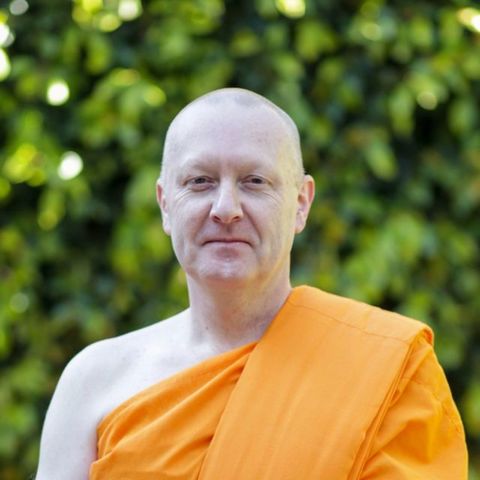
Last time you saw me,
We looked at blessing number 13,
Cherishing our husband or wife.
With the Dhamma talk today,
We will move on in our series on Enlightened Living to the final blessing in the Family Harmony subsection,
Namely,
Blessing number 14,
Not leaving our work undone.
Like many other faith traditions,
Since Buddhism is not a religion to tolerate laziness,
You could say it supports a work ethic.
Even if you have already fulfilled all the blessings in the Family Harmony subsection by cherishing your parents,
Children and spouse,
If you neglect to be lively in earning a living,
Money troubles will eventually lead to family infighting.
From a financial point of view,
It is necessary to devote oneself to earning one's living in order to support one's children,
To have a legacy,
To pass on to one's children,
To support one's spouse and cherish one's parents.
In Buddhism,
To work hard is seen as a way to repay one's debt of gratitude for the considerable time,
Money,
Education,
Love and patience invested in our upbringing by our parents,
Teachers and state.
If we weren't to put our skills into action,
Then all that investment would go to waste.
This is why in Buddhism,
A lazy person would also be seen as an ungrateful person.
Some people with the best of education and experience make no impact on their work if they never get around to doing it.
Laziness is not the only reason for procrastination,
However.
In recent academic studies,
It turns out that the reason people don't get around to doing things,
Even when they know it is a good idea,
Can often be much more elaborate.
Some people procrastinate out of fear of being judged for lack of ability.
Such people lack confidence about their ability and would rather be seen to fail in a task because of lack of available time and because of lack of ability.
Consequently,
Their rush at the last minute makes a perfect excuse for slip-short workmanship.
Some people procrastinate out of perfectionism.
If a person has been brought up with a fear of appearing to try too hard or being a goody-goody,
They might procrastinate so that if the results come out well,
It can be put down to a fluke.
Some people procrastinate out of the misconception that work expands to fill the time available.
Some people are so disorganised they feel they have no control over the time they spend on any task.
Therefore,
They leave the main task at the last minute in order to allow themselves to fit in other minor tasks beforehand.
The final results of the main task will be rushed and substandard though.
Some people procrastinate out of resentment of control,
For example,
When a person doesn't like their boss.
Here,
Procrastination serves as a way to give power to the underdog by saying get off my back,
As a sort of game where they try to remind others that they are being taken for granted,
Often when the person is not assertive enough to say no directly.
Lastly,
Some people procrastinate to control distance in relationships,
Often to make another person more or less reliant on them.
Whatever the reason,
The Buddha taught that procrastination,
Either in worldly or spiritual work,
Will limit one's ability to earn one's living and the result will be to destroy harmony in one's family life.
As a fun way to explain the psychology of procrastination,
Tim Urban's blog called Wait But Why?
Proposed a difference between what goes on in the heads of those more or less prone to procrastinate.
For a non-procrastinator,
There is a rational decision-maker firmly at the wheel in the brain.
However,
In the procrastinator's brain,
There are a couple of extra sidekicks in the guise of the instant gratification monkey and the panic monster.
For as long as there is no pressure,
The procrastinator puts the instant gratification monkey at the wheel of the brain,
Living in the present moment and caring only about what is easy and fun.
In other words,
Things that have very little to do with making sense in life.
Any thoughts of guilt,
Dread,
Anxiety and self-hatred about unfinished work are forgotten.
The only thing the monkey will listen to is the panic monster.
Luckily,
The panic monster is dormant most of the time.
But he suddenly wakes up any time a deadline gets too close or there's danger of public embarrassment,
A career disaster or some other scary consequence.
When the panic monster wakes up,
The monkey will then relinquish the wheel to the rational decision-maker.
So,
If you have a deadline to work to as a potential procrastinator,
It would just be the case of looking out for the monkey and artificially setting milestones to wake up the panic monster occasionally.
Unfortunately,
For many of the most important things in our lives,
Like seeing your family,
Exercising and taking care of your health,
Or working on a relationship or getting out of a relationship or even meditating,
There are no imposed deadlines.
Sometimes with these things,
If we haven't done the groundwork to build up the momentum to get these things moving,
Then the panic monster mechanism won't help to shake us out of complacency.
Because in all these non-deadline situations,
The panic monster just doesn't show up.
It's this long-term kind of procrastination that's much less visible and dramatic than the short-term deadline-based that kind.
It's usually suffered quietly and privately.
It can be the source of huge amounts of long-term unhappiness and regrets.
It's that long-term procrastination that can make you feel like a spectator at times in your own life.
You'll be left with the frustration that you couldn't achieve your dreams,
Mostly because you never got round to even chasing them.
So remember the instant gratification monkey's sneakiest trick is complacency when the deadlines just aren't there.
When we talk about leaving work undone,
We would generally mean the sort of work that puts the food on the table,
Since we cannot survive without an honest means to feed ourselves and our families.
Nevertheless,
Families can't survive by bread alone.
They also need to be nurtured spiritually.
Therefore,
We need to consider the danger of delaying to provide nourishment both for the body and the mind.
Therefore,
For the blessing of not leaving one's work undone means avoiding prevarication both in terms of physical and spiritual work.
So if we know our worldly and spiritual work is so important,
Why would we want to neglect it?
Some people in an office get a reputation for leaving a backlog of work.
Every piece of unfinished work can be easily tracked down to that person's inbox.
Meanwhile,
Their out tray remains empty and gathers dust.
The same is true for students who always leave their exam revision to the last moment.
Work left undone has been ungenerously compared to dung accumulating on a pig's tail.
And in the Buddhist context,
The value of a person is often considered proportional to the amount of work they manage to complete.
The work they leave undone detracts from their value.
As we said earlier,
The reason for the neglect is often not laziness,
But for as many as four different reasons.
Wrong timing,
Wrong technique,
Never getting started,
Or not making a genuine effort.
So for the first reason of leaving one's work unfinished has to do with wrong timing,
Which may mean doing the work at the wrong time or with the wrong timing.
For example,
If you plow a field out of season,
Weeds will choke the bare soil before you manage to sow your crops,
Which would illustrate being rushed into things that don't require it.
An opposite illustration would be delaying in things that should have been finished long ago.
For example,
Passing up the opportunity to study as a child and later struggling with school when you are too old to remember anything.
It's the same for people who wait until they are old before becoming interested in training the mind.
More haste less speed is valuable advice for work like using a potter's wheel and also for meditation where the ultimate of patience needs to be developed and where it is rare to hear about overnight success except in various exceptional circumstances.
Time is also wasted when you rush into something and end up making mistakes.
Often it's best to do something cautiously so that you can get it right from the start.
If you can first recognize the nature of the work you're doing in terms of timing,
You can press on to completion without disparaging obstacles.
Second reason for leaving work undone has to do with using the wrong technique.
One example of doing things by wrong technique would be trying to work individually when the task requires teamwork such as let's say lifting a heavy object.
Another example might be dividing up your time wrongly,
Perhaps getting bogged down in the first of 10 questions on an examination paper.
The result of poor technique is that you run out of motivation to do the work at all.
Third reason for leaving work undone has to do with never getting started.
Apart from all the managerial reasons for prevarication I've already mentioned,
One extra reason some people don't get around to things is that they are waiting for the auspicious time by studying horoscopes.
Although this sort of worldview might appear a little bit archaic,
You should beware of such superstitious thinking nonetheless as it often goes hand in hand with those who believe in fate and luck,
Especially gamblers.
In fact later on today I have a study to illustrate how such thinking affected an important decision.
Meditators however are those who take their destiny into their own hands and don't wait for astrologers to organize their lives for them.
Any time when you get around to doing good deeds then the simple fact of getting down to doing it would be auspicious in itself.
If you want to know whether it's the auspicious time to do something or not,
Don't waste money to consult a fortune teller but instead use your powers of observation and experience to see whether you're ready and prepared to do the task in hand.
If in your estimation you are ready to do something then there is a good chance that getting started will yield success.
The final reason for leaving one's work undone has to do with not being genuine in one's efforts.
Mostly these involve the playground of the instant gratification monkey and cause you to get your priorities wrong.
Instead of realizing how important your work is,
You get distracted by food,
Sleep,
Intoxicants,
Romance,
Gambling,
Entertainment,
Bad friends,
Laziness or incompatible working hours.
To overcome obsession with food,
You might need to go on a meditation retreat where you're forced to eat food all mixed up together or eat only one meal a day.
To overcome obsession with sleeping,
You may need to train yourself to sleep on a less luxurious bed.
To overcome obsession with intoxicants,
In other words,
You're dealing with an addiction to alcohol,
Tobacco or recreational drugs,
You might need to abstain completely from consuming these substances rather than just moderating your intake.
To overcome obsession with romance,
You may need to spend less time obsessing over your dating life.
To overcome obsession with entertainment,
You need to realize that you can become as much a junkie for soaps or sport as you can for intoxicants.
To overcome obsession with gambling,
You may need to confess your addiction to a sponsor and voluntarily restrict your access to credit cards.
To overcome obsession with bad friends,
You need to avoid getting in with people who idolize laziness,
Picking more diligent role models instead.
Even if your efforts seem to be disrupted by pure laziness,
Laziness itself can be deconstructed into having too many excuses for everything where work is concerned.
If it's not too hot to work,
Then it's too cold.
If it's not too early to work,
Then it's too late.
Therefore,
If you skip the excuses,
You can usually skip the laziness at the same time.
Lastly,
Your inability to put a genuine effort into work may boil down to incompatible working hours.
This is not the same as being interested in sleeping,
But may disrupt the efforts you make in work because you work at a time that doesn't fit in with other people's schedule,
And therefore you'll be fraught with inefficiency from lack of teamwork.
So,
We have a little time for a story,
Which today is a scriptural tale from the fourth jataka about a poor man who,
Through diligence,
Was able to elevate himself from rags to riches.
There once was a millionaire and his servant who were traveling in a cart in the middle of India.
The servant was a poor man who is the protagonist of the story.
The millionaire saw a dead mouse at the side of the road and pointed it out to his servant,
Saying,
If someone had proper principles of working as a salesman,
Even with such a dead mouse as this,
He could set himself up in life quite easily.
The servant immediately got down from the cart and allowed the millionaire to go home alone.
He picked up the mouse,
And because he knew a lot of people in the area,
He selected a house where he knew a compassionate person who kept cats,
And took the mouse there.
He knew that compassionate people won't kill mice,
But at the same time their cat has to have something to eat every day,
So he sold the mouse to the householder for a few cents.
He used that few cents to buy some sugar cane juice from the people crushing the cane.
He asked for another bucket of plain water.
He took the water and the sugar cane juice to the gate of the city.
There he waited until the flower gatherers from the palace came back from where they had been picking flowers outside the city wall all day.
Of course,
They were tired and thirsty as they came to the gates.
He gave them a glass of plain water to drink first of all.
After they had slaked their thirst,
He gave them a second glass of sugar cane juice.
The palace attendants didn't know how to pay the man,
So each gave him a handful of jasmine flowers.
The man took the flowers and sold them for a small profit.
He thereby gained a little more money than before,
And bought some more sugar cane juice,
And collected a little more drinking water.
He sold all of it to the flower gatherers on the second day,
And got enough money for a second round of sugar cane juice.
Enough for the people collecting the firewood as well.
People with the firewood drank the sugar cane juice,
And each left him with a bundle of firewood.
He sold the firewood,
And got even more sugar cane juice.
He kept his eyes and ears open,
And noticed that there had been a storm in the night.
In the royal forest,
There were many broken branches and tree trunks all along the ground.
He offered his services to the forest keeper to be the one to clear up the broken branches,
And the forester agreed because he would be able to have an easy day.
He therefore offered sugar cane juice to the children playing nearby,
And the children cut and gathered all the broken branches together into a huge pile.
He sold the branches as firewood to a potter,
And bought a big barrel.
Where he had sold sugar cane by the bucket before,
Now he sold it by the barrel.
He bartered sugar cane juice for flowers,
Firewood,
And even grass fodder.
One day,
A big caravan of traders arrived at the gate of the city with many hungry horses.
He told the stable boys in the palace not to sell their fodder to anyone,
And he sold his own fodder at a high price to the traders.
It turned out that it wasn't enough,
And they took the fodder from the palace to sell to them at the same high price so that everyone got a profit.
He carried on working like this until before long he was able to put down a deposit on a trading ship.
His ship kept trading until he had amassed a fortune of 100,
000 kahapanas.
In the end,
He returned to the old millionaire who had been his former boss,
And presented him with the 100,
000,
Saying that all of his wealth had come from the policy of seeing benefit in a dead mouse.
The millionaire was so impressed that he gave the man a fortune of a million,
And also his daughter's hand in marriage.
So,
This story illustrates why diligence is highly prized in Buddhism.
The Buddha even went as far as to say in the Dhammapada that diligence is the path to the deathless,
Whereas procrastination is the path of death.
The diligent never die,
But those who procrastinate are as good as already dead.
Understanding this distinctly,
Those who are skilled in diligence rejoice in diligence,
And will be able to delight in the pasture of the noble ones.
So,
To come back to our subject matter for today,
We will start to examine some strategies for non-prevarication.
To be successful in whatever you do,
It's important to do it at the right time,
In the appropriate way,
And get round to doing it,
And finally,
To do it enthusiastically and conscientiously.
The qualities to aim for to be successful at work are elaborated upon in the Samyutta Nikaya's Alavaka Sutta.
The first quality it mentions is approaching work in the appropriate way,
Or in the Pali language,
Patirupakari.
In other words,
We need to put into practice all the knowledge and craftsmanship we have learned in Blessings 7 and 8.
When you are new to a job,
Then you have to learn from any mistakes.
You shouldn't make the same mistake more than once,
If you observe your own performance carefully.
Secondly,
You need to conjure up the willingness to work,
And to challenge your own previous ability,
Or turavah in the Pali language.
This would mean never looking down on tasks,
No matter how humble.
Lastly,
You need to have a certain keenness and quickness in the way you work,
To keep yourself enthusiastic,
Lively,
And active,
Or as it is referred to in the Pali language,
Uttatha.
If you know you have a tendency to lethargy,
Then maybe you should take up a sport.
Success in one's job will be attained more easily,
If one is able to put into practice the following four principles found in the Dighinikaya Sanghiti Sutta,
Amongst other places,
And called the four foundations of power or success,
Or itthipattha,
And which in effect are appropriate to ensure success in any sort of work,
Worldly or spiritual.
Now come back to the spiritual applications in just a moment.
In your day job,
The itthipattha would be applied in four stages.
First comes initial motivation,
Or chanttha,
Which means that with work you need to have the willingness to get down to do the work.
Without this,
You will never make a start.
Second comes initial application,
Which might be referred to in Pali as viriya,
Or when we come to meditation,
Vittattha.
So what this tells us is that having conjured up the motivation,
The next thing which you need to have is actually to apply yourself to the work in the proper way,
Starting as you mean to go on.
This often means achieving an optimal balance between productivity and enjoyment.
Third comes sustained application,
Which might be referred to in Pali as jitta,
Or in the context of meditation,
Vichara.
This means that starting out well is not enough,
But you have to be able to be consistent in your good work if you're able to succeed in eventually bringing the task to completion.
Like learning to swim,
You might feel awkward and unskilled on the first day in the pool,
But if you keep it up,
One day you might make Olympic champion.
Lastly,
True success requires retrospective analysis,
Or vimamsa.
This means that you need to go back over your work and give yourself feedback by looking for even better and more efficient ways to do the same task in the future.
You need regularly to examine your own performance,
Remedying your weaknesses as quickly as possible so they no longer impede your worthy progress.
If you experience success,
You should remember the reasons for your success so that you can apply it on future occasions.
If you can follow these four simple principles in your professional life,
Success will be just around the corner.
So we turn now from worldly work to look at spiritual work of nourishing the mind,
Heart and soul.
The dangers of neglecting this work in our lives may be even more harmful than lazing around in the house instead of earning a living,
Because as the Buddha pointed out in the Akamaniya Sutta,
I do not perceive even one other thing that when left undeveloped and uncultivated entails such great suffering as the mind.
The mind when undeveloped and uncultivated entails great suffering.
It would therefore appear that we need to apply our Itthipatha or recipes for success as energetically to our meditation practice as we do to our work life.
And luckily in this respect,
The Itthipatha teachings readily adapt themselves to the context of meditation.
There are five components equivalent to the Itthipatha as applied to not leaving your work undone in the context of meditation,
Namely,
And I try to get them all to start with the letter C for ease of remembering,
Conducive,
Comfort,
Conscious,
Consistent and checking.
The first step of your meditation requires conduciveness or willingness to cultivate clarity of mind.
This is equivalent to the initial motivation for worldly work.
For spiritual practice,
It is essential to have that sense of willingness to cultivate oneself.
Sometimes rather than waiting for the inclination to meditate to arise accidentally,
You need to look for ways to put yourself in the mood.
You might generate the enthusiasm by reading up on the benefits of meditation,
Or perhaps seeking out a nearby meditation group where you can have the moral support of meditating in company.
You'd also take care to create the ideal conditions to attract you to have a good meditation,
Whether it be selecting the best time of the day,
Practicing in a conducive activity beforehand like showering or exercise,
Or creating a quiet and conducive corner for meditation in your home,
Or investing in an especially comfortable meditation cushion.
The second factor for successive meditation,
Which is the equivalent to initial application in a worldly job,
Is the twin track of comfort and consciousness.
In other words,
We need to maintain focus in our meditation,
Alongside a feeling that we are comfortable with what we are doing.
Comfort can be understood as accepting yourself as you are.
Comfort can be achieved by physical relaxation,
Especially concerning sitting position,
Clothing and the way you close your eyes.
Comfort is also achieved by relaxation of the mental state,
Treating each session as if it were the first time we've meditated.
Comfort of the mind means keeping our emotions positive and stable,
Both during our meditation and also in our daily life.
The second part of mental comfort is the gentleness with which we place our attention at the centre of the body.
The flip side of comfort,
But something which we need to keep it in balance with,
Is the quality of being conscious or focusing in our meditation.
This mostly concerns the way we conjure up or observe the object of meditation,
Which might mean the centre of the body,
Our visualisation or the mantra.
If we are able to maintain a balance between comfort and consciousness,
We will be able to obtain a peaceful and progressive meditation experience.
So what we have said up to this point is that we need to maintain the relaxed and alert quality in our meditation,
So that comfort and consciousness can go hand in hand,
Almost like the parallel tracks of a dirt road or the twin tracks of a railroad.
In either case,
If we go off the tracks or slip off the road,
Then we get bogged down in the dead end,
Where the effort we put in will be unrewarded.
Your wheels will be spinning,
But you will be getting nowhere fast.
If you are on a dirt road,
Then you need a tractor to come and get you out.
If you go off the rails,
Well,
That speaks for itself.
So what I am saying is that step three of our Itthipatha for meditation is just to keep the balance between comfort and consciousness going,
Without falling by the wayside.
And this is the quality of consistency.
Or if we come back to our comparison,
We can see it would be considered as sustained application in the workplace,
Or pacing ourselves so we don't burn ourselves out before we reach the finishing line.
More concretely,
Meditation is maybe supported by establishing a routine to meditate every day,
But it would also concern keeping the balance,
Going all day long and practising mindfulness by maintaining the mind at the centre of the body throughout the day.
So,
After we place our mind gently at the centre,
We would need to be consistent in maintaining our balance of comfort and consciousness going,
That twin track between ease and focus,
Relaxation and alertness,
Without slipping too far in either direction.
If we err too much on the side of comfort,
Our meditation will drift off into sleepiness or distraction.
If we err too much on the side of consciousness,
In other words,
We are too forceful in the way that we focus,
Then we will drift off into either tension or trying to pre-empt the results.
If we notice we have slipped off the beaten track,
Or gone off the parallel rails of comfort and consciousness,
We shouldn't hesitate to place the mind again and do a restart,
Without worrying that it's a waste of our effort so far.
In this way,
Our mind will gradually make its way further and further down the twin tracks,
Until we can hit upon the golden states of mind we are aiming for,
Which we refer to as inner experience.
The final aspect of the recipe for success in meditation is checking or constructive retrospective evaluation of your practice.
It means going back over our meditation,
Usually after we've finished the practice,
To make sure there's not a better way that we could do it next time round.
Being systematic in the way we check back over our meditation will have the advantage of helping us to remember our experience,
Renewing our inspiration,
Giving us an overview of our progress,
Lending preciousness to the passing experience,
Making sure meditation doesn't become a chore,
Allowing us to pick up on changes too subtle to notice from one day to the next,
And completing the loop of quality control in our meditation.
It will also help us to clear up any doubts about our meditation practice.
The main things we need to ask ourselves repeatedly when checking back over our meditation is whether our body was truly comfortable,
What were the techniques that led to good experiences,
And what were the things that seemed to hold us back.
So,
In summary,
For success in our meditation,
We apply the Itthipatha in the form of the five Cs,
Namely conducive,
Comfort,
Conscious,
Consistent,
And checking.
Today we still have time for a quick story to finish off with,
And the story concerns the perils of putting off an important task because of superstitious beliefs in auspicious timing.
There once was a man from a family near Savatthi who intended to marry a lady from the same city.
Having fixed a day to come and fetch the bride,
He subsequently consulted a fortune teller who was familiar with his family as to whether the stars were favorable for holding the festivities that day.
The fortune teller was indignant that the couple had fixed a date for the wedding without asking him first,
So he thought,
I'll teach them a lesson.
So the fortune teller made up the prediction that the stars were not favorable for marrying on the appointed day,
And the nuptials ought not to be celebrated that day,
And that if they were for some reason celebrated on that day,
Then great misfortune would come of it.
The man believed the fortune teller and decided not to turn up for his own wedding.
Now the bride's friends in the town had made all the preparations for celebrating the nuptials,
And when they saw the groom's family did not turn up,
The bride,
Who had waited and waited,
Eventually thought,
It was the groom who decided the wedding date,
And yet they have not turned up.
We have gone to considerable expense for the arrangements,
So let us marry the girl to someone else.
So they found another bridegroom and gave the girl to him in marriage with all the festivities they had already prepared.
The bride availed herself of the whole dowry in compensation for the groom having broken the marriage contract,
And on the new date the fortune teller had given them,
The groom's party came to fetch the bride.
But the people of Sabatii berated them with the words,
You country folk are a bad lot,
You fixed the day yourselves and then insulted us by not coming.
We have married the bride to someone else.
So this is the origin of the Buddhist advice that if you are ready to start an activity,
That readiness itself is all you need to propitiate success in the activity.
In other words,
You don't need a fortune teller to tell you whether success will be achieved on a certain date or not.
And if you do persist in superstitious beliefs,
Then you,
Like the gullible groom,
May lose everything you had prepared for.
So in this session I have introduced you to blessing number 14 on not leaving your work undone.
For my next session I'll move on to blessing 15 about generosity,
Which explains how generosity can contribute to becoming a pillar of society.
Hopefully as a result of today's session you will be a little less tempted to prevaricate about your worldly and spiritual work.
So for today this is me,
Pratt Nicholas,
Signing off for now.
So long folks and stay safe.