We are going to sit now for meditation,
If you'd like to find a comfortable position for yourself in meditation.
Having done the chanting in homage to the triple gem,
From this moment forth,
All of us should do our best to realign our minds with the pathway to Nirvana.
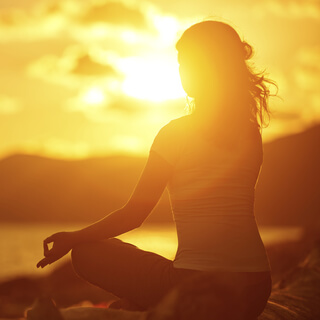
Sit in a cross-legged position with your right leg on your left leg,
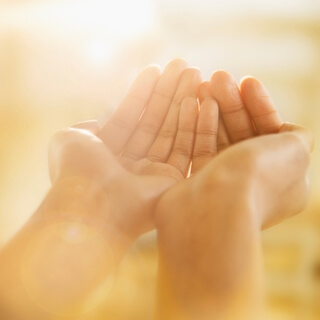
Your right hand on your left hand,
The index finger of your right hand touching against the thumb of your left hand,
With your hands,
Palm upwards on your lap.
And close your eyes very gently.
Close your eyes as if you were only half closing them,
Almost as if you were closing your eyes in order to go to sleep.
Never squeeze your eyes closed and make sure there's no pressure around your eyes.
Fill your mind with happiness and joy.
And suppose that inside your body is empty of all organs and tissues,
Just an empty space inside yourself.
Imagine that inside your body is just a hollow cavity,
Without any organs or tissues,
Without any muscles or bones,
Similar to a hollow pipe inside yourself,
A pipe made of glass,
A pipe made of crystal.
So imagine that inside yourself is just a hollow empty space,
Like a crystal tube or a diamond tube,
Clear and bright,
Transparent inside yourself.
We have to anchor the mind that normally wanders around at the centre of the body.
There is nothing else we need to do.
You can anchor your mind at the centre of the body by visualising a mental object there,
Or you can just rest your mind at the centre of the body without visualising anything,
Cultivating mindfulness and self-possession at the centre of the body,
By bouncing our sense of relaxedness and alertness at the centre of the body the whole of the time.
And our job as meditators is simply to observe continuously,
To observe without any thoughts in the mind.
This is our job as a meditator,
Without having any questions in our mind.
And what will happen once we are able to see a sphere at the centre,
Is that within the sphere we will see further spheres,
And within the spheres we will start to be able to see bodies within the body,
Feelings within the feelings,
Minds within the mind,
And mental phenomena inside the mental phenomena,
According to all the foundations of mindfulness laid down for us in the Mahāsātipatthāna Sūta.
So we observe continuously.
What we find is that the different levels of the Dhamma are nested as spheres within,
One inside the other.
Each of the spheres of the Dhamma has its own name.
The first one is called the Dhamma Nupāsana Sattipatthāna sphere.
After this we find the sphere of self-discipline or sila,
The sphere of concentration or samāti,
The sphere of wisdom or paññā,
The sphere of liberation or vimutti,
And the sphere of seeing and knowing of liberation,
Or vimuttiyānata-sana,
A set comprising a total of six spheres.
And these six spheres are what link between one inner body and the next.
Including our physical body,
There are a total of eighteen inner bodies.
Each of the inner bodies is connected to the next by a set of these six spheres.
Inside the human body there is the astral body or subtle human body.
Inside the astral body is the course angelic body.
Inside the course angelic body is the subtle angelic body.
Inside the subtle angelic body is the coarse form-brahma body.
Inside the coarse form-brahma body is the subtle form-brahma body.
Inside the subtle form-brahma body is the coarse formless brahma body.
Inside the coarse formless brahma body is the subtle formless brahma body.
Inside the subtle,
Formless Brahma body is the first of the bodies of enlightenment,
Known as the coarse Kottapūdhamakāya body.
Inside the coarse Kottapūdhamakāya body is the subtle Kottapūdhamakāya body.
Inside the subtle Kottapūdhamakāya body is the coarse Śrīmāntara dhamakāya body.
Body.
Inside the Course stream-enderer dhanmakaya body is the subtle stream-enderer dhanmakaya body.
Design the subtle stream-enderer dhanmakaya body is the course once-returner dhanmakaya body.
Inside the course once-returner dhanmakaya body is the subtle once-returner dhanmakaya body.
Inside the subtle once-returner dhanmakaya body is the Course non-returner dhanmakaya body.
Inside the Coarse Non-Returner Tamakaya body is the Subtle Non-343 body.
Inside the Subtle Non-Returner Tamakaya body,
Is the Coarse Arahant Tamakaya body.
Inside the Coarse Arahant Tamakaya body is the Subtle Arahant Tamakaya body.
All of these bodies are nested one inside the other and linked together by these sets of six inner spheres.
This is like a blueprint for the structure of our lives and it has been so since the very first time we were born as a human being.
For each inner body there are bodies,
Feelings,
Minds and mental phenomena to be explored according to the foundations of mindfulness,
As if we were going through the different layers of an onion or as if we were going through different layers of a Russian doll.
Going through the core of the core,
Seeing behind the scenes of everything inside ourselves,
Going straight to the center in sequence until we can come to the bodies of enlightenment inside ourselves.
Once we reach the bodies of enlightenment inside ourselves,
The body of enlightenment will start to reflect upon the aggregates inside ourselves.
It has to be the body of enlightenment which does this reflection.
It will reflect that these aggregates are not of us.
They are not our real self,
That we have no real self in these five aggregates.
If it's not the body of enlightenment which considers these,
The reflection will not lead to anything significant.
But with the eyes of the body of enlightenment,
We will be able to see what is really permanent and what is impermanent,
What is our true self and what is not our true self.
Once our body of enlightenment sees the things for what they really are,
We will be able to let go of all things which are not our true self.
We are not able to be a refuge to us.
By letting go,
We will be liberated of all of these things and the mind will become pure as a result.
As the mind becomes more pure,
Then we will be able to go deeper inside.
The mind will become more radiant,
Becoming more pure,
And then we will be able to go deeper inside ourself.
The mind will become more radiant and will return to its true position inside.
It will allow us to touch on true happiness which will magnify and multiply as the time goes on,
And we will be inspired to look for higher forms of knowledge and happiness as well.
And at this point,
The mindfulness and wisdom will reach beyond the conventional virtues to become great mindfulness and great wisdom.
Once we have broken free of the imprisonment in the five aggregates,
We will realize that anything that is still within triple world,
That is everything which is made up of the five aggregates,
Is restricted to the triple world.
They are all things which cannot be one's true self,
Which are impermanent,
Which are of a nature of suffering.
Once the dhammakaya sees through these things for what they are,
It will let go of all of these things and will allow us to enter upon deep meditation.
Once we have broken free of these things,
We will not become attached to them ever again,
Rather like a palm tree which has been struck dead by lightning,
Or a tree which has had its top bud nipped out,
Which will no longer grow anymore.
It will be completely extinguished.
But in fact,
For our mind,
It has become united with the body of enlightenment inside,
Just as it has become part of the flavor of that body of enlightenment,
Inseparable.
On this pathway,
There are two sectors,
The mundane path or lokīyamaka and the transcendental path or lokuttaramaka.
On the mundane path,
We traverse the formless Brahma bodies,
The form Brahma bodies,
The angelic bodies and the human body.
However,
On the transcendental part of the path,
We traverse the bodies of enlightenment at the levels of kotrapū,
Stream-entry,
Once-returner,
Non-returner and arahant.
All of these are inner bodies inside ourselves.
All those on the transcendental path have broken free of the three universal characteristics or samanyalakanā.
We have to make a thorough study of all these inner bodies,
But most important of all is that we study about the bodies of enlightenment.
They are identified by a lotus bud topknot and are endowed with all thirty-two signs of the great man or mahā-puri-salakanā.
The bodies of enlightenment are crystal clear,
More transparent than anything in the world.
These are the most important inner bodies of all.
The aim in all our lives is to attain the inner bodies of enlightenment,
Especially that of the arahant dhammakāya body,
Because it is the body that is broken free of all forms of mental defilements.
It is the body of enlightenment of one who is fully awakened and joyous.
It is the Buddha body,
The body that allowed the Lord Buddha to become enlightened.
The body exists inside the body of every human being in the world.
It doesn't matter what sort of person we might be,
But we all have the body of enlightenment inside,
Although people from one country to the next might look different on the outside,
Distinguished by their own creed or race,
But on the inside,
Once they reach the body of enlightenment,
They all look the same.
It is the highest attainment for all of us.
It is an inner body that is no longer affected by the law of karma.
Thus we should study as well as we can about this body of enlightenment,
Because it can be our true refuge.
It is a holy body inside us,
And it is something that can sanctify us as well.
As Buddhists,
We have to find out what is the heart of our religion,
So that we can pass on a true explanation of Buddhism to other interested parties who seek our advice.
Our aim in life is to attain nirvana and accumulate the maximum of merits and perfection for ourselves.
Just as a fire will burn out as soon as it has no more fuel to feed the flames,
Once someone is enlightened,
Once they have no more defilements,
There is nothing to lead them back into the cycle of rebirth anymore.
We have to make the effort to attain nirvana,
Or at least to be able to see nirvana for ourselves.
It is only by bringing the mind to a standstill that we see this inner body of enlightenment for ourselves.
We must do everything in our power to attain this inner body of enlightenment inside ourselves.
Because the inner body of enlightenment has a way of seeing the world that goes beyond the mundane.
The way it sees the world is to go through the eyes of insight.
It penetrates into the reality of all things.
It penetrates reality much more completely than any other inner body,
Whether it be the celestial bodies,
The form-brahma bodies,
Or the formless brahma bodies.
It sees in all directions all around at the same time,
360 degrees at one glance.
It can see into the future,
And it can see into the past.
It can see both the causes and the effects of every factor.
There is no secret hidden from the eye of the dhammakaya,
Whether issues about life or the world.
The wisdom of the Lord Buddha was all-knowing and thorough,
And that is why they call the Lord Buddha the Lokāwidū,
Or seer of the world.
This is what we really mean by the word insight.
The syllable sight in the word insight indicates that insight meditation involves seeing,
But it is no ordinary seeing.
It is penetrative seeing of the world.
If you can attain the Gautapū dhammakaya body of enlightenment,
You can see things on a certain level.
If you can attain the stream-entered dhamma body,
Then you can see a little bit more.
If you can attain the bodies of the once-returner or the non-returner,
You can see more still.
But it is only when you can attain the body of enlightenment of the arrow hand that you can see everything.
This is the true meaning of the word vipassana.
This is our real aim in the practice of meditation,
So that we can attain this sort of vision for ourselves.
And the way we can do that is by bringing our mind to a standstill.
We have to strike a balance and poise for ourselves in meditation,
A balance which will occur whenever our mind comes to a standstill.
You will know at that time what is the optimum for your mind.
This is why we say that the stopping of the mind is the secret of success.
Every moment of every day,
We are using up the merit which we have stored up from our past,
And we need to replenish our merit to replace the merits from our past that we are burning up.
But one way of replenishing the merit that we often forget about is the merit of practicing meditation until our mind can come to a standstill.
The great Abbot of Wat Phak Nam once taught that to meditate until the mind comes to a standstill,
Even for an instant of no longer than the flap of an elephant's ear or the flick of a snake's tongue,
Is a huge merit,
More than the building of ten temples or pavilions.
Because the merit of building temples,
Although improving the quality of your rebirth,
Still leads you back to be reborn in samsara,
The cycle of birth,
Death,
And rebirth.
The whole of the time,
We are using up the merits we have accumulated for ourselves from the past.
This is why the accumulation of new merits is so important to us.
If we understand this properly,
We can steer our lives away from catastrophe and towards success.
So,
If we cultivate all sorts of merits in the meantime,
We will help the mind to come to a standstill.
We will be able to find out who we really are.
In this connection,
There is an account from the time of the Lord Buddha about a group of thirty princes,
Known as the Pāṭavakīya,
Who were amusing themselves by playing hide-and-seek in a forest glade between Benares and Uruvela.
All of the princes except one had paired themselves off with a princess.
The remaining prince had brought along a courtesan instead.
As they were playing hide-and-seek,
They had taken off their crown jewels and left them in the safekeeping of the courtesan.
When the princes and princesses were busy looking for each other,
The courtesan made off with the crown jewels she had been entrusted with,
Intending to quit her courtesan's trade and never to have to work again for the rest of her life.
So she took the crown jewels and ran away from the forest.
Now,
Instead of being a game,
The hide-and-seek became a hunt for the courtesan.
But no matter how hard they looked,
They could never find her anymore.
However,
While they were looking for her,
They came across the Lord Buddha in the forest.
They asked if he had seen a courtesan carrying jewels passing that way.
Instead of answering them,
The Buddha asked them a very profound question in return,
Namely,
Would you be better off looking for that woman or looking for yourself?
Do you want to look for that woman or would you be better off looking for yourself?
Because the Lord Buddha knew very well that those princes hardly knew themselves at all.
It is only the superficial self which they knew.
And where is the benefit in that?
He asked them again,
Would you be better off looking for that woman or looking for yourself?
The princes had latent wisdom from their previous merits,
And they admitted that they would be better off looking for themselves.
Accordingly,
The Buddha said,
If you want to look for yourself,
I will teach you the method.
And the method he taught was just the same as you are being taught now,
How to find your true self by sitting down to meditate.
The Lord Buddha taught that the physical body is not our true self.
It is only our superficial self.
There's no point wasting our time with this because it harbours only suffering from the time we are born to the time we pass away.
If they thought they were reducing their suffering by playing hide and seek,
They were surely mistaken because such distractions are only a temporary escape from suffering.
It just serves to take our mind off the suffering.
It would be better if they look inside themselves at the centre of the body to bring the mind to a standstill and in this way to release themselves from the aggregates on various different levels.
As soon as their mind comes to a standstill,
They would see their true self inside and would attain unbridled happiness for themselves.
The princes listened to his advice and followed it.
They were no longer reckless,
And before long as a result of the Buddha's teaching,
All thirty of the Padawakiya were able to attain their true selves inside,
That is,
The body of enlightenment of the Arahant,
And they became ordained there and then.
As for us,
The principle is just the same.
Our true self is our Dharmakaya inside or our body of enlightenment.
So today,
In your meditation,
May all of you succeed in attaining the body of enlightenment inside yourself.
Now each to their own meditation for a few more moments in silence.