Namaste,
Welcome to today's podcast.
My name is Teresa.
I am the founder of Nithyam studio.
In this podcast We will talk about what is the philosophy of Ashtanga Yoga The philosophy of Ashtanga Yoga is the basis for raja and hatha yoga This knowledge came from Patanjali who gathered all available information on yoga and was the most responsible for preserving this philosophy.
This whole philosophy is described in the book called Patanjali's Yoga Sutras which contains 195 sutras versus.
What does Ashtanga Yoga mean?
So Ashtau means eight Anga means branch and yoga is unity and Ashtanga Yoga means eight branches of yoga And those branches are Yama Niyama,
Recommendation on how to treat our surroundings and others Niyama recommendation on how to treat ourself Asana Yoga postures exercise that brings physical stability and mental balance Pranayama Directing like force by controlling and handling the breath Pratyahara the direction of external senses inside the body dharana concentration dhyana Meditation and Samadhi the meditative consciousness.
So let's look a bit deeper into each of the branches Yamas Yamas consists of the five Recommendations for relationship with others and your surroundings.
So first is Ahimsa which means non-violence You should not cause any suffering and pain by action,
Thoughts and thoughts Second is Satya which means truthfulness Truthfulness in speech,
Thoughts and action The third Yama is called Asteya which means non-stealing It is the ability to resist the desire for what does not belong to us The fourth is a brahmacharya which means moderation Is the way to arrive at absolute truth.
The last Yama is called Aparigraha It's non-hoarding.
It means not being greedy and accept only what is appropriate and needed Now we look at the second branch of yoga,
Which are Niyamas.
Niyamas consists of the five recommendations for relationship with ourself So first is saucha which means cleanliness Its purity in the approach to life.
The second is Santosa which means contentment You should do everything in your power and accept any results The third is Tapas which means self-discipline Regular practice that supports your development leads to the transformation The fourth Niyama is called Svadhyaya Which means self-reflection.
It is the study of oneself and the development on truth based on established knowledge And the last Niyama is Ishvara Pranitana.
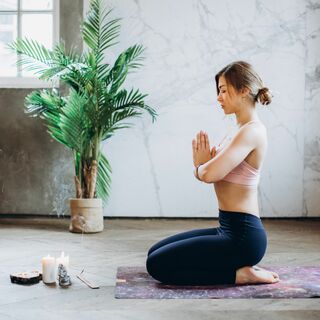
It is a surrender to a higher power It is about surrendering to the principle of life and not sticking to what we have managed to accept our limitations The third branch of yoga is Belmon It is Asana and the basic meaning of word Asana is the ability to stay calm and long in a selected position Sitting is considered the basis position because it's the most suitable for practicing pranayama and meditation And in order for our body to be stable and relaxed in the selected seated position It is necessary to prepare it with regular exercise Then we will perceive the world Asana as a yoga position that will lead us to this goal Regular practice of Asana also have a positive effects of human health It stretches and opens the body and calms the mind.
During the exercise the internal organs are stimulated Which contributes to the proper functioning of the whole organism.
Practicing asanas is also a form of self-knowledge We learn to perceive our body,
Breathe properly and we learn to direct the mind.
Another yoga branch is pranayama Which is also well known.
Pranayama principle lies in working with life energy,
Prana,
By using the control of the respiratory system Pranayama aims to awaken,
Activate and regular the energy of the Kundalini that is resisting in each of us Pranayama is considered to be the most effective practice leading to transformation and spiritual development The fifth branch of yoga is pratyahara Pratyahara principle lies in detachment of the senses from the external environment and by directing the senses inward We stop being distracted by the external perceptions and the mind is able to focus on selected object Another branch is dharana and dharana principle lies in connecting the mind to one object or place It is the training of concentration of the mind and concentration is the beginning of meditation The mind tends to always run away all the time and our job is to bring it back every time The age of the eight limbs of yoga prepares us for the next one So whereas pratyahara teaches us to shift our focus from the external to internal dharana teaches to kind of zoom in so that we can focus solely on one thing and most of us have Experienced what yoga refers as a monkey mind.
So restless thought that jump around like monkeys sleeping from tree to tree So learning to focus our attention on a single thing takes some discipline and patience And the last branch of yoga is called samadhi Samadhi is a Sanskrit word that means liberation or realization In order to achieve true freedom we must transcend our self and our life and there is a reason it's called Realization reaching samadhi isn't about escaping floating away or being always joyful It's about realizing the very life that exists within us right now Samadhi is a culmination of meditation.
It has several levels and is the highest state of yoga That was it.
Thank you