Hello,
This is A.
Le Fay of Sylvanosity,
And today I'd like to share the opening chapter of my novel Edith Shay.
It begins with a telegram,
Dated August 2,
1869,
Received at Clarkston,
Michigan office,
To Mrs.
Charles Roberts from Mrs.
Albert London,
Catherine arriving August 9,
Train arrives 9 p.
M.
Keep her waiting.
We'll send money for return fare.
Candace Chapter 1 Wayward My hands were addicted to ink.
For as long as I can remember,
I favored a good newspaper over maple syrup candy floating in a cup of cider,
A cool dip in Miller's Creek on an egg-frying hot day,
Or even a trip to Madison.
In my mind,
The only rival to a good newspaper was a train headed out of Wisconsin.
The truth was,
Trains and newspapers were my passions,
And there was nothing I could do to get them out of my blood.
On Saturdays,
My father shoveled coal to chip away at the balance of the note the bank had on our family for building a fancy plank house in the middle of Wisconsin logging country.
While father worked with other men to fill the coal car,
I kept my place on the bench beside the employee door.
I watched people as they dribbled out of the train stairwell,
With wrinkled clothing,
Wobbly knees,
And pasty smiles that met their hosts.
When the last person staggered from the steps,
I watched the windows to see the conductor pass through the train,
Looking left and right,
Making sure nothing and no one but himself remained behind.
No matter who the conductor was,
Young or old,
Fat or thin,
He would squint up to the sun and adjust to the bright light as he came down the steps.
On the platform,
He'd stretch out his back and check his watch.
Conducting creates an obsession with time.
Close to a hundred conductors stepped under the platform.
In the ten years I'd haunted that bench,
They all knew me by name.
The man from Minneapolis with the eyebrows resembling misplaced mustaches always patted me on the head as if I were the dog he'd left at home.
Here you are,
Catherine,
He'd say as he handed me the paper.
I like the script and the star,
But the print was often smudged due to his sweaty hands.
One conductor I can recall right down to the mason's pin on his collar was a man named Buford.
I couldn't believe my ears when I heard the railroad was adding a connection to Chicago.
Seeing Buford made me a believer.
I saw the newspaper tucked under his arm as he stepped off the train.
It was almost as thick as a pound of sliced bacon,
With far too many pages for local paper.
The letter cresting over his wrist was a C.
I inched to the edge of the bench and said,
Excuse me,
Sir.
He stopped and tipped his hat to me.
Hello there,
Young lady,
And what's your name?
I stood right up and pulled out my skirts to smooth the wrinkles.
Catherine in London.
Proper name.
Mine's Buford Marks.
Now,
What are you doing sitting here all by your lonesome?
Waiting for a newspaper.
He laughed,
With the dry-knittle crunch of an old man.
Now,
What do you want with a paper?
To read it,
Sir.
Read.
The laugh seemed to be swallowed by his expanding eyes.
He tapped the paper under his arm.
You want to read his paper?
Yes,
Sir.
What for?
Chicago's in there,
I pointed.
Aren't you a bit young to be traveling to Chicago?
Yes,
Sir.
I just wanted to know more about it.
All right,
Then.
He handed the paper to me.
Free of charge.
With the paper in hand,
I could go anywhere in Chicago.
From an advertisement for fresh fruit on the third page,
I could walk to the market on the corner of Michigan and Third and buy apples for a penny apiece.
There was once a full-page article about a museum exhibit on safari animals.
By the end of it,
I could see the hardwood floors,
Polished to a shine,
Reflecting wavy images of the giant stuffed beasts carried across continents.
Then again,
Given my mother's view on leaving home,
I was lucky to be able to step outside my front door.
She even objected to my job at the Mercantile,
Changing window displays and restocking for Mrs.
Bofield.
Mother felt I should be home keeping house as a good woman did.
Since I had turned 16,
She regarded me as a woman.
It didn't make me feel all that womanly,
The way she had me scrubbing floors and chopping wood.
A woman wore fine clothes and hosted tea socials in her parlor.
We didn't even have a parlor.
The thought of my leaving made my mother rigid and silent.
I guess maybe she knew I was raising money so I could make my way to Chicago.
She'd rather I'd married some Wisconsin farm boy and settle down.
I longed to marry two,
But not some country boy.
I wanted to marry a city gentleman who would treat me like a lady and take me to the far reaches of the country.
Mother finally asked me about my job when she took in our first harvest of apples.
She was cutting apples for a pie when I came in to help her with supper.
Without looking up,
She asked,
What does Mrs.
Bofield have you doing down at the store?
Strapping on an apron,
I said,
Unpacking the new merchandise.
Mother hummed one low note then asked,
A lot of folks come in on Saturday,
I suppose.
Yes,
It's nice to see everyone when they stop in for supplies,
I said,
Taking an apple to court.
She nodded.
A smile crossed her lips.
You see any young men you fancy?
No,
I answered honestly.
Her mouth slid into a frown.
She cut up an entire apple before she spoke again.
Your aunt Fran has asked for help with this year's harvest.
I wrote to tell her you'd be glad to.
And she was so delighted she sent you a ticket.
My fingers froze at the thought of actually stepping onto a train.
I had watched hundreds come and go.
But I never thought I could afford to sit in one of those cars with a cloth covered seats and hanging lanterns.
Since I had only a $1.
85 saved,
Chicago was still well out of my reach.
But Michigan would bring me closer.
At that moment,
I thought Mother had given me her silent approval.
When I didn't speak,
Mother continued without stopping her work.
It's nothing to be excited about,
Catherine.
It'll mean 21 hours on a train.
Your aunt will expect you to work.
And I mean work.
It won't be nearly so easy as the showcase work you do at the store.
The train could have gone in circles for all I cared.
I packed that night.
I placed two dresses,
Undergarments,
A hairbrush,
And three newspapers into a satchel.
The slumped over cloth bag sat by the front door for over a week.
Mother kept tight-lipped and dry-eyed right up to when she saw me off at the front door.
Gripping my hand,
She said,
Come back to me,
Catherine.
I smiled,
But I wanted to cry.
Come see me off,
I said,
As I tugged her towards the front steps.
She shook her head.
My feet are planted on this land.
I don't need to go.
My mother only hinted it,
But my father's farewell told me they were truly afraid I wouldn't return.
He kissed me on the cheek and sat down beside me.
Grandma Margaret made you these.
He held up three sandwiches wrapped in a towel.
They were honey and brown sugar,
Knowing Grandma.
Father slid them into my satchel.
He sat down,
Then held my hand.
When the conductor made the last call,
Father stood up and said,
You keep your head about,
You girl.
This world's a lot bigger than you think.
If I'd had any sense of what I was leaving behind,
I would have watched him as he left the train.
At the time,
All I could think of was that I was finally on my way out of Wisconsin.
The train wasn't what I had expected.
The seats were covered in scratchy woe.
The floors were so beaten down that they were warped and splintering.
The lanterns flickered and clanked as the train pulled out of the station.
I didn't care.
I was on my way,
But only to Michigan.
I've never been to Michigan.
I'd read Aunt Fran's letters.
It was all trees,
Rolling hills,
And little farming towns just like my own town of Moss Stone.
I wanted libraries with more books in one room than Wisconsin had in an entire county.
I longed for museums with bits and pieces from all around the world.
A lion that stuck railroad men on the savannas of Africa.
Butterflies that flooded their wings on the branches of trees rooted in the banks of the Amazon River.
Mummies who slept among their earthly possessions longer than my kinphone had walked this earth.
I wanted to be where I could catch a glimpse of the whole world.
Chicago was that place.
But my family would have none of it.
A city was no place for a fine young girl.
I wanted Chicago,
And I was getting Clarkston,
Michigan.
It didn't seem like a fair trade.
We didn't reach Clarkston until sunset on the second day.
The narrow platform was crowded with people waiting for the train to arrive.
I searched the crowd for Aunt Fran and Uncle Charles as we pulled in,
But I didn't see them.
Stepping off the train,
I felt as if I could float.
It was almost as if the rocking of the train had hollowed out my bones,
And I would have risen up in the air like a feather if I hadn't the satchel to weigh me down.
People slowly disappeared off the platform,
Some boarding the train,
Others collecting passengers and heading home.
But there was still no sign of Aunt Fran and Uncle Charles.
The station was a hollow shell by the time the train engine cooled.
I sat on a bench that looked like a church pew.
It still had the scratches and oil marks of a parish on the arm.
I sat through another arrival and departure waiting for my relatives to arrive.
The train whistles rattled the wavy glass in the windows.
When the second train left,
I began to pace the floor and watch the dust gather in clouds around my feet.
I quickly lost my patience and went to the ticket counter.
The man behind it had veins in the pattern of red snowflakes on his cheeks.
He smiled as I approached,
And the snowflakes expanded.
Can I help you,
Miss?
Sir,
Is there another train from Wisconsin today?
I think my relatives might believe I'm arriving on it.
The arrival times are up there on the board,
He pointed over my shoulder.
A man on the bench beside the window said,
Can't you read?
I turned to face the board.
The clerk pointed to in order to keep myself from shouting,
Of course I can read.
I've been reading since I was six.
It was just that I knew what I'd find on that board.
I'd see Chicago in bright white letters drawn in chalk,
And it'd be too much to resist.
I'd have to go.
To keep my mind off Chicago,
I recited the names of the 17 names of the United States with their terms of office and places of birth.
I got to Springfield,
Illinois for Abraham Lincoln,
And I had to take those letters in.
Springfield was right next to Lansing,
And Chicago was written in under Detroit.
The next train for Chicago left in less than an hour,
And the fare was only $1.
75.
No,
I couldn't go.
London's didn't leave their home.
By the time I was born in 1853,
The Londons had lived in Wisconsin for so long our name appeared on local maps.
The London woods was just above the dot representing milestone.
My great-great-grandfather had settled there as a trader before the American colonists declared victory at Yorktown.
Grandpa Jacob grew up on the farm his grandfather had carved out of the rugged woods.
From the day I was born,
I was told how I'd live in Wisconsin forever,
Marry an earth-loving man who would buy land adjoining ours.
He and I would build our house and raise a family.
Our children would marry local folk,
Settle down nearby,
Then raise their own families.
That was the way things were done in the London plan.
It was like a family gospel,
No one questioned.
I accepted my family's plan as simply as the way things were,
Until newspapers put a crack in my isolated home and showed me there was a whole world out there and a million ways to live in it.
Thinking back on all the places I'd longed to see,
I felt as if I was going to burst like a target practice apple if I didn't buy that ticket to Chicago.
The coins tucked away in my pocket were enough to cover the fare.
I could walk up to the ticket counter and slide those coins over to the ticket clerk with an open palm.
The clerk would adjust his gold spectacles as he asked my destination with a voice that echoed in his flattened nose.
Chicago would roll off my lips and he'd nod with a smile.
The ticket would be perfect,
No wrinkles,
No smudges in the fresh ink.
I'd carry it to the platform without sweating.
It would be crisp and flat when I handed it to the conductor and took my place on a velvet-covered seat.
The toll of the clock in the corner brought me back to the station in Michigan.
I had to keep my mind on my duty.
I thought perhaps my aunt had left a message.
Maybe they knew they'd be late.
I went back to the clerk.
Excuse me,
Do you have a message for Catherine London?
No,
Miss.
No messages.
What seems to be the trouble?
The man on the bench spoke up again,
His gravelly voice scraping inside my ears.
She's not a traveler,
That one.
Nervous,
I suspect.
Papa always said,
I've got a temper that boils quicker than water on a bonfire.
And I was ready to push that nosy old man right into the flames.
What did he know of my travels?
I kept my eye on the clerk's rosy snowflakes.
My relatives are simply late,
Four hours late.
Perhaps they had trouble on the road.
Do you need someone to take you in,
Miss?
The clerk asked.
A Frenchman stood up to say,
Young girl like you shouldn't be left to her own defenses.
No stranger was going to tell me my needs.
Thank you.
No.
I said to the clerk,
Ignoring the other man altogether.
I went back to the pew where I'd left my satchel.
My body was too tired to pace,
But my muscles were too eager to keep still.
So I sat down on the bench below the slate board and let my feet sway.
The rush of skirts pulled my purse to the floor.
I bent over my knees to pick it up and came face to face with a cracked leather suitcase tucked under the bench.
The case carried the marks of great use.
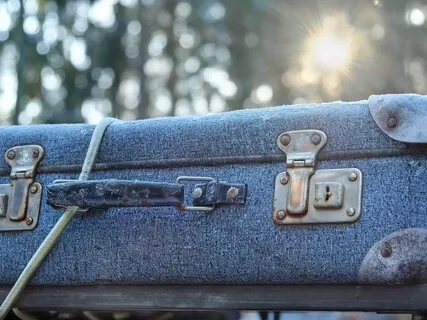
The brass clasps were tarnished brown.
The handle had been replaced with braided strips of twine,
Turned black with hands,
Sweat and dirt.
The studs that lined the seams scratched the floor as I pulled it forward.
The tag read Edith Shea,
1919 Fillmore Lane,
Richmond,
Virginia.
I searched the room for a face that fit the name.
I was the only woman present.
A man sat on the stool in the corner cleaning up the grooves in his pocket watch with his thumbnail.
The ticket clerk was conversing with a bench man,
The bench man,
Who wore a wool suit that blended into the browns of the wall paint as he leaned next to the ticket window.
I knocked the suitcase over.
The bang as it hit the ground didn't even raise an eyebrow between the two men,
So I carried it over to the shelf below the window.
My hands sweated with guilt as I opened it.
Inside I found no clues.
Nothing that would point me in the right direction to find the woman's destination in the Midwest.
There were 14 tiny packages wrapped in crisp brown paper of various shapes and sizes.
Beside them was a dark gray wool dress with black velvet trim,
A low round gray hat kept firm by a circular pillow covered with pink satin,
And a pair of smooth leather gloves that felt like the skin on my grandma London's cheeks when I pinched them for color before Sunday church services.
The bench man stood up straight when I set the suitcase on the ledge of the ticket window.
I ignored him and asked the clerk,
Did you see the woman who left this behind?
Obviously,
They weren't as good as they pretended to be about taking care of the women in the station.
The clerk bit his lip to hold back the laugh that shivered at his stomach.
Mess,
There are a hundred ladies who travel through here every day.
Is there somewhere I could leave this for her?
To be truthful,
I'd just take it home to my wife if you left it.
Most people get halfway to the next city before they realize they've left something behind.
By that time,
It's too late.
I have never seen a person with enough money to buy a ticket back here that had a suitcase with a rope handle.
The bench man nodded,
Saying,
Take it home yourself,
Mess.
You look like you could use a handout.
That was all it took.
His comment made me pull the suitcase back.
It knocked into my knees.
They buckled,
But I stood my ground.
I wanted to tell them I'd sewn the dress I was wearing with my own two hands out of fabric that came from the store I helped stock.
But then I thought I'd only be adding to his insult,
So I decided to show him just what I could do on my own.
I pulled out the pine green coin purse my father had given me and paid for a ticket to Chicago with the money I'd saved up from working at the store.
I was on the train with the suitcase in my lap before I realized what I'd done.
It was wrong to take another woman's suitcase,
Even worse to abandon Aunt Fran without so much as a note to explain my whereabouts.
It didn't take a minute after I slid the suitcase and my satchel under my feet to prove that the bench man was right.
There was a woman in sight who didn't have a hat on her head and gloves on her hands.
There wasn't a single dress that didn't have trim or ribbons.
They wore dignified colors like cat gray and burgundy,
And I sat in my plain cornflower brood dress that barely touched the top of my shoes.
I sank into my seat in shame.
With only ten cents to my name,
I was riding toward a city I only knew by heart and print,
But had never seen.
My ticket was soaked with sweat,
And the conductor stared at me when I handed it to him.
Are you traveling alone,
Miss?
Yes,
Sir.
Shaking his head,
The conductor walked away,
His watch-fob rattling.
I thought he was just old-fashioned.
Women could do quite well on their own.
A man need not lead them everywhere.
What was going to happen to me on a train,
Anyway?
The excitement of going to Chicago put Wisconsin far behind me.
I could see the city in my mind,
The wide streets where two wagons could pass each other with room to spare for a horse or a bicycle.
I'd seen an advertisement for one of those two-wheeled bone-shakers.
How I longed to try one,
Wheeled my way around the pond and Humboldt Park,
Past the ladies with their parasols,
The gentleman with tailored suits and walking canes.
I'd seen the beautiful park and real estate advertisements for the Humboldt Park neighborhood,
Which had a depot for the Chicago Pacific Railroad,
The park,
The Power Hotel,
And even walks made of concrete so smooth you could iron fabric over them.
I had newspapers to thank for all of my ideas of Chicago and everywhere else for that matter.
My mother couldn't abide by my love for print.
When I was a child,
She told me I should find a better pursuit than filthy newspapers.
By the time I was 12,
She wouldn't hear a word out of them.
We were in the thick of the war with the South.
The threat of the rebels filled every page.
With the drawn pictures of men crouched low on the battlefield and the words surrounding them,
I could smell the blood and the smoke,
Hear the screams and explosions.
Father said the story scared Mother.
When he came home from the logging camp each night,
He called me over to the fireplace.
I sat at his feet and read to the rest of the family,
While Mother prepared the evening meal.
I remembered the shadows of the flames behind me dancing over the page.
For me,
The Civil War wasn't a battle waged between two sides over a cause.
It was something reenacted in thin line drawings and printed words that fed a teasing fire in my heart.
I was excited when headlines declared the end of another bloody battle,
Not because it was over,
But because I could take it all in detail by detail and bring them home to read in front of my family.
I thought of myself as the London's link to the rest of the world,
And the fire inside me was a growing desire to see the world outside of Chicago and Wisconsin.
My mother made it her duty to try to douse that fire.
I remember her on a night early in March when she told me to help her wash the dishes.
She didn't even look up from the bowl she was drying when she said,
I know you well enough to put your skin on and fool the Lord himself.
I know you have your eyes on living in a city.
You can't wait to pack your bags and find yourself in Chicago.
Why not,
Mother?
Think of all the places there,
Museums,
Libraries,
Curio shops.
And what do you need of all that,
Catherine?
You have a family right here,
A house your father slaved for.
You have no right to leave it.
I'm not going to live here forever.
I'll be married someday.
Wisconsin's been this family's home since they came to this country.
I see no reason why it can't be yours too,
For life.
Her standard speech sounded like a bad sermon.
She delivered it whenever my brother Thomas or I talked about going with father on his annual trip to visit relatives in Mankato,
Minnesota.
Her connection with Wisconsin made it a sin for her to even talk about other states.
Her sister Fran had committed the greatest sin by leaving the state entirely and settling on a Michigan cherry orchard with her husband,
Charles.
I had to ask her,
Don't you ever want to see what's out there,
To know what lies beyond Wisconsin?
Outside Wisconsin?
She bit her lip,
Chewing her thoughts before spreading them out.
I've seen what's outside Wisconsin.
My father worked himself to death in a Virginia coal mine,
Turned him black inside and out.
He came home on holidays,
Coughing up bits of coal into his handkerchief.
All he could talk about was coming home with enough money to move into our own house.
His last letter said he would settle for being home in Wisconsin,
Under any roof where he could rest.
He was put to rest all right,
Six feet underground on our family plot.
She pointed at me and I shivered.
Don't ever try and tempt me with places outside Wisconsin,
Catherine.
This is my house.
It's where I belong.
And you'd consider it your home too,
If you had the good sense God gave you.
I thought I could wear my mother down,
Show her over time how wonderful Chicago was.
But the world conspired against me,
Flinging something horrible my way to crush my love of newspapers.
The first blow came when my reading performances ended on April 21st,
1865.
It took a week for the news to travel west on the Burlington line through Chicago.
I stood in the doorway,
The paper rattling in my hands as I fought to catch my breath.
The whole household stopped to listen as I read the report of Abraham Lincoln's last hours.
After weeks of disturbing dreams about his own death,
President Lincoln had gone to see My American Cousin at Ford's Theater,
Just five short days after General Lee had surrendered.
During the third act,
The actor John Wilkes Booth burst into the President's box with a knife and a derringer to shoot the President in the head before jumping to the stage to make his escape.
It was almost too unreal to believe.
Reading the article made me feel hollow,
Right down to the tips of my fingers.
No one spoke as I turned the paper down to see their reaction.
My mother stood at the stove as the pot she had been stirring boiled over.
Grandpa and Grandma sat on the bench below the window in the sitting room,
Their hands locked together so tight,
Their knuckles widened.
My father walked up the stairs and didn't come down until supper.
Thomas and I went outside to read the article again.
We couldn't believe a man could charge out of a play and shoot the President.
The following Saturday,
Father told me to keep my paper to myself for reading practice before bed.
Any word I spoke at the dinner table was silenced by a stare.
I suppose they believed the bad news would never come if I had not read it out loud,
But I knew different.
I'd been reading about the little children who lost their hands to the churning looms of the textile mills,
The entire family swallowed by flames in tenement fires,
And the bent wreckage after trains collided.
The newspaper was filled with those horrors,
But I had always thought that they had happened far off and over there.
They were the freak accidents that would never happen to me.
I overlooked them,
Forced myself to forget them,
And turned and said to the beautiful descriptions of gala balls and museum exhibits.
Those were the things of the world I wanted to see.
My family wanted nothing of the outside world,
And I was drawn to it as if my soul had been set adrift and I had to follow it.
But no one had understood.
They all thought I was simply lost in my own daydreams.
But now here I was,
Riding across the Illinois prairie,
And I'd be in Chicago in no time.
No time at all.
The thought of it made my insides turn to ice.
I'd be there by early evening,
And there was so much to do.
If only I hadn't been so foolish with my money.
I'd purchase the fabric for my dress,
The satchel for my things,
And enough lemon drops to rub my teeth.
I only had ten cents.
What could I do in Chicago with ten cents?
I'd have to find a place to stay.
A job.
I would need to find a job that offered room and board,
Along with a decent wage.
I could cook or sew,
Perhaps stock shelves in a store.
In no time at all I'd have enough money for a fine dress,
Perhaps my own apartment with lace curtains and a window overlooking a park.
I had all my plans lay out as it drifted off to sleep.
Chicago would be the land the newspapers had always promised it to be.
You know,
It can be hard when we have very different dreams for ourselves than the thoughts our parents have for us.
The differences between our visions for our lives can stay with us for long periods of time.
And it begs the question,
How can parents and children meet in the middle?
Perhaps you're not the child in this case,
But the parent,
Wondering how to help a child understand the practicalities of life,
And why their dreams may not be the safest choice or the best choice for them.
In reality,
Each individual has to make their own choices about how to shape their dreams,
To pursue their dreams.
And the best thing we can do as parents is to support them as they travel towards their own destinations.
Likewise sometimes translating our dreams to our parents can be difficult,
But it is well worth the effort to show them the world as you see it.
If you want them to be open to seeing things from your perspective,
Then you need to be open to seeing things from their perspective.
And the sharing of views of the world might bring you even closer together,
Even if your goal is to travel far apart.
Thank you for travelling with me through the opening of Edith Shea.
This is Elif E.
Of Sylvanosity.