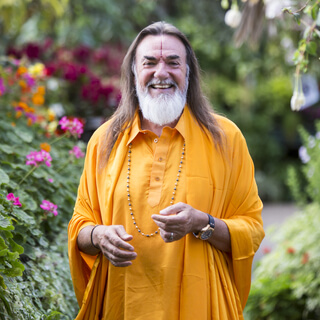
Namaste!
Welcome to Chats with Swamiji.
For more information,
Log on to www.
Swamigovindananda.
Com Hello again everyone.
We're back.
Chats with Swamiji.
Namaste Swamiji.
Namaste.
Great to have you here again.
So as you know,
Right now we're facing COVID.
And one of the topics that has come up as very interesting is this idea of poverty consciousness.
Because a number of people are losing their jobs,
They're worried about their income,
Instability and insecurity.
So I'd like to actually understand from your perspective.
First of all,
Have you personally experienced poverty or witnessed poverty in your life?
I personally haven't gone without.
I haven't been wealthy either.
I grew up in a very humble family in New Zealand.
It was a time when there was a one-car family.
That's how people were in those days.
My father would make toys out of wood.
He would do it himself.
My first bike was a secondhand bike.
I worked in the family business delivering groceries,
Etc.
,
After school.
So,
You know,
It wasn't a wealthy,
Well-to-do environment at all.
It was quite humble.
But witnessing poverty,
I first came across that when I went to India to see people sleeping in their sort of built-up concrete thing between two lanes of cars.
And traffic like you wouldn't believe.
Honking of horns and pollution in the air and mist in the winter.
To see these poor souls with just a sheet over their head and sleeping through that.
So I have seen that.
And I know that people are doing it tough.
And,
You know,
So I have to be careful here that you don't just dismiss people's concerns.
Because they're very real.
But I do think often it's kind of a first-world problem.
If you can take that expression.
I think most of us do have shelter.
We do have clothing and food and transport.
Perhaps people have mortgaged themselves or are in a rental situation which on a typical normal year wouldn't be a problem.
And they need to downsize.
They need to rethink how they're going about it.
That's probably a reality for a number of people.
And that is one of the reasons why spiritually to understand about the rhythms of life and the choices that we have.
You know,
There's an axiom that's a Western one.
You know,
It's not what happens to you in your life.
It's how you react to it.
Which is the character building and the main thing.
And that's easy to say and not so easy to do.
But when you get the knowledge of the philosophy,
For example,
Of the Vedas,
And it talks about the qualities of your mind and the quality of thought and about cause and effect,
Which here we know as destiny.
In India they'll call it karma.
There are many things that come into play.
And so for those who are doing it tough,
I would recommend that perhaps they walk this journey with me and learn a little bit more about the mind and about how you react to life and about strengthening your spiritual energy,
Your spiritual power.
You know,
Knowledge is so good.
There's such a simple example I use where if two people are having an argument with each other and their faces are contorted and their egos are inflamed and they're saying things that on a normal kind of situation they'd never say those things,
But because they've got carried away in their argument they're saying things without much discrimination.
And these two are really ding-donging at each other until one of them actually suddenly dawns on them that they have misunderstood,
That they have got the wrong end of the rope,
That the other person has been right all along and it's just them standing stubbornly for something which they hadn't thought through properly.
The moment that understanding dawns,
Then,
You know,
A sense of embarrassment comes,
A sense of apology,
Of humility comes,
A sense of wanting to make up the circumstance,
You know,
The situation to heal it because you think,
Oh my gosh,
I'm really sorry.
I can't imagine why I took that tack.
I didn't realize.
That's the power of knowledge.
It can undo in the twinkling of an eye,
Build up stress and anxiety and anger and lack of self-worth,
Etc.
So that is why they say the word sangha.
Sangha means association.
And there's two types of association.
One is called satsang and the other is called kusang.
These are Sanskrit words.
Don't worry about the word themselves,
Except.
Satsang is to understand the spiritual truth of your being and that enables you to put your life into perspective.
It's like a pressure cooker,
You know,
The steam builds up and then it's released through the top.
That's what a pressure cooker does.
And this kind of knowledge,
This satsanga,
It enables you to release the built-up tension.
You go,
Oh,
Of course.
And you reset,
You rejuvenate,
You get your confidence back,
You get your focus back.
And even though your problems of the world haven't just dissipated because of that release,
They're still there.
But your attitude and your understanding and your approach is very different.
Now the other word kusang,
This is exactly the opposite to satsang.
Instead of having a pressure valve to release through wisdom and understanding,
It's kind of like what you call common knowledge.
It's something that you learn at the breakfast table,
When you watch TV,
Your friends in the uni.
It's people's opinions going around and around without much understanding of their spiritual nature at all.
So that kind of support,
Though you could say community is very valuable and family support,
It's true,
Those are all valuable things.
But this kusang side of things doesn't go deep enough.
And so the moment you find yourself in turbulent waters of life,
You lose it.
You lose your equilibrium,
You lose your calmness,
And you know,
Stress and anxiety and anger starts to become who you become that.
And nobody wants to be that.
And then you'll say,
Well,
Look,
I'm like this because I have the pressure of and under these COVID days,
There are a number of people who could justifiably say,
Look,
I'm struggling to pay the rent,
I'm struggling to keep my family from,
You know,
Arguing all the time,
I'm struggling to just find work,
I'm struggling to pay my debts.
And so those things conspire to make us very,
Very uncomfortable with our life.
Now that's an awful thing to say,
Isn't it?
I'm uncomfortable with my life.
I'm uncomfortable to be in this human experience.
And so that is pure kusang.
That is going away from knowledge of who you are,
What your choices are with your mind and your body and your spirit and your spiritual power.
There's a danger when you say these words,
Spiritual power,
Etc.
,
Because they're almost cliche terms.
And,
You know,
In the world,
There are a lot of chiefs and very few Indians.
You know,
People have got remedies of how to fix your problem when their own problems are a mess,
But they'll still say this is what you should do.
So the world is a confused place right now.
And one of the things that attracted me to this pathway in the first instance,
It wasn't an individual in a soapbox.
It wasn't like a science fiction writer who came up with a jolly good idea and managed to package it up and,
You know,
In a way that everybody says,
Wow,
That's really good.
But it's not good at all.
It's just a self-opinion that's promoted and marketed extremely well.
And so it will not satisfy.
It cannot.
So I was attracted to the Vedas.
You know,
There's a verse about the Vedas.
I know the Western audience would go,
The what?
You know,
Many people don't know.
But the Vedas is a verse,
Nihasvasita masya vedaha,
That's Sanskrit language.
And says the Vedas are the breath of the eternal.
They were never made.
They'll never be unmade.
They just are.
Now you could say,
Oh,
That's a big claim,
Isn't it?
You know,
What is it,
An eternal book?
No,
No.
When personality is called the guru,
You know,
If an individual soul comes to realize the essence of the Vedas,
In the full context of the meaning,
They are authorized and qualified to represent.
And so this is how the Vedas are kept alive.
Yes,
There are writings that manifest 5,
000 years ago by a personality who's known as Vedavyas.
Yes,
He noted down the Vedas,
But he didn't create them or think them up or invent them.
He represented.
Along comes the souls like you and I under the guide or guidance of the guru.
When we come to understand that,
We become the guru in that sense.
This is a big,
Big subject as you can understand.
So the difference between somebody on a soapbox and a body of knowledge that many,
Many people have followed,
Experienced and said,
Yes,
Come on,
This is really good.
That appealed to me.
Not somebody on the street corner pontificating.
And so the more I got into the Vedas,
The more I understood the value and then you come back to your COVID question.
You know,
It's a difference like being on the great oceans in a little one-meter rowing boat,
Trying to deal with all the weather patterns of the big ocean and I mean the most scariest stuff or being in a big ocean going liner.
And the ocean going liner,
It's equipped to deal with these big waves and the wind,
Etc.
And when you're in these big ocean going liners and you hear the captain's voice through the PA system saying to you,
Be careful everybody,
We know there's a storm coming,
Just hold on to the galleys,
Ways,
The banisters,
Etc.
Don't go on deck.
You're okay though,
Because we know that in 45 minutes we'll have passed through the storm and you'll be perfectly fine.
Now in this analogy,
The size of the ship is the depth of your knowledge.
The captain speaking is your intellect,
Advising yourself,
Look,
We're equipped for this,
Don't worry.
Imagine you're in the COVID scenario and you've got this depth,
The ocean going liner,
The depth of understanding and the confidence about this birth and death,
About the value of human life and how you react to what's around you that you are being taken care of.
You still got somewhere to sleep and eat,
Etc.
You may have to modify,
But you are okay.
You're okay.
That's priceless.
Okay,
So what I'm hearing is more about that,
We're talking about a temporary poverty experience then,
Since we're in COVID.
I was quite puzzled when I went to India myself for a volunteer project and I saw people in orphanage with kids and slums,
As well as old people that were actually left on the street and were being looked after.
The kids were just amazingly more happier than any other country I've seen and the elderly were actually peace and calm,
But they barely had much food to eat in a day and they were all wearing the same clothes every day.
So,
Now,
Forgetting about temporary poverty,
But these people are in a permanent poverty state,
What's different about their consciousness?
I would expect,
Rishi,
That's kind of a generalization,
But you are correct in that I have seen villages at the back of the ashram,
For example,
Who don't have electricity that pump water,
Pump it for their bath,
Standing outside on a slab of concrete,
Washing themselves.
And yet the glow in their eyes and the smiles and the playfulness,
They would invent games like just the rim of a bicycle without the rubber on it and they'd have sticks and they would sprint with the stick inside the rim of the wheel trying to keep the rim from falling over on the ground.
The laughter and the joy,
You're absolutely right.
I mean,
I actually,
When I lived in the ashram,
I used to love going and walking through these villages.
They got to know me.
As I was learning the Hindi alphabet,
You know,
Kakka,
Ki ki,
Kuku,
Kekai,
All these children used to just get behind me like the Pied Piper when I would walk along practicing the consonants and the vowels of Hindi.
They would repeat it after me,
You know,
And so,
You know,
I became known to them and them to me.
But your question about,
You know,
Long-term poverty versus short-term poverty,
You could say that the DNA of the Indian culture is they do understand about karma.
They understand about consequence and they do have a rhythm of life which is very different from us.
I used to watch the manual laborers and they would work long hours and I think,
How can they do that?
Until I observed that the rhythm that they went about it wasn't manic,
Wasn't rushed.
They weren't in a hurry.
They didn't have a zillion things they had to do.
They just worked at a pace that enabled them to keep their energy and their calmness about them.
And so,
I suppose the example I gave of someone sleeping between the cars coming and going,
I never really observed their life perhaps like you suggested you have,
But I have observed the poverty of villages and the calmness and the peacefulness.
And so,
I do think that they have a sense of going with the flow as Bhagavan wills,
As God wills.
They know their potentials.
There are class systems in India and it's very hard,
I think,
To change from one circumstance to another.
It takes a lot of connection,
A lot of education,
And a lot of them just know that that kind of education is beyond them and so they accept where they are.
So,
Would you say then that poverty is more a mental,
I guess,
Consciousness?
Or is it more physical?
It's a bit of both.
Certainly agitation,
Any agitation that we have,
You know,
It comes primarily from the mind.
There's definitely agitation of a sickly body and there's agitation from heat and cold,
The external,
The weather.
But primarily the main driver of your life force is your intellect,
Your understanding.
And that is why I just love this philosophy because it really does say,
You know,
There's a verse,
Chaitaha Kalvasya Bandhaye Muktaye Chatmano Matam.
The Sanskrit verse says,
Your mind,
Your mind,
It can elevate you and rise you or it can bind you to suffering and misery,
Your mind.
You can go in either direction.
And so it stands,
Doesn't it,
To reason that if you can understand how all this works,
Then you are empowered to make decisions that will help you to elevate and rise upwards.
Now that's quite a privilege.
I say privilege because to have the luxury of meeting a teacher who really understands this and can pass it on to you in a way that you accept and understand and put it into practice yourself,
That's something that actually takes effort.
It takes dedication.
You know,
For example,
If you say you're hungry,
I mean,
Let's say you are hungry.
Just saying the word food is not going to satisfy your belly.
And just by saying,
Look,
I'm a king or I'm a queen doesn't make you royalty at all.
And just saying,
Okay,
I understand how the mind works,
So that's all I got to do.
No,
A lot of effort is required.
A lot of effort.
So the COVID scenario,
I think everybody has the opportunity to improve on where they are.
They may not be able to make quantum leaps into the heights of the sages.
That may not be possible.
But we can all make decisions to be positive and to move towards what's come our way with a way of let me find a solution to this rather than let me freak out about it,
Let me blame,
Let me get angry,
Let me get so mad at society for making me like this.
You're taking the line into trouble.
Instead,
If we can learn to use the mind in a positive way and say,
Okay,
This is a difficult hand I've got in terms of life,
But there are opportunities.
There was a very interesting lecture that you gave maybe two or three weeks ago.
And it was interesting because all of a sudden,
Sometimes as humans,
We start thinking,
Oh,
What are we going to do about this because let's go and help and change people's lives and give them things,
Etc.
There was a story about Shiva and Parvati where Parvati wanted to help in terms of reducing miseries of people.
Are you able to maybe share that story?
Because it was a great learning for me that you really can't just all of a sudden change your circumstances,
It was more about changing your own mind.
Yes,
I mean,
Just very quickly,
That story,
Parvati and Shiva,
They are manifestations of the divine one.
You know,
They have divine qualities and divine purpose.
There are many different forms of the one God and Shiva and Parvati are forms of the one divine being.
And so Parvati,
The partner of Shiva,
She said,
You know,
When they were visiting Earth,
Why don't you do something to help people?
Look at all this poverty.
I mean,
You know,
You're God for heaven's sake.
Why don't you do something?
Now,
Of course,
Parvati knew the answer,
But for us to help through this example to understand.
So Shiva said,
Well,
What would you have me do then?
How would you go about this?
And she said,
Looking down a deserted pathway,
Except for one man,
A very poor man was coming along the pathway.
And she said,
Well,
Look at that fellow there,
For example.
Now,
You can tell by the way he's dressed,
Et cetera,
That he's very,
Very poor.
So why don't you manifest a bag of gold and put the gold on the pathway?
He can't miss it,
Right?
There's no one else around.
So put it there and look after him.
So that's what Shiva did.
And they retired,
You could say,
Behind the bushes just to observe what was going on.
And as this poor man was approaching the bag of gold,
He was thinking,
You know,
My circumstances are really bad,
You know,
I'm so poor,
Et cetera.
But he said,
At least I'm not blind.
That would be horrible.
Actually,
What would it like to be blind?
And so he thought,
I'll shut my eyes and I'll walk,
You know,
A few paces and see.
So he shut his eyes and he walked maybe 10 meters,
Which is,
You know,
If you've ever tried that,
It's a little scary outside.
But he managed to do 10 paces,
10 meters,
You could say.
And in so doing,
He walked past the gold and didn't see it.
When he opened his eyes again,
The gold was behind him,
So he didn't turn around,
He had no idea.
And he said to himself,
Oh,
What an experience,
At least I'm not blind,
So I'm not that bad off.
And he continued walking.
Now,
That story has many shades of understanding about it.
First of all,
Whilst we should be community-minded and charity-minded and try and promote people's circumstances who are far less than ourselves,
We can't insist that we're going to fix all the cures of people.
They have,
And that's a big discussion in itself,
They have their fate or their destiny to undergo.
And you can't just wipe away the consequences that they have brought upon themselves by the way that they've used their mind in the past.
That's a big lesson.
It doesn't mean that you lie down and say,
Well,
What will happen is my destiny and what doesn't happen is my destiny and I'll just relax and go for a ride and see what happens.
No,
In fact,
My guru would say only cowards shun proactivity and resort to destiny and fate.
And so that's a question I hope for listeners in the future you'll ask me to explain because it's intricate but it's very explanatory.
It gives us real understanding as to what we as individuals can do about building our future and what we have to undergo as a result of our past thinking and how we can relate to what we're undergoing.
So here's a scenario where people just lose their sense of balance.
I must go out there and fix the world.
I have to solve everybody's problems.
I have to build hospitals.
I mean these people are good of course if they actually put that energy and get hospitals done.
All power to them.
But sometimes people get so passionate they lose their own sense of balance.
And another aspect of that story is that the gentleman,
The poor person,
You know,
He said at least I'm not blind.
I could be worse.
And saying that he felt better about how he was.
And Sri Maharaj,
Our guru,
Would say,
You know,
It's the looking ahead at people who've got more than you is where you get into trouble.
For example,
Look,
I've got a motorbike but now I want a car.
Now I've got a car.
Now I want a Maserati.
Now I've got a Maserati.
I want to own my own apartment.
But I'm on the basement.
I want to go up into the penthouse.
And now that I'm at the penthouse,
Well,
Gosh,
You know,
I think I actually want somewhere that's got a yard.
And so it goes on and on and on and you look ahead at what people have.
It then creates the strong mechanism of desire in you.
You end up working so hard to achieve what you think will satisfy you.
It never does.
On the other hand,
Sri Maharaj,
He says,
If in your current circumstance you start getting agitated,
I haven't,
I haven't,
Haven't got,
Haven't got,
Haven't got,
Just look behind you because there's always people worse off than you.
Always.
And if you look back and you see,
Well,
Look,
I've got two eyes and I can see,
There are people with one eye who are totally blind,
For example.
So it's about what you understand.
That's the key.
And if you look retrospect at people less than you,
You'll feel better where you are.
If you look at people ahead of you,
You'll get desirous of wanting and that creates long hours at the office.
It creates marital problems.
It creates no time for your children.
Look,
There's a lot of problems inherent in that.
Now this is not to say don't be ambitious.
I mean,
Everything I express with you,
You know,
People could come along and go,
Ah,
Yes,
But.
Well,
You should know that in these discussions you can't cover all the bases.
What it is to say,
Though,
Is that your mind is the driver of your life's car.
And as I gave the verse that you can rise up or sink down by your own mind,
This is what,
This is,
As Captain Kirk or Picard would say,
The final frontier is to understand how you can genuinely elevate your spiritual nature,
Elevate your spiritual sense of joy,
To be calm and positive and focused and to grow.
That is the wisdom of the ages.
That is the Vedas.
That's what the Vedas are all about.
That is what the Guru is here to teach you.
So whether you have more or less is actually irrelevant.
Whether you're walking or going in your own private airplane,
It's actually irrelevant because your mind is your world.
Your mind is your world.
And what you think determines how you feel about yourself.
Whether you're peaceful or agitated or avarice or calm,
All of these kind of things,
How you think.
And this is linked with spiritual wisdom.
It's about the soul power in your body that enables your body to function.
It's about the mind understanding that and understanding,
Well,
What is the soul and why is it important?
Once you start to get these things,
You realize,
Okay,
If I become wealthy or poor,
That's not what I'm on this earth for at all.
Have or not have is another thing.
But to feel the spiritual nature of your being,
To have your mind under control and to be able to discriminate from the real and the unreal,
To walk in the footsteps of the sages,
Our history is full of extraordinary people from Buddha,
Christ,
Krishna.
These personalities were manifestations of hope and positivity and beauty.
And if you argue and say,
Ah,
Yes,
But that's them.
I can't possibly be like that.
Well,
You were defeated before you started,
Don't you think?
And I think one of your lines that is my favorite is that don't argue for your limitations.
So in this context,
If I am feeling like,
Oh,
I've lost my job,
I can't pay my mortgage and COVID's around,
I probably won't be able to get another job.
What's the one key takeaway that you can give our listeners that are going through that trouble and maybe a practical tip that they can do on a daily basis to just,
Like you said,
Keep that balance in their mind and keep the control and have the calmness and positivity?
Well,
Rishi,
You put it like it's a simple question with a simple answer.
It does bring into question understanding who you essentially are.
One of the tenets of Vedic philosophy is that your body is impermanent.
You might live to 30,
40,
50,
60,
70,
80,
90 years.
How long do we live?
And you're going to have to give up this body eventually as well as your possessions,
Your relationships,
Your achievements.
You leave all these things behind.
So once you start to understand that and you start to value your soul power,
The atma in Sanskrit,
Once you start to accept that,
Then the most practical thing would be sit down quietly,
Develop a nice deep breathing rhythm.
I say a deeper rhythm than you normally would breathe because most of us breathe not deep enough.
It's too shallow.
And what's the advantage of deep breathing?
Well,
For a start,
It calms you down.
Secondly,
It oxygenates your blood system.
Thirdly,
As a result of that,
The organs of your body function better.
So just sitting quietly,
Be it in your lounge or in the bedroom or under the shade of a tree in a park or by a river,
And breathing and then thinking,
Well,
What did Swamiji say about what the Vedas advise?
You are the atma,
The soul.
This body is impermanent.
It'll pass.
And just as clouds come,
I mean,
Surely you can't go out of your house and say,
You know that cloud up there,
It's been above my head for 30 years.
I can tell because it's got a little pink spot in the middle of it.
No.
We know the clouds get to and they move on,
Don't they?
So similarly,
Your circumstances,
They are temporary too and they will pass.
The only thing that is permanent is the soul power.
Now I know that's a little bit lofty in its expression.
But once you understand that and deeply understand that,
Then you can have a reset in the middle of this,
I'm freaking out,
You know,
I'm in the office and I've got so much stress or my partner is saying this or my child is not behaving or the stress of financial concerns and oh,
What am I going to do and nobody's employing me,
I may as well explode.
Or you could sit down,
Cross your legs or sit on a straight back chair,
Choose somewhere that you're not going to be interrupted.
Three to five minutes of deep breathing and think,
Well,
You know,
The soul,
All these great sages say the soul is an eternal power and the body's an impermanent power,
It'll finish and so are my problems.
I need a reset,
I need to find that spark of positivity.
I'm not going to give up,
I'm going to stand up after doing that reset and I'm going to start afresh.
Every moment is a new beginning.
Beautiful.
Well,
That's definitely a reset moment for me.
Thank you so much for your wisdom as usual.
And again to the listeners,
If you have any other questions,
Please come to www.
Swamigovindananda.
Com and put in your questions,
We'd love to actually bring them to life here.
Thank you.
Namaste Swamiji.
Namaste Rishi,
Thank you.
Your contributions help Swamiji continue his work.
To learn more about Swamiji's charity work,
Retreats,
Live and virtual satsangs or for mentoring opportunities,
Go to www.
Swamigovindananda.
Com