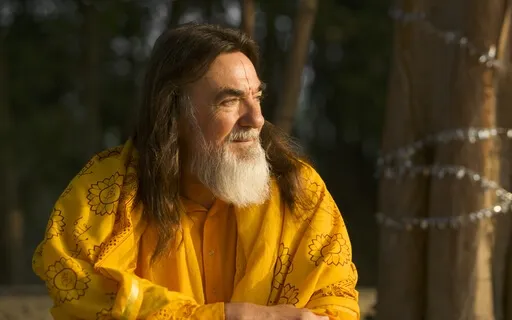
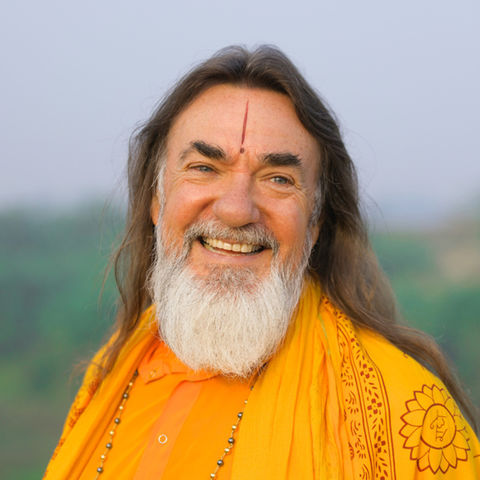
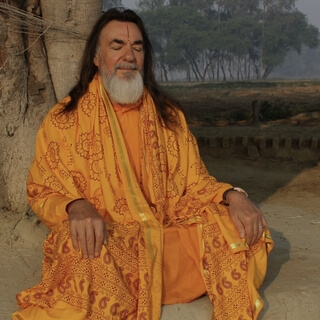
Namaste.
Welcome to Chats with Swamiji.
For more information,
Log on to www.
Swamigovindananda.
Com Welcome everybody.
It is an honor,
A privilege and a pleasure to host my Swamiji,
Swami Govindananda,
For all this podcast,
The podcast name,
Chats with Swamiji.
Namaste Swamiji.
How are you?
Namaste,
Rishi.
I'm good.
Thanks.
Thank you.
Now for those who don't know,
I mean,
I'm hearing a Kiwi accent.
Are you?
Well,
It's not surprising.
I mean,
Yes,
I'm born and bred in New Zealand.
I came across to Australia,
I think about 1990.
I'm an Australian citizen,
A dual citizen now.
But,
You know,
The Kiwi socks and all that sort of thing kind of just sticks and comes out every now and again.
So,
Yeah.
Yeah,
I think that's one of my favorite things about you.
So I thought for the first episode,
I would like to actually bring out a number of questions that are more about knowing you,
Your journey as well.
The first part is that nobody really thinks about becoming a spiritual seeker of truth or a guru.
I'm keen to know,
You know,
When you were a kid,
Were you actually thinking about what you wanted to become?
Well,
In a sense,
But not as a Swami or a teacher.
That never occurred to me whatsoever.
But I always had an eye on,
You know,
What is this all about?
You know,
I tried hard to fit into the mold of what is a typical New Zealander in terms of rugby and swimming and all that sort of thing.
And I still have an interest in those things.
But,
You know,
I went into the arts as a young man.
I went through a national drama school.
I got into professional theater,
Radio,
TV.
And all of this was just,
You know,
Prior to sort of hitting 21,
22 years of age.
So,
And I did that.
I was curious as to why I was doing that.
But I really wanted to feel the passions of life.
I wanted to shake the foundations of what life is about.
And I thought Shakespeare and such things would help bring out this expression in myself.
And whilst I had a good time doing that,
It was a lot of fun.
It's just like it did not satisfy.
So as a result,
You know,
A friend of mine said when I just turned 21,
How about we go across to Australia,
To Sydney.
So it's a rite of passage for New Zealanders to cross the ditch,
So to speak,
And have a look at Australia.
And I ended up in Sydney.
And then I was there for one year and halfway through that period,
That's where I came across a lot of wonderful writings that I'd never ever seen before.
Like,
You know,
Yogananda Paramahansa,
Autobiography for Yogi,
Milarepa,
Tibetan's greatest yogi,
Ramakrishna Paramahansa,
The Gita,
Such things like this.
And it was like the lights had turned on in my head.
And I thought,
My goodness,
If I do anything at all,
This is what I want to learn about.
This is,
This is what I believe,
What I've been looking for all this time,
Which is to understand the mystery of the self,
Why you're in the human body,
What is this thing called death,
What are we trying to achieve while we're in the human body,
Why do I feel out of sorts,
Why do I find that no matter what I do,
I still don't feel like I'm in focus.
And so that was the journey,
That was the beginning point.
And I'm curious to understand,
I mean,
You mentioned Shakespeare and then you went on to sort of more Indian type of philosophies.
What really triggered you to actually learn about those?
I mean,
There's so many different types of poets and philosophers out there.
Well,
You know,
When I went,
Came to Sydney,
A friend of mine who was also a professional actor back in Auckland,
New Zealand,
And Wellington,
He was already here in Sydney.
And,
You know,
I had taken an apartment with another friend and his friends,
Friends,
Etc.
And it was just a bit too crowded for my liking.
It didn't resonate with me so.
That actor of past said,
Look,
You know,
I've got this,
And it was,
It was the ex-governor's mansion in Randwick.
So it was a beautifully constructed building.
And there was the servant's quarters,
Which was a building separate from the main building.
And it had beautiful gardens and fountains and it was wooden floors and just really delightful.
So this was a two bedroom apartment.
And he said,
I am looking for someone.
Why don't you come and share with me?
I didn't hesitate.
Now,
What that's got to do with your question is there was a tradition that this apartment was kept within the acting fraternity.
And there was another tradition that if you bought a book,
You just left it there when you went.
So there was a little library building,
You see.
And within that library,
Here was autobiography of a yogi and Milarepa and Ramakrishna and so on.
And so I had never,
Ever,
I didn't even know what these titles were,
Rishi.
It's not as if I sort out these personalities.
They were there.
And when I started reading one or two,
I thought,
My,
This is extraordinary.
So the interest in,
I suppose it looks to appear to be Indian culture,
But it isn't.
It's universal.
The principles are what they would call sanaratandarama.
It's the eternal truths.
And it's for all people,
Regardless of your skin,
Your nationality,
Your language,
Your gender,
And so on.
So you could say by chance.
I wouldn't say that.
There's a term called praarabdakarama.
And maybe as we get into these discussions,
You can ask me more about that.
But it was kind of fatalistic in a way.
So when I read it,
It's,
There was an immense resonation.
I really felt like I was approaching home.
You could ask probably a thousand other people to have a look at these books and they go,
Oh,
Yeah,
And put it back again.
So that's what I mean.
There was an instant attraction to it.
So that's an interesting saying where you said,
Felt like reaching home.
I mean,
You're a Kiwi,
But you felt this was like reaching home.
So could you maybe elaborate a little bit?
It was more something that touched your soul?
Yes,
I would definitely say touches your soul.
I mean,
What would you consider the deepest part of yourself?
You know,
I could say it's my finger,
It's my nose,
It's my eyes,
But it's not,
Is it?
I mean,
It's the energy that makes us who we are.
And I've always wanted something to address that mystery of being.
What is it that makes us who we are?
Why am I like this?
What choices have I got?
What is my potential?
What are my failings?
I mean,
And I don't mean sort of psychoanalytic kind of approach.
I mean,
I wanted to learn,
But I wanted to learn from people who knew.
I didn't want to learn from somebody who got a degree,
For instance,
Or set up a shop and say,
You know,
I've studied and I've got a degree in this and this and this,
Come to me.
No,
I understood that spiritual knowledge is the essence of who we are,
But I wanted the best teacher.
And whilst I read these books and I was extremely fascinated by them,
When I finally met my guru,
I was grateful because he was able to take those principles and really shape it into my life so I could not only understand more about myself,
But clearly understand what I need to do to strengthen my spiritual awareness,
Understanding and experience.
So take me through that time of,
You know,
A young Kiwi actor that has come to Sydney and then now all of a sudden I see somebody sitting in front of me that's wearing,
You know,
An orange garb.
So what was the journey like?
What happened after you read all of this and did you actually go to India straightaway or did you kept reading?
Oh,
Rishi,
That's a huge question.
You know,
I'll try and keep it brief because,
You know,
After being in Sydney for a year,
My brother announced he was getting married back in Wellington,
New Zealand and,
You know,
Being the brother,
I thought,
Okay,
Sure,
You know,
I'll go.
And my intention was to go back for two weeks only,
Come back to Sydney and carry on.
But it didn't turn out like that.
I went to the wedding.
I connected with all my friends from Wellington.
It was nice to see them all again.
But the very morning that I was meant to fly back to Australia,
There was a terrible,
Which is kind of typical Wellington weather,
It was a terrible storm.
There was wind and there was rain.
I was staying in a friend's apartment.
I didn't know the layout of the apartment.
He had vacated it so that I could stay and he went to stay with his friends,
Which is very nice of him.
But,
You know,
The phone went when it was still pitch black and I could hear the window panes rattling and the wind and the rain.
And I leapt out of bed thinking,
What is that?
Where's the phone?
Where's the phone?
And I had to sort of rush around the apartment trying to find light switches,
Et cetera.
And when I got to the phone,
It was actually the airline saying,
Are you coming?
Because the plane is going to take off very soon.
And I said,
But surely,
You know,
With my wits about me saying the weather is so bad,
Surely you're not going to fly.
And they said,
Well,
Actually domestic flights,
No,
But internationals,
Yes.
And you've got 20 minutes to get here.
Well,
To cut the story short,
I got there in time to see the plane taking off.
My friend who rushed me out to the airport in the car said,
You know,
Freaking,
What are you going to do now?
Because I had no money,
You know.
But this calmness was over me.
I said,
Look,
Something's going to happen today.
To which my friend who was a reporter for a newspaper skeptically said,
What's going to happen today?
You know,
You've missed your plane,
You dimwit.
But really,
I ended up meeting a Swami on that particular day.
And in that evening,
Hearing a speech by him,
He had been overseas.
He's originally from India,
Even I think come from Fiji,
If I remember,
On part of his tour.
So when I heard him speak,
It was like the words that were on the pages of those books that I had read had suddenly manifest in a very wise individual who was speaking directly,
I think,
To the things that I wanted to learn.
And on that day,
I saw a black and white photo of his guru.
And the black and white photo totally captured me.
I recognized the Swami was a gatekeeper to the experience of meeting the guru in person.
And so I became his,
That is the Swami's secretary and assistant for a number of years,
Traveling internationally also.
But all the time my eye was on going to India and meeting his guru.
So you could say from 1975 to 1982,
I was in the care of the Swami.
But in 1982,
I finally,
I wanted to go on day one,
But the invitation finally came through in 1982.
And that is when I made the journey to India.
I met Sri Maharaji,
That's his affectionate name,
Full name Jagat Gurutham Sri Kripaluji Maharaj,
A legendary master.
And when I went there,
I stayed for four months on the first visit.
I came back again in 1985.
He had said to me,
You know,
Save a certain amount of money.
I didn't know why.
I thought maybe he wanted some kind of support for his projects.
But in 85,
He said,
Come.
And when I came with that small amount that I'd saved,
He said to me,
No,
No,
That's not for me.
It's for you to live off while you study to become a Swami.
So from 1985 onwards,
For a number of years,
I lived in India,
Learning personally from this great master.
And so time tick,
Tick,
Tick,
Tick.
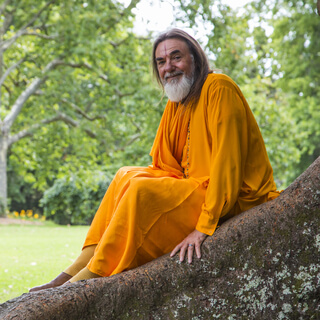
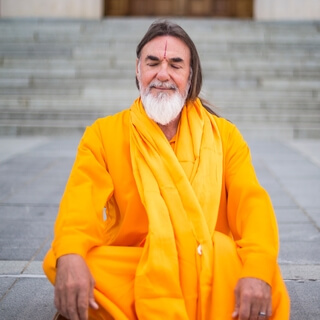
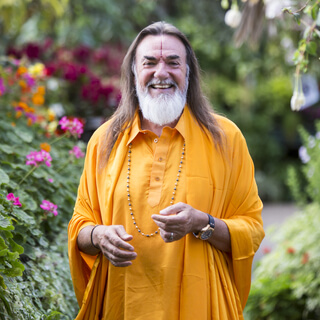
And now you see a gray bearded Swami sitting in front of you and orange robes,
Which has become natural to me.
I don't quite see people looking and saying,
Who's that flower in orange?
I don't really see that anymore.
So the aspiration to be a teacher,
To be a Swami never was there.
The invitation by my guru Sri Maharaj,
Because that's what he wanted me to do,
I understood that sewa,
That's a term to give of yourself.
And if the guru advises and tells you,
I want you to do this,
Then it's to your benefit to do so.
And if others benefit by me doing this,
So be it.
But I'm not on a crusade to save them or anything like that.
I merely pass on what was shared with me.
And if others feel benefited,
Then they should go deeper.
They should definitely.
So I'm just going to rewind back.
It feels like that you did go home all of a sudden when you did meet your Maharaj.
And you didn't intend on becoming a Swami.
It feels like that this is a service that you are doing for your spiritual master.
How did it feel to be somebody that did not have so much knowledge,
Like most of us who are seeking this,
And then all of a sudden going deep into the end and actually becoming a Swami?
Was it more about that you had made up your mind that this is what I'm doing and so I'm going to learn?
Or did you have trials and tribulations internally while you were going through this spiritual path?
It was quite easy a decision for me.
I know others definitely have in and out of,
You know,
It's too hard and I'm not sure I want to and how do I know and all those kind of questions that this is right for me and so on.
But for me,
The questions,
Those questions didn't come up.
And I suppose being a younger man,
You don't tend to look at the bigger picture of how much study you have to do in order to become that.
I just took one step at a time and Sri Maharaji himself had said,
Look,
This fellow,
This young man,
Me,
He doesn't know anything at all.
So there's no,
He can't do this unless I personally teach him.
So unlike many of the other brother and sister Swami,
Swaminis,
He definitely teaches them as well.
But he took personal care to teach me how to read and write and speak Hindi.
And then from there we progressed onto how to pronounce Sanskrit properly.
And from there I started learning verses from the Vedas,
Gita,
Ramayana and so on.
And he would check my pronunciation.
And while living there,
I had to not only study those verses,
Mantra or shloka as you wish,
But I also was given volumes of his talks,
Which is the bedrock for all of his teachers to learn,
Which is a series,
I think,
Of 17 consecutive talks,
Which I actually extrapolated further because they were quite intense.
So I broke them down into further steps so that the Western mentality,
So to speak,
Could keep up with it.
So studying those talks,
Which are peppered with these verses,
Quoting from the Vedas and so on,
Having Sri Maharaj constantly check me to live in the environment and participate in the sadhana,
Which is another term for meditation.
So the association,
It's called satsanga,
The association of the guru,
The environment and the ashram to be taught and to sit there day after day and absorb the teachings and practice and do meditation and have his association all combined,
I suppose,
To a fully absorbing experience.
So one didn't have time to speculate,
You know,
What's it going to be like when I'm a Swami?
You know,
How will it be when I get back to New Zealand,
Australia?
I wonder what my life is going to be like and am I good enough?
Am I up for this?
Maharaj,
He kept me too busy for that.
I didn't extrapolate any further other than this feels really good.
It feels like I'm home.
I'm learning about that,
Which I want to learn.
And you know,
There's a verse,
Sarabekshayanta nityaaha patananta hasamutrayaha.
This Vedic verse says only by going over the philosophy again and again and again and again,
Will it sink deeply into your consciousness and will you begin to understand its importance?
So that is why I understood doing this was the best thing possible.
It was an amazing grace and blessing that he gave upon me to take a typical New Zealand mind and put it in a very Indian culture in a small village in the middle of India and get me to focus on this most extraordinary profound philosophy.
If I had known the magnitude of the work,
You know,
I might have caught a breath and thought,
Oh gosh,
This is terrible.
But he never let me do that.
He just kept hold of me in a gentle way and kept urging me to go forward and kept me busy.
And it was an extraordinary experience.
And so you have been traveling all around the world,
Asia,
US,
UK and Australia,
New Zealand delivering programs.
I'd like to understand what is your mission,
Your hope for all the people that you are preaching to or are teaching?
I think the main thing is,
You know,
People are hurting,
They're suffering,
They're getting absorbed into their dreams and hopes of what they think their life will turn out as.
And you know,
If that's their choice and they want to continue like that,
It's not for me to pass judgment.
However,
The way that Sri Maharaj explains about the rhythm of birth and death and about the desire to be happy and where your true happiness lies and understanding how the mind works and the different qualities that you can bring out and manifest,
They explain it really clearly.
And if I encounter people,
Which I have,
As you've just said,
I've been around the world teaching,
My hope is that this will give a spark of interest in them to say,
Well,
No matter what I'm doing in my life,
You know,
I can augment that,
I can enhance it,
I can enrich it,
I can get clarity through this knowledge so that when I chase my aspirations,
I'm doing it with wisdom of the ages.
Men and women,
The sages,
The yogis,
The rishis,
The guru,
The Mahapurush,
Different terms,
But men and women through the ages who really deeply and profoundly given their life to understand what it is that makes me who I am and how I can take that knowledge and practically apply it into my life so that I rise up,
Which I become a better human being and I understand more about myself.
These are the ones who've left footprints in the sands of time,
Blueprints for us to follow.
And as you go deeper,
You begin to understand what is the guru,
What is the sage,
What are the Vedas,
Why are they important?
And you go,
My goodness,
You know,
I'm amazed that I got this far because it is,
It's so beautiful,
So profound,
Such pure gold that I could have easily turned away from it in the beginning because I had no idea of its value.
When you don't value something,
You go,
Yeah,
Well,
Maybe.
But when you do value something,
Like food,
Everybody knows you need food,
Like water,
Everybody knows.
So you naturally do that every day because you know the value of it.
And so just as you eat and drink every day,
You've got to learn,
I think,
To appreciate who you are,
Nurture your spiritual nature,
Calm the mind down through wisdom and clarity and direction.
These are not just words,
Pretty words on a page.
Many,
Many,
Many souls have followed the advice of the wise ones,
The gurus,
Etc.
They themselves in their turn have come to understand the fruits of this.
And if they are asked by their guru to be a teacher,
Then why would you hesitate?
You do that.
And so I want,
When I meet people,
Please go deeper.
And interestingly enough,
One of the problems that I face as I've traveled around the world is I get one or two interested people here,
There,
You know,
Japan,
Hong Kong,
Europe,
USA.
And it was difficult until now to actually keep people together because if you're not in the company of,
You soon forget and your own habits take over.
With live streaming,
To be able to reach out no matter where you are from three to five times a week and assist people to develop their interest,
To provide an online library of talks that they can tap into when they want to,
This is a plus,
Absolutely a plus.
Absolutely.
And I mean,
I'm benefiting from it quite extensively.
What I wanted to understand is those people that are interested in joining your live streams that are happening,
And I know you do them,
Series of them,
Based on different levels of I guess knowledge someone has,
What is the central criteria for anyone that is interested in actually learning more about it?
Do they need to know about the soul or do they need to be just curious or.
.
.
There's a term in India from Hindi,
You know,
Bhuk and piyas,
You know,
Hunger and thirst.
And,
You know,
The old saying,
You can lead a horse to water but you can't make it drink.
And you know,
People have got to have a sense that when they hear something like this,
They've then got to develop that desire to learn.
And usually one encounter with this wonderful knowledge,
You know,
People,
I see people really focused,
Their eyes are wide,
There's a smile on their face or they're just so absorbed,
They're just looking like a possum in headlights,
Just looking and listening.
But when they walk out the door or they turn off their computer and they go back into their daily lives,
They go,
Every one of us are busy.
Responsibilities vary but usually it's family,
Job,
You know,
That kind of thing,
Mortgage,
Et cetera.
So the world very,
Very quickly can pull you back into the norm.
And the norm is,
Look,
I get up in the morning and it's go,
You know,
All systems go.
And so the big danger I suppose is that you hear it once and then you really like it.
But the discipline of scheduling in to come back and develop that learning,
That's the threshold.
And if you have a personality who goes,
Look,
I really want to,
Then of course that'll be an easier decision for you.
But if you're ACDC about this,
If you think,
Yeah,
Well,
You know,
Because as I've said,
I was grateful that I got as far as I have because when I look back at the embryonic days when I didn't know anything,
I really didn't know that my hand was full of diamonds kind of thing.
I probably thought they were two cent coins.
I had no idea.
And so that's the challenge for people.
And you could say it's a challenge for me,
But I've learned through the years,
That's quite right.
If the horse doesn't want to drink water,
Why should I go and have a hissy fit,
Bang my head against the wall and say I'm a failure?
No,
My job is to offer and I try hard to do it in a way I think is applicable,
That it's accessible.
I think one of the reasons why Sri Maharaj,
I mean,
I'm a Caucasian New Zealander in a sea of Indians in India,
Really,
There's hardly any Caucasians.
I think one of the reasons why he asked me to do,
Or told me do this was because I had a theatrical background and he knew that the teaching and articulating that hard work had already been done.
And because being a Caucasian of Australasia,
You know,
I know about the way of speak.
I know about the examples,
The rugby,
The rugby league,
The AFL,
You know,
The beaches with the golden sand,
The surfboards,
The culture.
I know about it.
I'm part of it.
So when people hear me speak,
They instantly know this person is from our backyard.
And if he can do this,
If he can go deep into this and still focus his life on this,
Then if we want to,
Here's a way for us to do this.
And so I think that's an advantage and an opportunity for people.
It is indeed.
And with that,
I'd like to thank you for today's episode.
And from next week onwards,
Of course,
We've got a series of questions that has been asked by the seekers of spiritual truth,
And I'm really keen to host you again.
Till then we'll meet and for everyone else,
If you have any questions,
Please log on to www.
Swamigovindananda.
Com.
Hit the contact button,
Ask your question,
Put your name and email address,
And we will be asking your question right here.
Thank you everyone.
Namaste Swamiji.
Okay.
Namaste.
Thank you.
Your contributions help Swamiji continue his work.
To learn more about Swamiji's charity work,
Retreats,
Live and virtual satsangs,
Or for mentoring opportunities,
Go to www.
Swamigovindananda.
Com