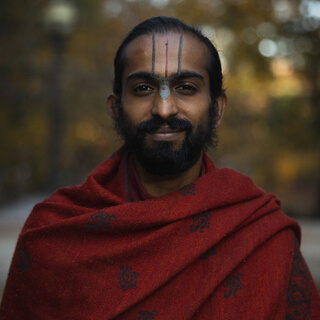
In today's Bhagavad Gita series,
We're going to speak about the concept of equanimity.
Equanimity is something that is talked about at length in the Bhagavad Gita and which something Krishna continuously emphasizes to Arjuna.
In the early chapters of the Bhagavad Gita,
Krishna continues to tell Arjuna that he is in fact this Atma,
The soul,
Which is eternal.
Once he understands its true nature,
Then he will find clarity and discernment about how to do his duty properly,
And ultimately he will also find peace.
The thing that is stopping Arjuna from understanding his true nature is his mind.
The mind attaches to the things of the world.
The mind experiences duality,
The mind experiences suffering,
The ups and downs of life.
And in these spaces we're overcome with anxiety,
Anger,
Depression.
And this stops us from understanding our nature.
So Krishna speaks about the nature of the mind and how we view the world.
And in chapter 2,
Verse 14,
Krishna states,
The contact of senses with their objects,
O Arjuna,
Give rise to feelings of cold and heat,
Pleasure and pain.
They come and go.
They are impermanent,
So endure them without being disturbed.
Here Krishna is saying,
Look,
As long as you're operating in the world,
As long as your senses are interacting with the sense objects of the world,
You're going to experience heat and cold.
You're going to experience pleasure and pain.
This is the very nature of this world.
Many people want this world to be perfect.
But this world is not a place which is perfect.
It is a place where the soul can experience duality,
Where it can experience the ups and downs,
The dark and the light.
That is why the soul has come into this world to experience this duality.
And then after this experience,
To realize its oneness with the divine again.
So as long as it's in this world,
It's going to experience cold and heat,
Pleasure and pain.
But Krishna also says something very unique about this world.
He says that this world and everything comes and goes.
Nothing is permanent.
So for a lot of us,
When we look at our life,
There are things that have happened in our life where we've experienced immense amounts of joy.
There are also things in our life where we've experienced immense amounts of suffering.
But the beautiful thing is that the suffering never lasts.
Over time,
It always goes.
And in the same way,
Happiness doesn't always last.
It also goes.
It comes and it goes.
So the first teaching of the Bhagavad Gita that Krishna says to Arjuna is,
Endure Arjuna without being disturbed.
He doesn't give very fancy,
Fancy teachings.
He's not saying,
Do this,
Do that.
He's saying,
Learn to endure.
Learn to understand how this world works.
And when you start to pick up your bow and fight and you start to endure,
Then there are other techniques which makes it easier for us to endure.
The yoga techniques,
The meditations are only helpful if we make the choice to keep going.
If we choose to pick up our bow and we start to continue to move forward in life.
But in life,
If bad things happen and we go into our fear and we become stuck,
Then no matter how many times we meditate,
No matter how many chantings we have,
No matter how many classes we go to,
It's not going to help.
We have to first learn to accept and endure the ups and downs of life.
And once we start to do that,
Then we can start to add on other practices that help us to ultimately reach that state of equanimity.
Krishna says in the very next verse in chapter 2 verse 14,
One who is unaffected by the duality of this world,
To whom pain and pleasure are the same,
That steadfast person alone is worthy of realization.
So here,
Krishna is saying we have to remain equanimous.
We cannot get overly excited when things go well and we cannot get overly sad when things don't go well.
The more and more we strive to remain in a state of equanimity,
The less and less power the mind has.
And the less power the mind has and the more we learn to transcend the mind,
The more we drop into a heart and realize our true nature.
Once we realize our true nature,
We have much more clarity and discernment about our duty.
How to do it properly.
And in that space,
We can find purpose and meaning in life.
In the future Bhagavad Gita series talks,
We'll continue with what Krishna has to tell Arjuna about the various yoga techniques that he can utilize after that initial quality of enduring the ups and downs,
Which is what we discussed today.
So with that,
Much love,
Talk soon,
Take care.