Hi,
In today's grounding practice I'm going to lead you through a visualization for well-being.
Once anchored there,
We will explore the forces that can pull you out of that comfortable place of well-being,
As well as a way to bring yourself back into it.
The analogy I'm using for the visualization comes from the brilliant minds of neuropsychiatrist Dr.
Daniel Siegel and psychotherapist Tina Payne Bryson.
There's a few ways that this practice can help you.
It can help you deepen awareness of those grounded moments when things are calm around you.
We don't often take time to appreciate those moments and instead we tend to move on to the next issue demanding our attention.
Using this practice can help you increase your awareness of the very first sign that emotion is beginning to activate up inside you when old strategies of thinking or reacting are starting to creep into your day,
And a grounding practice to help you anchor yourself back into the present moment.
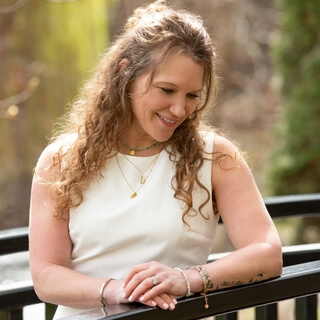
I'm pleased to be here today as your audio therapist.
My name is Susan Guttridge.
I'm a master degree counselor,
EMDR certified therapist,
And owner of Live Happy Counseling Services.
I authored the book Calm in the Storm,
Which is a book about shifting out of anxiety,
A toolkit essentially of emotion regulation strategies.
I'm also a parent,
An all things summertime lake enthusiast,
And an overall fierce optimist.
If you are new to guided imagery and mindfulness practices,
You might find this to be a bit challenging.
You might notice your thoughts to be very loud or busy,
Which is totally normal for the human brain.
Just remind yourself to return to listening each time you catch your thoughts wandering.
With kindness towards yourself,
A simple,
There I go again,
Often works.
And I encourage you to stick with listening.
You know how what we practice we tend to get really good at?
Well,
It's possible that the busyness of thoughts,
Or racing thoughts,
Or the overwhelm of constant worry,
Even hyper vigilance has become something of a habit,
Something your thoughts just do.
If you've been falling into that habit every single day,
All day long,
All that practice has made you really good at it.
That way of being in the world has become entrenched to the point that it might be the way in which you view or prepare for your day.
It's going to take a bit of time to practice something else,
To give a different way of being in the world a chance to take root and shift out of strong overpowering emotion.
That's essentially a set of skills referred to as emotion regulation,
Which simply means the ability to gain control over those strong emotions and bring us back into a place of calm.
Okay,
We're going to start our practice today with the image of you in a canoe paddling down a river,
A calm,
Peaceful river.
Then we're going to look at the ways in which life and its daily array of obstacles can pull us from the stillness of that river.
And then we'll conclude with a practice for connecting back to stillness.
If you are a person who has trouble visualizing,
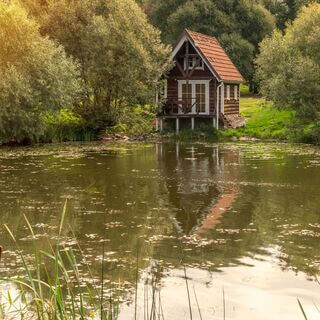
I encourage you to look at the image that goes along with this info track,
Or pull up any picture of a canoe on calm waters and then just follow along.
As we get started,
Take a moment to get comfortable to notice the weight of your body in your chair,
The sensation of your feet flat on the floor.
Draw your breath in deeply and steadily,
Pausing,
Then slowly exhale out.
Let me introduce you to your peaceful place for today,
Your river of well-being.
The water is calm in the center where you are.
You are seated comfortably in a well-built canoe.
It's strong and solid and capable of holding you and everything you need.
It keeps you afloat on this calm river.
You have a life fast.
You feel safe.
You feel at ease.
As you sit in your strong,
Solid canoe in the center of the river,
The water around you is still.
The surface like glass,
Shimmering and reflective of the outlying landscape.
The air warm,
The water cool,
Not cold.
You feel fully present in this one moment.
Every now and then,
You notice the stillness of the water's surface is disrupted by a fish or perhaps a loon.
When the water's crystal clear surface is disrupted,
Small ripples form,
Then slowly dissipate out in ever larger circles,
Larger and larger outward until they dissipate back to stillness.
Place it comfortably in your canoe,
Paddling down the still river center.
Along the sides of the river,
You notice the water is not so still,
The current there a bit rougher.
There's a reason for those rough waters,
You see.
On one side of the river,
The riverbank represents chaos.
To the other,
Rigidity.
Each of these riverbanks represent emotional overwhelm,
Just the way that overwhelm shows up is different.
I'll explain both in more detail in a moment.
For now,
You feel at ease,
Floating along in your canoe in the center of the river,
The calm surface there representing your mental wellness.
It is here in the center of the river,
Just paddling along that our thinking is flexible and adaptable.
Our emotions accurate for the situation we are in,
We feel open minded,
Curious,
Non-judgmental.
When we feel emotional wellness,
We are more able to regulate emotion,
To be present,
To be patient,
To access our problem solving skills,
To weigh the pros and cons to a reaction.
Basically,
We can handle the stressors that life throws at us.
Now remember those ripples in the water?
They represent our daily stressors because being in mental wellness doesn't mean there's no stress in life.
Actually,
This human life of ours can be quite stressful at times.
There are going to be days that are more challenging than others.
There are going to be super tough situations that we face.
Some of these will cause small ripples and others might cause quite big ripples that we feel destabilized by.
Those big events or stressors that make the ripples feel destabilizing can seem impossible to get through,
Hard to regain balance in the wake of.
You know,
Those are all the things that make it harder to regulate emotion.
Some maybe are physiological like not getting enough sleep,
Feeling hungry,
Being in pain,
Or they might be more all encompassing like a recent traumatic experience or the grief of loss to name just a couple examples.
So basically,
There are a lot of reasons why those ripples can last longer than we want them to.
And there's something else that happens when those ripples last too long,
When they get too big,
When stress ramps up and we start to feel overwhelmed.
Imagine again,
That peaceful river with you in your strong,
Sturdy canoe,
Floating along the center,
The water still in mental wellness.
The water around you like a sheet of shimmering reflective glass,
Calm,
Pristine.
As I mentioned,
In this human life of ours,
Stress happens and we find ourselves being pulled out of our calm center away from mental wellness.
We notice our canoe beginning to float towards a riverbank.
If your canoe floats too close to the riverbank of chaos,
You find yourself feeling out of control,
Confused,
As though you are in constant chaos and turmoil.
Emotion feels out of control,
Like you're caught up in a tumultuous current that you just aren't strong enough for,
Being tossed all about.
You feel overwhelmed by even the smallest stressor.
Everything feels out of control,
Unpredictable,
Unstable on the riverbank of chaos.
Alternatively,
If you float too close to the riverbank on the other side,
The one representing rigidity,
It is here that thoughts become rigid and suddenly you find yourself with the urge to impose control over everything and everyone around you.
It's on this riverbank of rigidity that we feel unwilling to adapt,
Unflexible in our thoughts,
Unwilling to compromise and unwilling to negotiate.
We get stuck on the belief that our way is the only way.
It's here that we can be too literal,
Losing perspective of the situation we are in,
Forgetting the nuances of the moment,
Of the context of our relationship with those around us.
We get stuck on our way of being as the only way,
The best way.
We fail to attune to those we love and we miss meaning when we're marred in the riverbank of rigidity.
Sit for a moment and reflect on what I've just shared with you.
When you experience the stressors of life,
Toward which riverbank does your canoe tend to float?
After a hard day when you feel emotionally drained and stressed out,
Does your canoe tend to get marred in the riverbank of chaos or rigidity?
When I first learned this concept,
I was suddenly keenly aware of all the moments when arriving home after a long day of work and feeling stressed,
Feeling the urgency of time that my canoe was very stuck in the riverbank of rigidity.
I'd find myself fighting the urge to bark out orders at my family members to move them along,
Who rightly so had their own equally important agenda and didn't want my taskmaster approach.
Which riverbank is it for you?
When under stress,
Does your canoe veer more towards chaos,
Feeling out of control or helpless?
Perhaps feeling trapped on that roller coaster of strong emotions,
Anger,
Sadness,
Worry,
Anxiety,
Fear,
Irritation?
Perhaps you catch yourself yelling or complaining or whining or on the brink of tears?
Or when under stress,
Does your canoe veer more towards rigidity,
Noticing yourself acting as the taskmaster,
Demanding compliance and trying to control everything and everyone around you and when they don't,
Acquiesce,
Feeling frustrated,
Angry,
Judgmental,
Impatient?
There is no judgment here.
Take a moment to sit in awareness,
To be completely honest with yourself.
When you feel stressed or overwhelmed,
Towards which riverbank does your canoe float?
It is only by first being present with honesty and awareness that we can facilitate change,
Now that you know your pattern of reacting under stress,
Let's create a pause for you.
What is the very first sign that you notice when your canoe is veering out of mental wellness and towards a riverbank?
Is it a feeling of anxiousness?
A sense of urgency?
Or is it more a felt sense in your body?
Perhaps tightness in your abdomen?
A lump in your throat?
Tensed shoulders?
A clenched jaw?
Or is it a negative belief about yourself?
Of your worth?
Of your competence?
Of your loveability?
You can use this information about yourself to notice when your canoe is veering off-center.
In fact,
That is the very moment within which we can interrupt old patterns of entrenched habitual behavior.
Knowing these very first signs that your canoe has slipped off course and is heading towards a riverbank can help you pause.
If we aren't aware it's happening,
We can't implement the change that's required.
Now that you have this awareness and you know you've slipped off-center and you're heading towards a riverbank,
Here are the strategies to use.
First,
Give yourself a prompt.
Be gentle with yourself and use kind words.
Try something like,
There I go again.
Then take three deep breaths.
Fully inhale in.
Pause.
Exhale out.
If it's hard for you to detach from the thoughts that want to keep you off course,
Add a count to your breath.
For example,
Inhale to the count of four.
Pause.
Exhale to the count of four.
Try it with me.
Inhale.
One,
Two,
Three,
Four.
Pause.
One,
Two,
Three,
Four.
You know yourself best.
Count at a tempo that works for you.
Try it now on your own.
Breathing in,
Exhaling out.
As your breath slows,
Your body begins to calm and settle.
Ask yourself,
What additional words do you need to hear?
What do you need to say to yourself?
For example,
If you are veering towards rigidity,
Do you need to remind yourself that there is plenty of time or that things are okay just as they are?
You don't need to control anything.
Or if your canoe veers into chaos,
Your gentle self statement might be,
There I go again,
Falling into old conditioning.
You might need to remind yourself of what's different now in this chapter of your life.
Where do you feel empowered,
In control,
Capable,
Competent?
Once you've got these positive words for yourself,
Picture lifting your paddle and pushing off the riverbank to gently glide back towards center.
As your canoe glides back to center,
Ask yourself what action can you take in your daily life right now that will align with detaching from rigidity or chaos?
For me,
In the example I shared earlier,
It was taking that pause to recenter and to speak kindly first to myself,
To settle the activation I was feeling and to remind myself that there was enough time.
And actually that even if there wasn't enough time,
Nothing bad was going to happen.
Everything was just as it needed to be.
And that enabled me to connect with what was most important in the moment,
Which wasn't tasks or chores.
It was reconnecting and attuning with my family members who I'd been apart from all day.
It was acting on my values that kept my canoe gliding steadily back to center and stabilizing there so that I could continue paddling down the river of wellbeing.
If the visualization I've shared with you today works for you,
Please use it.
When you feel stressed or overwhelmed,
Actually picture your canoe veering toward a riverbank.
Give yourself a kind,
Gentle prompt,
Take three deep breaths and picture using your paddle to push back to center,
To not get marred in chaos or rigidity.
Try that now.
Take a moment to breathe deeply in and exhale out.
Visualize lifting your paddle,
Reaching the tip up and out and pushing off that riverbank,
Watching as your canoe glides smoothly back to center into the middle of your river of wellbeing.
It's a powerful image,
Isn't it?
We all essentially want to enjoy life from the center of our river of wellbeing,
To feel flexible,
Adaptive,
Open-minded,
Curious in our thinking,
Stable and fluid in our emotions and to not feel so stuck in our thinking,
So at the mercy of life's twists and turns.
I encourage you to practice this visualization as often as you need to,
To deepen awareness of those first signs that emotion is activating up and that your canoe is changing course.
Practice using the grounding strategy to bring your canoe back to center.
Okay,
Here's a summary.
I've numbered each item from one to five,
So you can pair them up with the fingers of one hand.
Number one,
Notice that your canoe has just changed course.
Two,
Deepen awareness of self,
What emotion,
Sensation or negative belief activated up to cause your canoe to veer towards a riverbank and which riverbank?
Three,
Give yourself a gentle prompt.
Four,
Pause to take three deep breaths as you picture lifting your paddle and pushing yourself off the riverbank.
Five,
Take action.
What do you need to do that will bring your canoe back to center?
Try this out in the days that come.
Try it out first with the smallest of stressors to set yourself up for success and to build confidence using it.
And please go easy on yourself.
It's hard to start a new habit.
A special thank you and gratitude goes out to Dr.
Daniel Siegel and Dr.
Tina Payne Bryson for the concept this grounding practice was based on.
And thank you for listening.
I wish you all the best as you navigate courageously down your river of well-being.