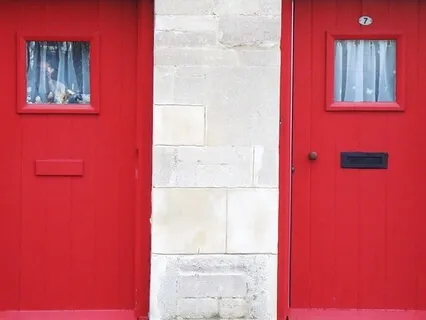
Imagine a room with two doors.
Not difficult to do.
There is door A which is open all of the time.
At the other end of the room there is door B which is closed 95% of the time.
Door A there is a queue of people,
A line of people constantly entering.
There can only go out door B.
But door B is closed 95% of the time.
So the odd person manages to squeeze through the gap in the door when it's open.
Very short periods.
So what happens to the room?
It fills up.
What happens after that?
There is a sense of claustrophobia.
Even the walls at some point come under stress.
There is nowhere to move.
There is a blockage.
There is a bottleneck.
And this is most human beings.
We are the room.
The queue of people represent life happening.
Life happens.
We can't stop it.
Life is happening.
And so there is an event,
There is an incident,
An interaction with the world and it leaves its mark.
It leaves an emotion.
The people are emotions.
They are the events of life.
Now a lot of these emotions we don't want.
So we try to suppress them,
We try to push them away.
But we can't.
They can't go back out door A.
They have already happened.
You can't undo an emotion.
You can't undo,
Turn back an incident.
Something that happens to us.
So what happens?
All these emotions build up.
Like the people in the room.
There is less and less room,
Less and less movement.
There is a bottleneck,
A blockage.
We become emotionally blocked.
So our work that we are engaged in here is to unblock our emotional life.
To free up our emotional life.
Now how do we do that?
Well it is very simple but not easy.
And almost everything we discuss,
Everything we explore in the Awakening Heart Programme is connected with this issue.
How to free up our emotional life or how to be at ease with our emotional life.
So we want to allow the people to enter the room for emotions to happen.
But we want also for the people to be able to exit the room.
So what do we do?
Simple isn't it?
You open door B.
You keep door B open more and more of the time.
But what does that mean in our experience?
It's easy to talk about.
It's easy to say,
Oh just keep door B open.
Of course.
But what does it actually mean?
OK.
So first of all let's look at how we close door B.
Then we'll be in a better position to see,
To know how to open it.
So we close door B on our emotional life.
Because there are certain emotions we don't like.
We may be afraid of them,
Embarrassed by them.
They make us feel vulnerable or uncomfortable.
They make us feel scared,
Angry,
Ashamed.
Depending on our particular makeup,
Our particular conditioning from childhood.
So we close door B.
We close the door on our emotional life.
Which means they can't pass through.
You close that door B and there's nowhere for them to go.
So they get locked in the body.
They become the ice we've spoken about.
We freeze them out of awareness.
And then what we have to do is we have to clench down inside in the body to keep them there.
And to keep them there we develop strategies.
And we all do this.
So how we open door B is to experience the emotion in the body.
And there's in a sense two components to this.
The first is when we're having an emotion we learn,
And that's what we're going to be looking at.
We learn how to experience it in the body.
Because a lot of the time we don't want it.
But this is real life.
Emotions,
They're part of being human.
So maybe we get some bad news,
We get news we've got an illness or somebody criticizes us or whatever it is.
Something happens,
We have a response.
And if we don't like it we tend to try to shut it out.
We keep busy.
That's one strategy.
It's good to know your strategies.
That's one strategy.
We keep busy.
Busyness is really the height of laziness.
Another way is we overthink.
If I think about this,
Think,
Think,
Think,
I'll find a way out.
Thinking can be useful,
But we don't think away our emotional life.
It cannot be thought away.
We rely far too much on the thinking mind.
Descartes,
His saying was,
I think therefore I am.
Well,
We change it around in the Buddhist tradition,
In the mindfulness tradition,
In the spiritual tradition.
We turn it around.
I am therefore I think.
I am aware therefore I think.
I can be aware of my thinking.
Or anyway.
So,
We experience the emotion,
That sadness,
That hurt,
That frustration,
That anger,
We experience it in the body.
As a present moment force.
Also,
We will find that.
Actually,
Let me backtrack.
So we experience it in the body.
What that does,
That is opening the second door,
Door B.
To feel something in the body is to open door B.
To overthink about it,
To keep busy,
To intoxicate ourselves with something,
Is closing door B.
To ignore it is closing door B.
Now,
There may have to be periods where we do ignore our emotions.
If we give them the talk or we are at work,
We don't want to be breaking down crying all the time.
That's not what we want to do.
It has to be periods of,
I'll deal with this later.
But we have to deal with it.
So,
Experiencing it in the body,
Where do you feel that sadness,
Where do you feel that anger,
That frustration,
That resentment,
Whatever it is.
You feel it in the body.
That is opening door B.
That is allowing the incident to happen,
The emotion to arise and then to pass away.
The experience of the emotion,
The direct experience of the emotion in the body,
Is the releasing of it.
But we don't do it to release it.
We don't do it to try and change it.
We're just there with it.
Hello.
And welcome it and feel it.
And what tends to happen,
Depending on the magnitude,
The strength of the emotion,
It eases and dissipates.
If we don't get lost into the storyline.
So that is opening door B in the moment when something happens.
But we've been closing the door B for many years since we were six,
Seven,
Eight,
Nine,
Since we were very young,
Let's say.
We've learned to shut the door on our emotions.
So what we do,
We take time out each day to come back into the body.
We meditate,
We sit quietly.
All those held emotions from decades ago are sitting there in the body waiting to be experienced.
And they're actually having an impact on our daily lives now.
They have an impact on our relationships,
On the way we feel about ourselves.
For example,
If there's somebody in our life that we see occasionally,
We react to them.
Again and again.
Maybe there's somebody who's confident,
For example.
And we don't like we start talking about them.
We are repulsed by them.
They're big headed,
They're this,
They're that.
If we have an emotional reaction to them,
Which is regular,
There's something there for us.
There's something held in the body.
We are denying something in ourself.
If we're over sensitive around certain people,
It's there in the body.
It's a held emotion that's not healed.
So we react to people.
We have a reaction to the world.
And what it says is more about us than the other people,
Than the other person,
Than the world.
It's saying something about us.
It's pointing back to where we need to heal,
What we need to become aware of.
For example,
You may be wanting approval from somebody and you don't get it.
Or you get it,
Then you want approval again two minutes later.
There's something inside that's not healed,
That's not expressed,
That's not alive.
So when we meditate,
We sit quietly and we go to the body.
And we become curious what's happening now,
We ask.
We learn to untie those emotional knots from decades ago.
And they're held in the body,
Not in the head.
Most of us,
Unfortunately,
We're leaving our heads too much.
We're a heady culture.
And that's why I'm going to,
I do suggest that you sit down regularly.
Just five minutes,
Ten minutes,
Twenty minutes a day.
Just a regular taking time out for yourself.
And just to experience,
Turn towards your present moment experience.
If there's a tension somewhere,
Feel it.
And doing this regularly,
What it allows is that buried,
That clenching that's happened,
That keeps all these emotions down,
Begin very gradually in a way that we can work with them.
Let me give you,
Let's use a metaphor.
I don't know how they make pure gold now.
But in the olden days,
They used to put the gold into a crucible and heat it up.
And all the impurities would rise to the top.
And then they'd skim the impurities off.
And they'd keep doing that until you had pure gold.
And it's similar to this.
When we sit and we're quiet and we feel the body,
We're curious about the body,
About the breath,
We give space for the arising of these long held emotions that continue to arise and to release very gradually.
There may be a few tears now and again,
There may be laughter,
Maybe memories.
But it's all about melting the ice because that's what the ice is made up of.
These long held emotions in the body,
Which if not released,
Can turn into illness.
And I see this every day in my work.
I'm not saying all illnesses,
This is the cause of all illness.
But the medical profession now are realizing that a lot of our illnesses are emotionally driven.
They have an emotional cause or component.
So let's just have a few moments of untying an emotional knot.
So you can close your eyes if you wish.
I'm going to talk you through this.
You can sit comfortably.
Just a few minutes,
I just want to give you a taste of how we do this.
Having a sense of the body sitting here.
Sensing the shape of the body.
And taking your attention into the body,
Feel the body as a whole,
Particularly around the middle body,
The chest,
The shoulders,
The belly.
And notice how you feel there.
Not what it feels like,
Is there a tension anywhere?
A tightness.
Be curious,
Be honest.
That's it.
If there's nothing there,
Maybe there's something that's bothering you in your life right now.
Bring it to mind and notice in the body where you feel it.
What does it feel like?
Ooh there,
Ooh there's something in the chest,
There's a tightness or there's a holding in the belly.
Ooh,
What does that feel like?
Ooh,
Just notice that,
Just feel that.
That's all we need to do.
Does it have a shape?
Does it have a colour?
Just sensing into it.
That's it.
Welcome it.
Notice how you feel towards it.
Are you a little scared or hesitant?
Honesty is the key.
We're not trying to get rid of it.
That's it.
Does it have a texture?
Ooh it feels heavy,
It feels hard or soft or.
.
.
It feels a little like a fist or a ball or a little jumpy.
Perhaps an image comes to mind.
Okay.
I'm going to bring this session to a close.
You can carry on for a while if you wish or open your eyes.
So I just want to give you a taste of how to untie an emotional knot.
And we'll revisit this time and again,
Time and again.
It's a really,
Really useful practice to be able to do.
This is how we transform.
This is how we melt the ice.
How we gain access to the jewel.
By working gently and kindly with ourself.
But with courage.
Thank you very much for listening.
And feel free to do this short practice several times a week.
Just for about five minutes at a time.