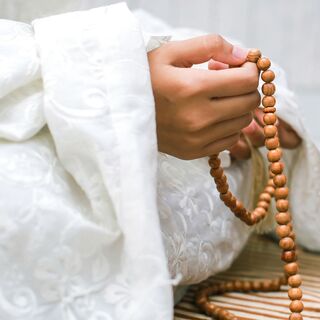
Welcome to the University of Sufism's Ramadan reading of Rosina Fawzia al-Rawi's book,
The Call of Allah,
A Companion to the Holy Month of Ramadan.
Today I will be sharing day four about forgiveness,
Otherwise known as tawbah.
The Prophet,
Alayhi wasalam,
Said,
Verily,
When the servant commits a sin,
A black stain appears on his heart.
If he abandons the sin,
Seeks forgiveness and repents,
Then the stain will disappear.
But if he doesn't and returns to the sin,
The black stains on his heart will multiply,
And in the end,
His whole heart will be covered with those black stains.
Tawbah is to turn back,
To return to our true being,
To those parts in us which are turned to the spirit and which we have lost sight of as a result of our mistakes and our forgetfulness.
At-tawab comes from the root t-w-b,
From which the following words and meanings are derived.
To regret,
To feel remorseful,
To turn away from,
To turn to,
To mend one's way,
To forgive,
To turn to God again.
Remorse is a purification.
It means to find one's way home again after getting lost.
Remorse is also an inner transformation of one's attitude.
It is to change the ego's cry,
What is God doing to me,
To the call of the soul.
What is God doing through me?
It is this deep confession that without Allah's mercy and compassion,
We are weak and bereft of all capability.
For man has been created weak,
Quran 4.
28.
This deep realization opens our hearts to Allah and we become receptive to his mercy.
Tawbah is like purifying water,
Which is why its most beautiful expression is tears that wash away all mistakes.
A Sufi by the name of Samad once said,
Although I regret my mistake,
I feel elevated because my limitations have enabled me to experience the incredible beauty of your forgiveness,
O Allah.
Indeed,
The Sufis say that the most essential qualities of the divine nature are mercy and compassion.
Were there no errors,
Mistakes,
Or sins,
That which matters most for reality,
Namely Allah's mercy,
His rahmah,
Would have no field in which to express itself.
In the Quran,
Life is described as a test.
Endless processes to give us the possibility to overcome the limitations of our ego,
To dive into our true being,
And to connect with Allah's compassion,
Wisdom,
And love.
Allah constantly moves us between his majesty and his beauty.
And the latter we tried with blessings as well as with afflictions,
So that they might mend their ways,
Quran 7.
168.
If we remain stuck only in the material world,
If we give free reign to our moods,
Our illusions,
Our desires,
And our will,
We will not be able to find peace.
Remorse is to make space in our hearts for God's will.
This process takes us away from self-pity and from the role of victim,
To which our wounded self tries to pull us time and time again,
And it leads us to a sincere bond with Allah.
It is the path towards both deep trust and responsibility.
Here I stand,
O Allah,
Armed with all the abilities you gave me to find you.
Open my heart so that I may experience your guidance and your love,
Which never fails to touch me.
Help me serve you and stay away from disobeying you.
None but you do I beseech.
Ameen.
It is human to make mistakes,
To sin.
What matters is that we do not persist in them and pass them off as convictions,
Be it in our own eyes or others.
Ramadan is the month of blessings and absolute mercy,
The month of forgiveness,
And the month of rueful return to God.
So often do we turn away from Allah.
So often do we,
In our complacency and our distraction,
Forget the deep meaning of our existence and argue with our fate when we fail to get what we wish for and what we picture for ourselves.
When does God forgive us,
If not during the gracious month of Ramadan?
For good deeds are accepted Ramadan and bad deeds pardoned.
Tawbah is to set out for God and discover the blessing which he has placed in you,
For you,
And for all of creation.
Find your blessing and offer it as a gift in the name of Allah.
Practice suggested for today.
The divine name At-Tawwab is the one who accepts repentance,
The one who leads to the return.
The divine name helps you to forgive.
When you are capable of forgiveness,
When you can forgive those who have upset or hurt you,
At least partly,
Or when you can forgive yourself,
You can feel the quality of this divine name in you.
Admit when you have been unjust,
Resolve not to do it again,
Use your bad conscience to strengthen your intention not to repeat the mistake or injustice,
And seek inner purity by trying to make up for it.
Put it in God's hands.
In this way,
You will be able to forgive both your own and your fellow human beings' carelessness.
On the outside,
Act so as not to forget that which you have regretted and thus not to repeat it,
Whilst remaining free of all reproaches on the inside.
Whenever you have allowed yourself to become too distracted by your hunger,
Your thirst,
Your wishes,
And your illusions,
Repeat Ya-Tawwab,
Ya-Tawwab,
Ya-Tawwab.
Thank you for joining us for Day 4.