Welcome to the guided sitting meditation.
You can use this meditation once you have cultivated some degree of focused attention and being in the present moment by using the body scan meditation and the two yoga practices.
Let's arrange to spend this time doing this meditation on a regular basis in a place where you can comfortably be still and at a time when you will not be interrupted.
Allowing this to be the time in which we set aside the usual mode in which we operate,
That of more or less constant doing and switch to a mode of non-doing,
A mode of simply being,
Of allowing ourselves to be,
Of becoming aware of our being.
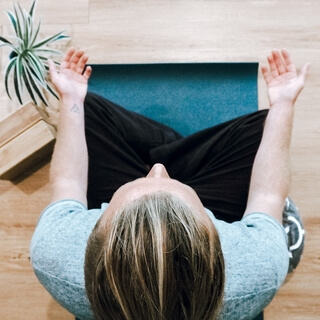
Settling into a comfortable position,
Sitting either in a straight back chair or on the floor on a cushion.
Taking your seat in a comfortable position in the place you choose for formal sitting meditation.
The posture is awake,
Relaxed and dignified.
Recalling the attitudes of mindfulness,
The attitudes of non-judging,
Patience,
Non-striving,
Acceptance,
Trust and letting be.
Letting go of any agenda about how things should be,
Not trying to make anything in particular happen.
Allowing the experience to be just as it is,
Not wanting anything to be different than it is in this moment.
Allowing the body to settle.
Noticing your body,
Noticing your hands resting where they are,
And your face and your tongue and your head as they are.
Letting your body ease and settle into a formal sitting posture.
As the body becomes still,
Gathering and collecting your awareness on the sensations of the breath and becoming aware that you are breathing.
Directing your attention on the sensations of your breath as it comes and goes.
Concentrating your awareness at the place in your body where you can feel the breath come and go most easily and naturally.
Where the breath feels most predominant for you in this moment.
For some this might be the abdomen,
For others the chest and for others the nose.
Letting your attention settle and focus exactly on that place where the breath sensations are easiest for you to feel.
Noticing how the breath feels in this area.
Letting your body relax.
Allow the breath to breathe itself,
Flowing naturally,
Not trying to control it.
This practice is about strengthening attention and awareness,
Not on controlling the breath.
Letting go of any thoughts about how many breaths,
Or the next breath,
Or the last breath.
Just this breath,
Moment by moment.
Not thinking about breathing,
Rather feeling it directly as best you can.
Letting your attention settle more deeply.
Deeply into the variety of sensations of the breath in the body.
Remaining present for the entire cycle of the breath in the body.
Giving full attention to the entire breath.
Noticing the beginning of the breath as the lungs fill,
And then noticing that tiny moment where there is a pause before the breath turns and begins to leave the body.
Remaining present for the entire experience of the breath.
Letting go of any thoughts about how many breaths,
Or the next breath,
Or the last breath.
Noticing the changing patterns of sensations,
How each breath is different.
Perhaps you notice that some breaths are shallow,
And some are deep.
Some are strong,
And some are weak.
Some breaths are rough,
And some are smooth.
Just noticing the character of each breath.
Feeling each breath as if you were breathing it for the first time,
With intense curiosity.
Adding the你就 Fill the body.
You may notice that at times the mind may wander to thoughts of the past or the future.
When this happens,
Don't be surprised.
Gently notice where it went.
Is it on another part of the body?
Perhaps on worry or anxiety or planning.
No matter where it goes,
With patience and kindness,
Escort your attention gently back to the place in your body where you're following your breath sensation,
The abdomen,
The chest,
Or the nostrils.
Remembering that recognizing the mind wandering is a moment of mindfulness.
It is part of the training of the mind that you have undertaken.
And continuing to open as much as possible,
Allowing yourself to feel the sensations of each breath directly as best you can.
Not trying too hard.
Do not even try to be a good meditator.
Simply make your best effort to pay attention to the breath sensations non-judgmentally,
Letting things be,
Using the breath as the anchor of your attention.
And again,
If thoughts arise in your experience,
Gently congratulate yourself for having noticed them.
And then intentionally and gently escort your focus back to your breath,
Picking up where it happens to be.
Now as you observe your breathing,
You may be finding that from time to time,
Sensations from your body come into your field of awareness.
Maybe discomfort or agitation.
And sometimes they might be quite intense.
And as you maintain the awareness of your breathing,
See if it is possible now to just expand the field of your awareness around your breathing so that it includes a sense of your body as a whole as you sit here.
Exploring all the sensations through the entire body.
Putting up the welcome mat for whatever arises as sensations in the body,
Whether they be discomfort or comfort.
We're just noticing it all,
Whatever they may be.
So of course,
And it happens with all of us,
There may be times when the sensations in one part of your body really become overwhelming and dominate the field of your awareness to the point where it becomes very difficult to stay focused and concentrated.
And if this happens,
You have two alternatives.
One is to mindfully shift to a more comfortable position to relieve some of the intensity.
And if you choose to move to just be aware of the intention to do it before you actually move.
But another way to work with this intensity is to try to simply stay here with it without moving and restricting the attention in these periods of intensity.
And just zeroing right in on that region of the body that is experiencing it.
Putting the mind right there in the knee or the back or wherever it may be.
And just going right into the sensation in each moment.
Breathing into it and breathing out with it.
And totally experiencing what your body is saying to you right now.
Responding to it by opening and softening rather than tensing and bracing and resisting.
So that even within the intensity you may find stillness and acceptance.
Noticing any reactions.
Observing them as well as the sensations.
And when the intensity subsides,
Bringing your awareness to the body as a whole and of the breath as it moves in and out of your body.
And now widening the focus of attention to include all sounds that may be present in your environment.
Allowing yourself to hear as carefully as you can.
If you find yourself commenting or reacting to a sound,
Notice that and let it go as best you can.
Allowing yourself to hear the sounds as just sounds without labeling or commentary.
Perhaps noticing sound vibration as intense or soft,
Low or high,
Near or far.
Noticing when the vibration arises how it changes and how it fades.
Recognizing thoughts such as that is a loud car or that is a beautiful bird as only thoughts about the sounds that have taken you away from the direct experience of the actual sound.
Resting in the spacious awareness of sounds.
And perhaps there are inter sounds inside your body,
Your heart beating or perhaps there are no sounds in your environment.
Whatever is there,
Just being with sounds.
If you're finding that you're too anxious to mindfully listen to sounds,
If you're finding that you're too anxious to mindfully listen,
Remember that you can always return to your breathing using your breath as the anchor to bring your attention back to the present moment.
And widening your focus of attention to include all changing body sensations as well as the breath and sounds.
You may notice certain sensations from the body,
Some discomfort or agitation may come into your field of awareness.
Perhaps these sensations are even intense.
Again softening with these sensations as best you can with an attitude of openness.
Softening and allowing each sensation to be in the open space of awareness.
Without judging or reacting,
Just being fully with whatever is arising for you in this moment.
Whether it be sounds,
The breath or the body.
And don't try too hard,
Allowing yourself to experience directly the breath,
The body,
The sounds.
Opening your awareness to include smells and even tastes that are present.
If there aren't any,
That is fine too.
Simply rest in awareness with whatever smells or tastes that might be present.
Being alert for the judging and reacting mind,
Allowing yourself to experience the direct experience moment by moment,
Breath by breath.
Awareness of smells and tastes.
And now adding to your awareness,
Including all forms of thinking,
Acknowledging the thinking that is going on now,
Focusing on observing the thinking process itself.
Not getting caught up in the content of the thoughts,
But just recognizing the form of the thinking.
Is there commentary,
Judgment,
Planning,
Storytelling?
Noticing certain themes in your thinking.
Is that the love story,
The boss story,
The anxiety story?
Learning to become aware of these stories is a moment of mindfulness.
Treating each thought the same,
Just as a thought passing through your mind.
They are just thoughts and nothing more.
The thoughts can be about anything,
Whatever they are,
Observing them as events as they come into awareness and as they dissolve from awareness.
Remembering that you are not your thoughts.
Resting in the open space of non-judging,
Non-thinking awareness of thoughts.
And now including in your awareness,
Everything and anything that arises.
It's a kind of choiceless awareness,
Whatever it is,
It's just another condition that is here now and it will soon be gone if you let it.
Being aware of body,
Breath,
Sounds,
Smells,
Tastes,
Thoughts,
Opening to it all.
Letting it be.
Grasping for it,
If it is pleasant or rejecting it,
If it is unpleasant,
Will only cause anguish.
Recognizing mind states and emotions like anger,
Fear,
Boredom,
Sleepiness,
Desire for something else,
Impatience,
Calm,
Peace,
Joy,
Kindness,
Compassion.
Recognizing it all,
Allowing yourself to open to the entire range of your experience.
Feeling the energy associated with each condition.
Practice holding them as best you can in the open space of awareness without identifying with them,
Grasping at them or pushing them away.
Resting in open choiceless awareness to whatever arises in your moment to moment experience.
Looking deeply,
Feeling deeply and listening deeply,
Allowing all the visitors to come and go,
Shining the light of mindfulness directly on whatever is the strongest or the loudest.