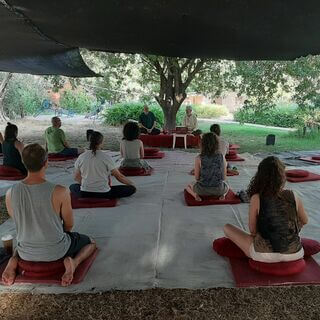
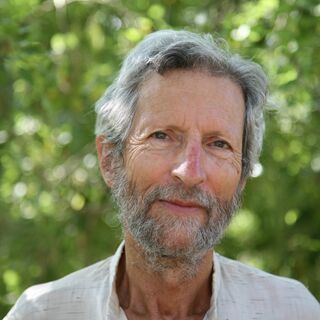
Let go of the forms of the needs of what was and move into presence.
And in a sense of muting the mind,
And presence doesn't need anything.
It's just knowing that I'm alive,
Knowing here,
Existence.
And it doesn't need any understanding,
Or any comment,
Or any thought,
Or any need,
Or any purpose,
Or any doing.
It's just very basic presence.
I'm here,
I exist.
And now,
Instead of going into any object of meditation,
Let the senses be less interesting.
They're the senses knowing the world,
But right now,
Let them go.
There may be hearing,
There is touching,
There is the body,
There is sight,
Even the eyes closed,
But there's colors.
There is thought,
Or the mind.
And all of that,
Let it be there,
And not relevant,
Not interesting.
Don't go to any of the senses.
You don't deny them,
Or stop them,
But you don't need to go into any of them.
And instead,
Be aware of an open space of knowing.
This knowing doesn't have a place.
You can't describe it.
It's transparent.
It's not a substance.
Experience may arise,
A thought,
A feeling,
A sense,
Touch,
Whatever,
And passes,
And another one arises and passes.
But something behind the experience allows the experience to be there.
If there wasn't knowing,
You wouldn't know this thought.
What is the knowing?
Just drop into it,
Just allow it.
Just welcome it.
It needs deep relaxation.
The meeting with awareness happens when you let go.
When experiences come and go,
And you let them go,
And what's left?
What's behind?
What's under?
What's the source?
It's just,
You drop into that place.
It's a bit like inner space.
And in the inner space,
There isn't a me there,
Sitting there,
Controlling it.
Inner space is spacious.
It's empty,
But very alive,
Because it allows experience.
And now,
If we connect with the breathing,
We're in a more dualistic world,
That's fine.
But try and kind of remember that we know the breath because of knowing.
So we know the in-breath and the out-breath,
But there's a knowing that's happening all the time.
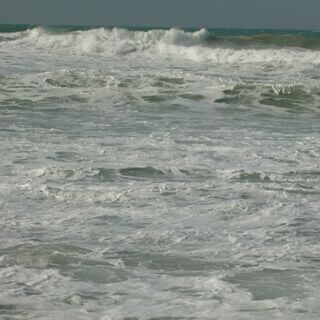
The waves of the breath ride on the ocean of knowing,
Of awareness.
The waves of thought,
That comes and goes.
The experiences of thinking.
It's really clear that a thought arises and goes and passes by itself.
It frees itself.
We don't have to do anything with it or get rid of it.
But thought frees itself.
And there is a witness.
We used the language before,
Witness.
But maybe we can take it one more step now and see that the witness is no body,
Is no position.
It's just a sense of knowing.
There's no subject.
There's just awareness that knows this thought that rises and passes.
It's known.
And if it feels a bit abstract,
And hard to grasp,
Stay with the witness as a subject object,
The subject looking at a thought as object.
I am looking at thought.
I am thinking.
That's the witness.
And just be interested in not just I am looking,
But looking,
Knowing.
The I may be not needed.
You just know that a thought arises and passes without a knower.
So let the knower kind of come in and out or leave it as a question.
Who is the knower of this thought that arises?
Like the thought of what I'm going to do tomorrow or what is,
How do I meditate?
Doesn't matter.
Doesn't matter.
Where is the knower of this?
Don't expect an answer.
Just let the question echo.
Where is the knower of this thought?
Okay,
And let's just leave everything now and take a little time,
Just be with the body and be aware.
Just simple awareness of bodily life.
Take a minute or two.
Kind of coming back to ground.
Okay,
And take a breath and let's open the eyes slowly.